Alocasia Watsoniana Aurea Variegated: The Complete Collector's Guide

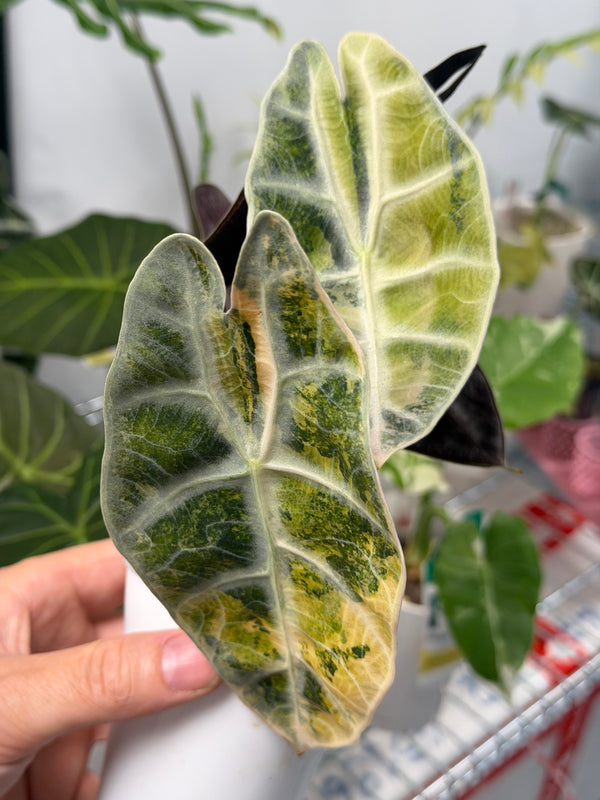
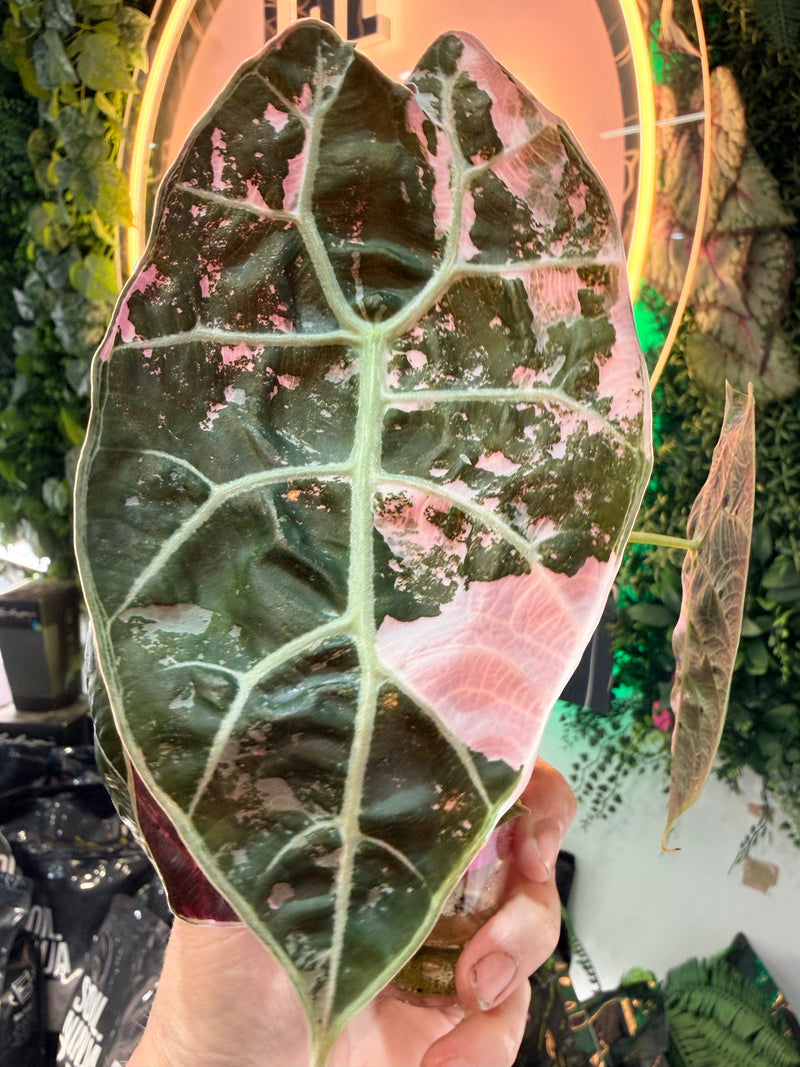
The Alocasia Watsoniana Aurea Variegated is a variegated form of Alocasia longiloba 'Watsoniana', a long-cultivated Alocasia with deep olive-green, shield-shaped leaves, ivory-white edges and veins, and a wine-purple underside. This guide covers what the base plant is, how it came to be named, how to recognise it, what its aurea variegation involves, and how to keep it. Where a detail is not documented, we say so rather than fill the gap.
What is Alocasia longiloba 'Watsoniana'?
'Watsoniana' is a named form of Alocasia longiloba, a variable species that has absorbed several names once treated as separate species. Aroidpedia records that it was first described as Alocasia watsoniana by Maxwell Masters in The Gardeners' Chronicle in 1893, and that Alistair Hay placed it within A. longiloba in 1998. Plants are still widely sold under the older name Alocasia watsoniana, which is why you will see both names used for the same plant. Our Alocasia longiloba species guide covers the wider species.
History and naming of 'Watsoniana'
Aroidpedia traces the plant to the Sander nursery in St Albans, which showed it at the 1893 Ghent Quinquennial exhibition. Kew's 1894 bulletin listed it among the new garden plants of 1893, crediting Sander and Sumatra. Aroidpedia notes that the name rests on a wood engraving published shortly after the description rather than on a pressed specimen, and that the engraving was later tied to a Kew specimen from the same Sander stock. It has been in cultivation since the Victorian era, when its dramatic foliage first drew European plant collectors to it.
A tradition from the 1980s says Sander introduced it from Java around 1880. Aroidpedia rejects that account, because the 1893 sources consistently say Sumatra and the name appears in no earlier record. Aroidpedia also reports that in the wild the plant tends to grow on rock, and its photographs include plants in Sarawak, though its text does not discuss that locality further. Because the species complex is variable and the history has been tangled, we do not give a single confident place of origin for the cultivated plant beyond what these sources record.
Is 'Watsoniana' a parent of the African Mask plant?
This is the part of the story most often repeated and most often overstated. Aroidpedia's entry for Alocasia × amazonica names Salvadore Mauro of Amazon Nursery in Florida, around the 1950s, as the hybridiser, with Alocasia sanderiana and Alocasia longiloba 'Watsoniana' as the parents. It also says that this parentage rests largely on secondhand evidence: an account from John Banta of what Mauro told him, plus Banta's own reported repeat of the cross in 1999, which produced plants matching Alocasia 'Amazonica'. Aroidpedia presents the parentage as assumed rather than formally confirmed. Whatever its exact standing, the hybrid that Mauro's cross produced went on to become one of the most widely sold houseplants in the world. The Alocasia amazonica group guide and our piece on the Amazonica legend hybrid cover the hybrid itself, and the Alocasia sanderiana species guide covers the other parent.
How to identify 'Watsoniana'
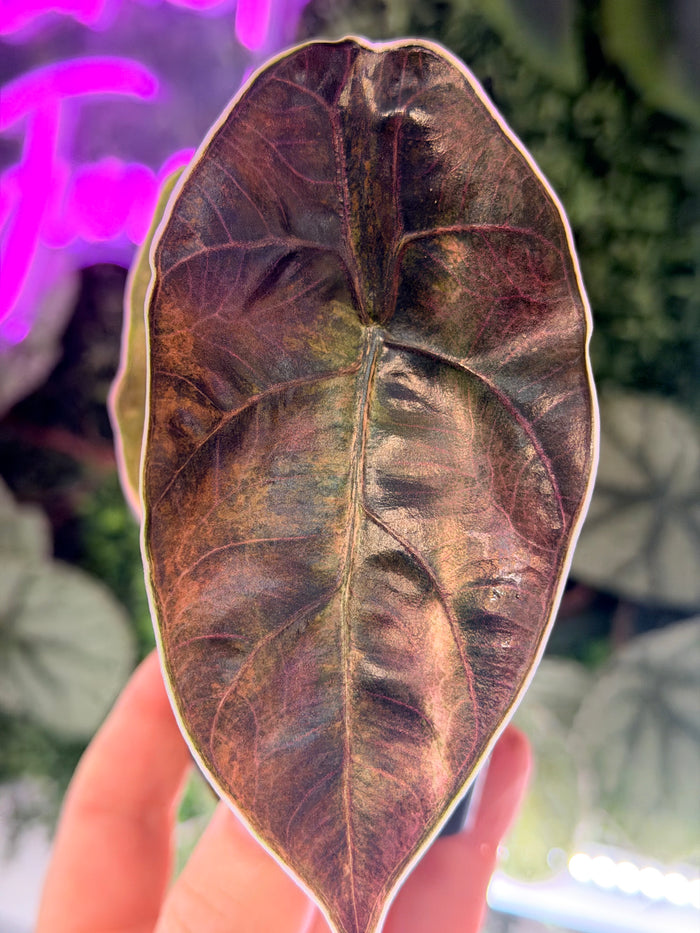
Aroidpedia describes the base plant as having a long, shield-shaped, gently bullate blade in deep olive green, with ivory-white edges and veins and a wine-purple underside. Mature blades reach about 20 inches (roughly 50cm) on slender pinkish petioles that curve just below the blade so that each leaf faces forward. The original description also records small, circular, translucent yellow spots on the underside where the primary veins meet the midrib, which can help confirm identity. In cultivation the surface has a velvety finish that gives very little light back, and the venation is bold, geometrically precise and remarkably regular in the way it covers the blade. Turn a leaf and the underside's warmth shows whenever light strikes at an angle.
Two points are worth knowing. First, Aroidpedia reports that growers describe at least two different plants travelling under this name: an older clone that tolerates neglect, and a newer, fussier introduction. Second, its closest relative within the species, 'Putzeysii', has curved primary veins and mostly grows on the forest floor, and the two intergrade where their ranges meet, so the boundary between them is not sharp.
How aurea variegation behaves on 'Watsoniana'
Aurea variegation is yellow to golden colouring caused by reduced chlorophyll, with the yellow carotenoid pigments still present. Unlike albo, the sectors keep some photosynthetic ability, so aurea plants are generally a little less demanding on the leaf's energy budget. Our own explainer is aurea variegation in Alocasia, and the wider overview is the complete guide to Alocasia variegation types.
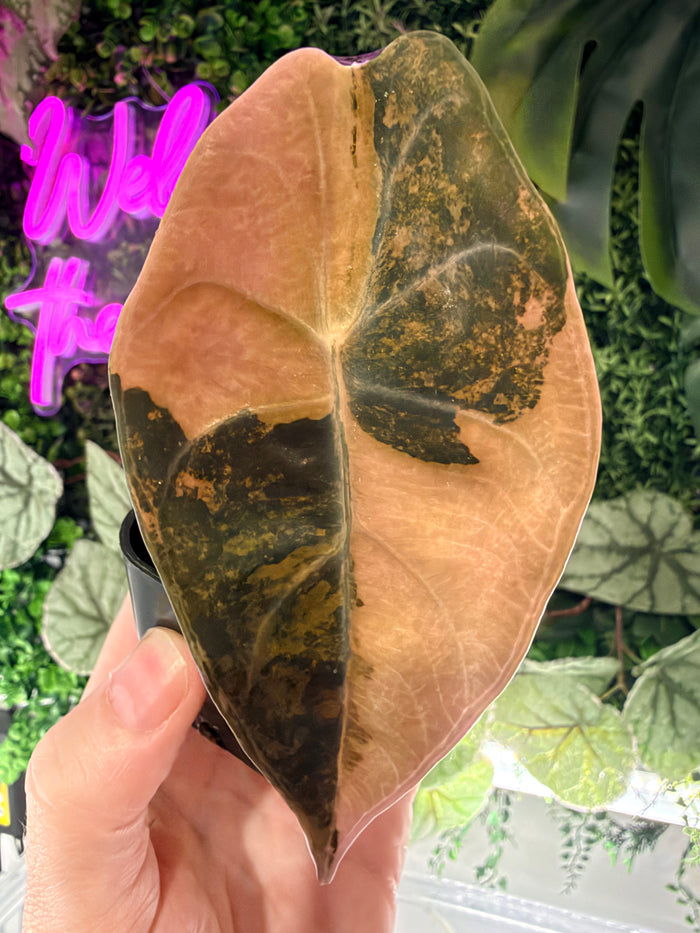
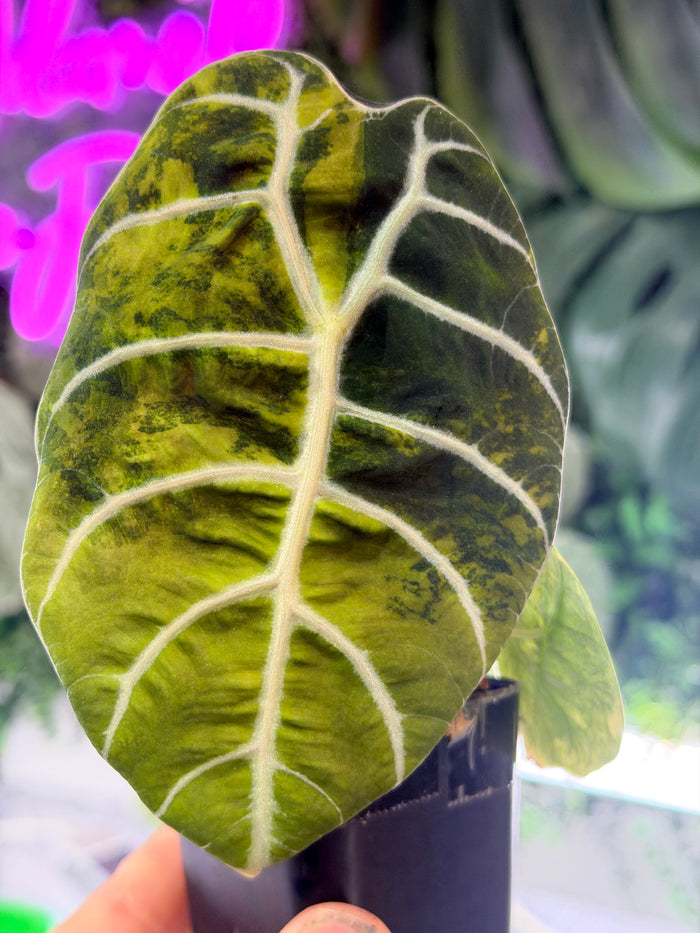
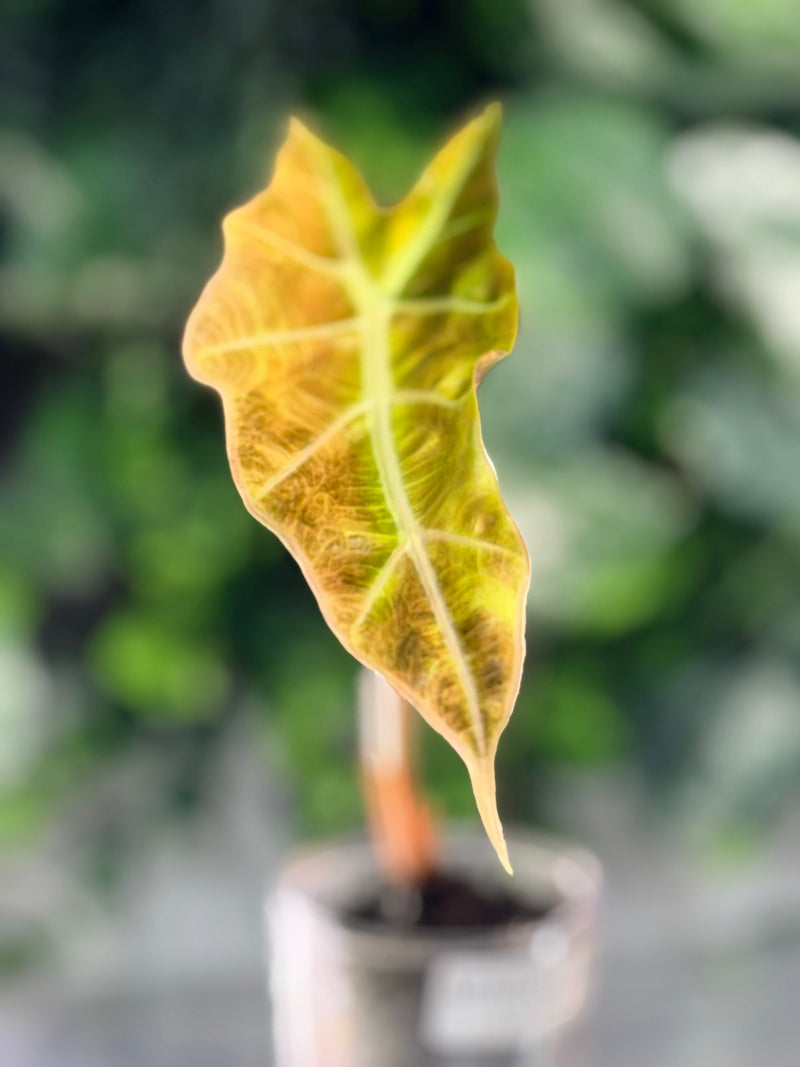
Aroidpedia does not document an aurea form of 'Watsoniana', so there is no recorded origin, breeder or date to quote for it, and it does not discuss the trade name 'Lightning' under which our listing is titled. What can be said is how the variegation tends to look. Golden sectors sit on a dark olive blade that already has ivory-white edges and veins, so the leaf can show gold, ivory and deep green together. Sector patterns vary from leaf to leaf, and chimeric variegation does not always carry over to plants grown from corms.
General care for Alocasia Watsoniana Aurea
This is general Alocasia care, and it applies to this plant. Aroidpedia gives no cultivar-specific cultural data for 'Watsoniana', so we rely on the same approach we use across our Alocasia.
Give bright indirect light, supplemented with LED grow lights where a room is dim, and keep temperatures between 20 and 27°C with humidity of 60 to 80%. Water when the top 2 to 3cm of the substrate has dried, and let any excess drain away. We prefer Fluval Stratum as a substrate, and a heat mat helps if the room runs cool. Feed with our Alocasia feed from the plant feed range at half strength. Our ultimate Alocasia care guide goes into more depth.
Golden sectors hold their colour best with steady bright light. If a plant is under-lit, the yellow areas tend to green up, which is the plant compensating for low light rather than a sign of disease. Brighter, consistent light and LED supplementation are the usual remedy.
Propagating from corms
Aroidpedia, citing Burnett (1984), notes that 'Watsoniana' seldom flowers and rarely produces corms, so do not count on offsets as a routine source of new plants. Where a corm is available, the method we use is self-wicking: the corm sits in Fluval Stratum in a Corm Keeper, which keeps moisture even without soaking the corm. Our Alocasia corm propagation guide gives the full steps, and how long a corm takes to sprout covers what to expect.
How it compares with similar plants
Within our own range, the Watsoniana Albo guide covers the white-sectored form of the same base plant, and the Watsoniana Pink 'Doff' guide covers the pink form. For a wider view of the golden-variegated Alocasia we grow, the aurea variegated collection is the place to start. Collectors generally file the plant with the jewel types, though it is nowhere near the compact scale of Alocasia baginda or Alocasia reginula: the same collector-grade visual character, delivered on a larger leaf.
The Amazonica group is the natural comparison for anyone curious about the plant's assumed role as a parent, and the Alocasia Watsoniana Pink article looks at another variegated form of the same base plant. Aroidpedia's separate entry for 'Watson's Giant' describes a hybrid that uses 'Watsoniana' as the pollen parent.
Frequently asked questions
Is Alocasia watsoniana the same as Alocasia longiloba 'Watsoniana'?
Yes. Alocasia watsoniana is the older species name. It is now treated as a named form within Alocasia longiloba, though plants are still widely sold under the old name.
Where does Watsoniana come from?
Aroidpedia records the 1893 accounts as giving Sumatra, and rejects a later tradition of Java. In the wild it tends to grow on rock. A single firm origin for the cultivated plant is not documented.
Is Watsoniana really a parent of the African Mask plant?
It is the commonly stated parent alongside Alocasia sanderiana, but Aroidpedia treats this as assumed, resting on secondhand accounts rather than formal confirmation.
Is there documented history for the aurea form?
No. Aroidpedia has an entry for the base 'Watsoniana' but none for the aurea variegated form, so we do not give a breeder, date or origin for it.
How should I care for it?
As for our other Alocasia: bright indirect light with LED supplementation, 20 to 27°C, humidity of 60 to 80%, water when the top 2 to 3cm has dried, and feed at half strength.
Does Alocasia contain toxic sap?
Alocasia contain calcium oxalate crystals and are generally regarded as toxic if chewed. Keep plants away from pets and children, and wash your hands after handling cut tissue.
We release this plant through our drop model. Join the collector list for early access and view our Alocasia Watsoniana Aurea Variegated listing. Our aurea variegated collection includes related plants.
Questions about Alocasia Watsoniana Aurea? Contact our team for guidance from specialists who grow rare Alocasia in our UK-based private nursery. We are happy to help with identification, light and substrate questions.
From the nursery