Alocasia Watsoniana Pink 'Doff' Variegated: The Complete Collector's Guide

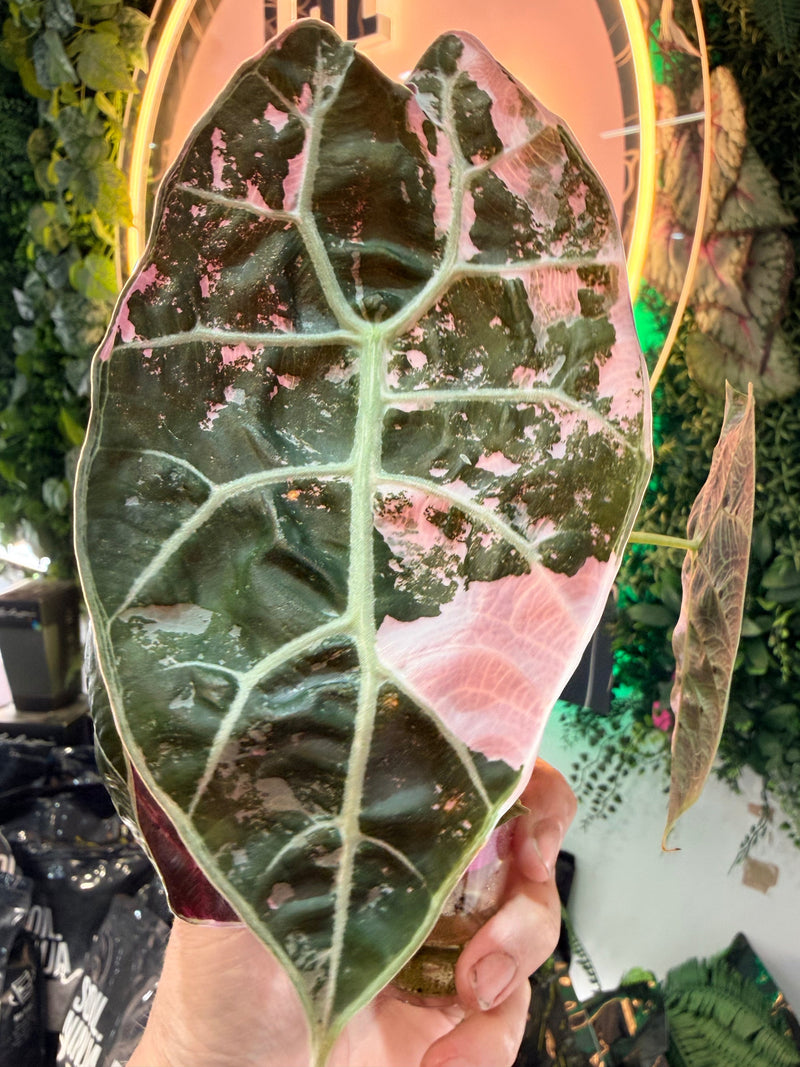
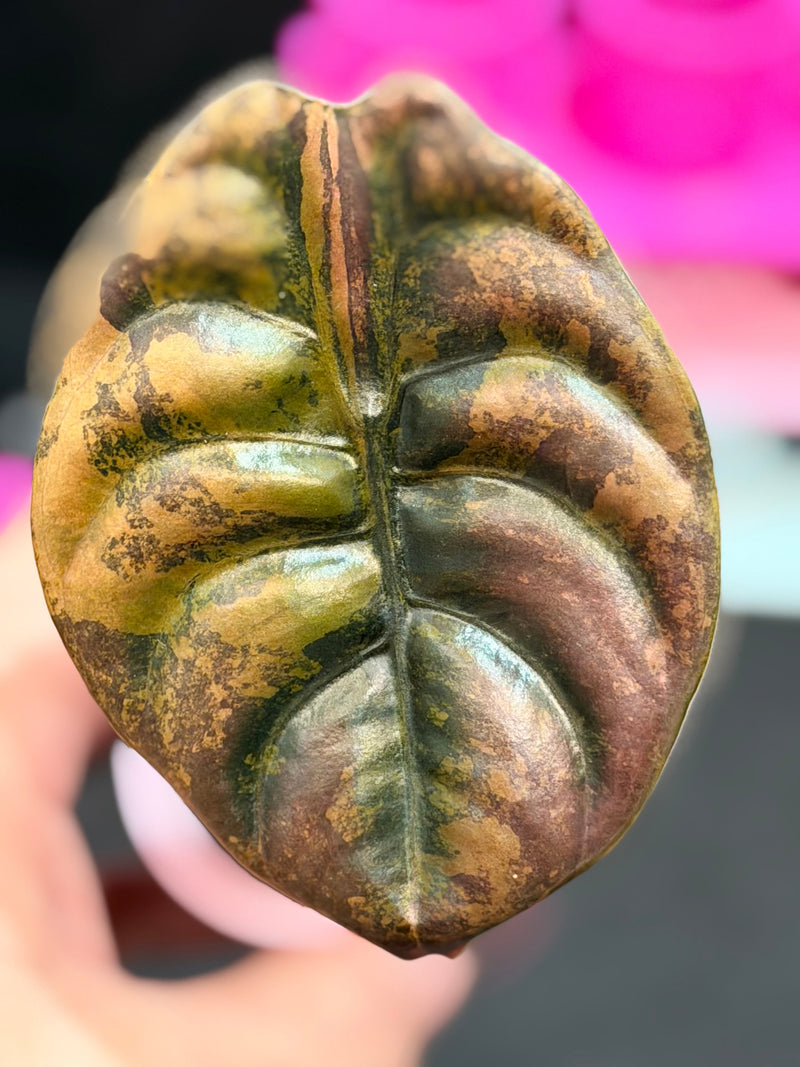
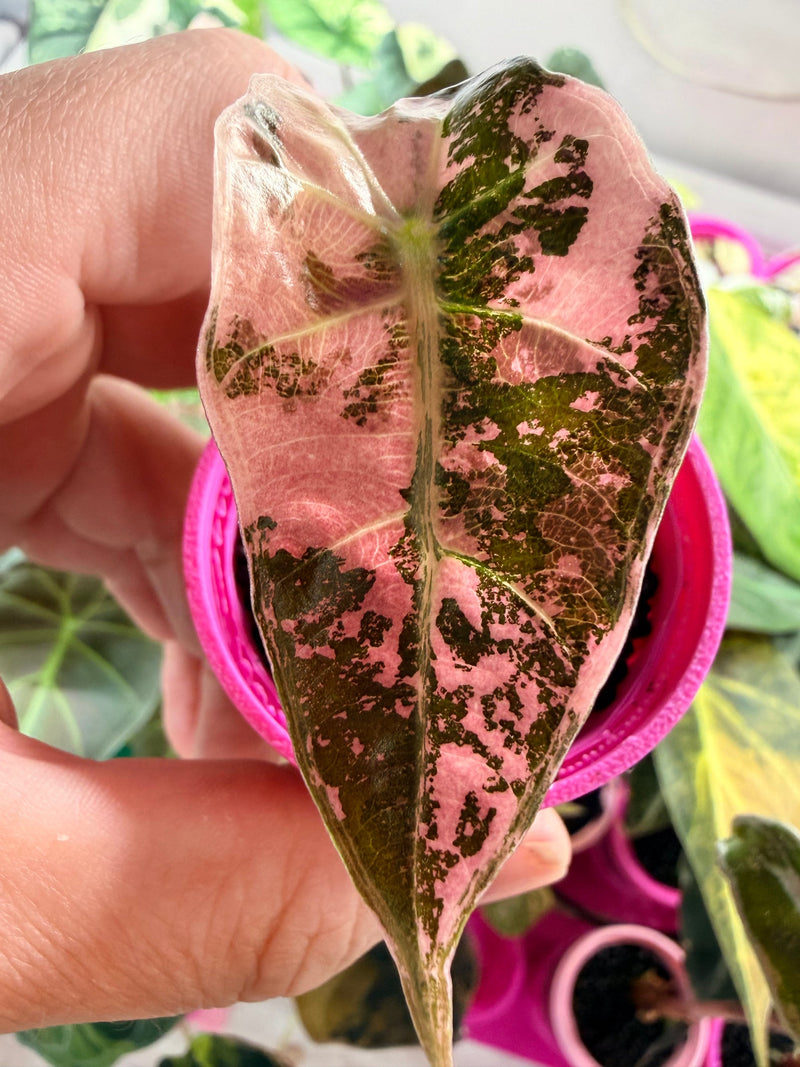
The Alocasia Watsoniana Pink 'Doff' Variegated is the rarest colour expression within the Watsoniana variegated family, chimeric pink variegation, driven by anthocyanin pigment expression in specific cell lineages, appearing on the velvety dark green foliage of Alocasia longiloba 'Watsoniana'. The 'Doff' designation references a specific selection of the pink variegated form, a collector name used to identify plants with particularly vivid or consistently expressed pink variegation. Pink variegation is the rarest colour expression in the Alocasia genus by any measure, and on 'Watsoniana', with its near-black base colouration and silver-white venation, the anthocyanin-driven pink sectors create a tonal complexity that is available in no other longiloba form.
Species Background: Alocasia longiloba 'Watsoniana'
Alocasia longiloba 'Watsoniana' spent many years recognised as a species in its own right, as Alocasia watsoniana, before being subsumed into the longiloba complex, and its place in Alocasia horticulture is genuinely historic. It is one of the parent plants behind Alocasia × amazonica, the African Mask plant, crossed with Alocasia sanderiana by nurseryman Salvadore Mauro at his Amazon Nursery in Florida in the 1950s, whose offspring became one of the most widely sold houseplants in the world. That lineage makes the cultivar foundational rather than incidental: the decorative Alocasia world as we have it today traces back through it.
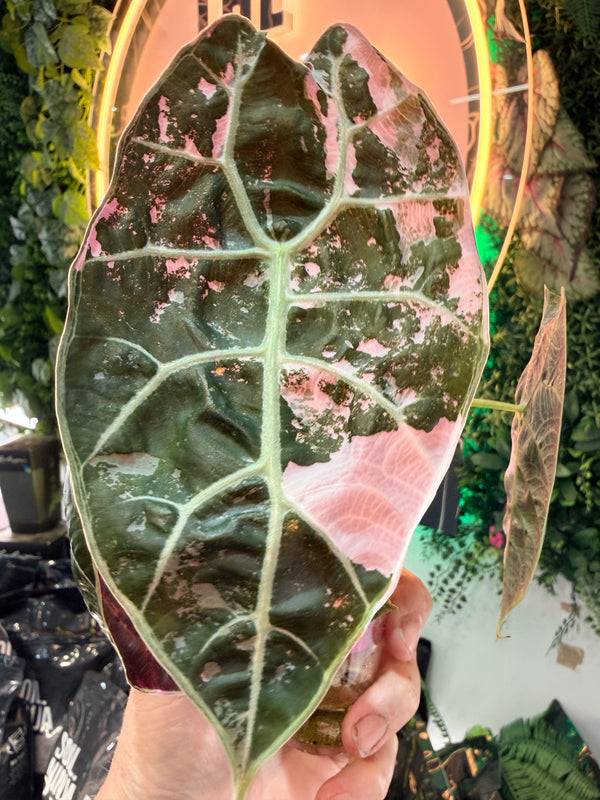
Considered on its own, 'Watsoniana' is a plant of considerable beauty, and it already carries a warm note. Its leaves are large, rounded to broadly heart-shaped, the surface velvety and dark green to near-black, the silver-white venation bold and geometrically precise, covering the blade with unusual regularity and clarity. The underside is reddish-purple, and that warmth appears whenever a leaf catches the light at an angle. In cultivation most collectors treat it as a jewel, if a large-leaved one: the scale is well beyond Alocasia baginda or Alocasia reginula, the visual character every bit as collector-grade. Endemic to Borneo, it grows in the warm, humid lowland tropical forest that is standard Bornean Alocasia habitat, and it has been in cultivation since the Victorian era, its dramatic foliage having caught the eye of European plant collectors then.
Pink Variegation and the 'Doff' Selection
Chimeric pink variegation in Alocasia longiloba 'Watsoniana' arises from elevated anthocyanin expression in specific cell lineages, the same mechanism that produces pink variegation in chimeric pink Alocasia across the genus. Unlike albo sectors, where affected cells lose chlorophyll, pink chimeric sectors retain full chlorophyll production alongside the elevated anthocyanin pigments. The pink colouration is an overlay on the green tissue rather than a replacement of it: the anthocyanin sits above the chlorophyll layer in the cell, tinting the base foliage through a filter-like effect. On 'Watsoniana's' near-dark-green base, the pink reads as an intensely warm note against the cool silver-white venation and dark ground, a combination of tones that is strikingly unusual in collector Alocasia.
The 'Doff' designation within the pink variegated Watsoniana population typically indicates a selection with particularly vivid, well-saturated pink expression or consistent sector coverage. As with all chimeric pink variegation the expression varies between leaves, some will carry extensive pink areas, others minimal. The 'Doff' selection represents the most compelling end of that range, and specimens offered under this designation have been selected for their colour quality.
Pink chimeric sectors retain chlorophyll and contribute to photosynthesis, making the Watsoniana Pink Doff somewhat more vigorous than an albo form. However pink variegation is notoriously sensitive to environmental conditions, anthocyanin production in plants is influenced by light, temperature, and nutritional status. Bright light and cooler temperatures within the acceptable growing range typically enhance pink expression; low light and high temperatures can suppress it. For UK collectors this means positioning near a well-lit window rather than in a warm, darker location, and maintaining good light throughout winter with LED supplementation.
Our guide to pink variegation in Alocasia covers the anthocyanin mechanism and what influences its expression in detail.
Care Requirements
Bright indirect light year-round, supplemented with LED grow lighting from October to March. Temperature 20-25°C (cooler end of the range supports anthocyanin production), humidity 60-80%. Fluval Stratum substrate, thorough watering when top 2-3cm is dry. Balanced feed at half strength from our plant feed range during the growing season, avoid excess nitrogen which can suppress anthocyanin expression. A heat mat beneath the pot supports root health in winter without over-warming the growing environment.
We release Watsoniana Pink Doff through our drop model when quality material is available, this is genuinely rare in supply. Join the collector list for advance notification and view our Alocasia Watsoniana Pink 'Doff' Variegated listing for availability. Our pink variegated Alocasia collection includes related specimens.
Questions about the Watsoniana Pink Doff, pink variegation, or the longiloba complex? Contact our team for specialist guidance from our UK nursery.
From the nursery