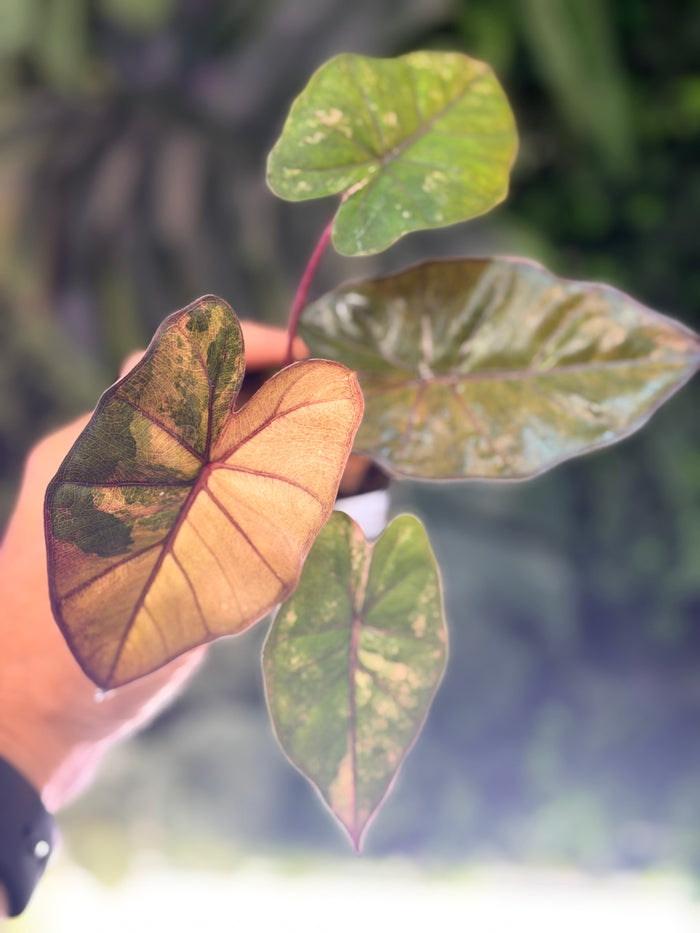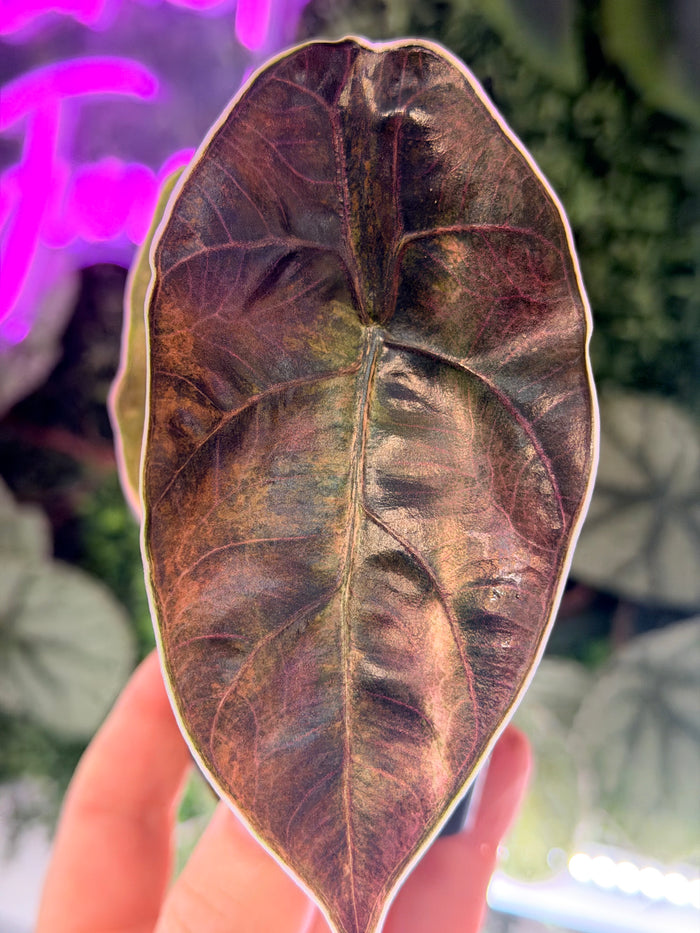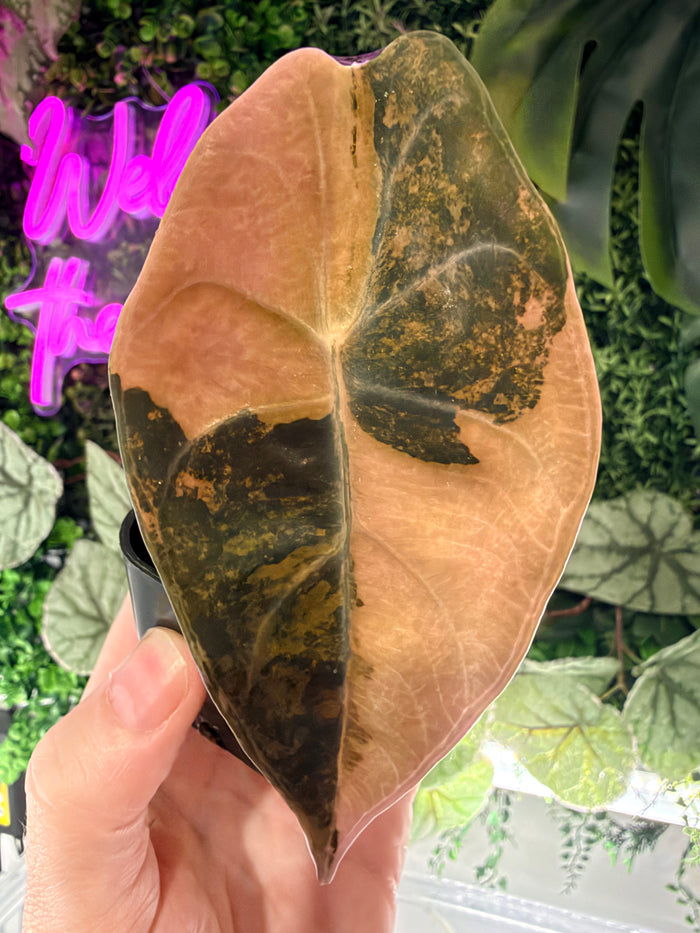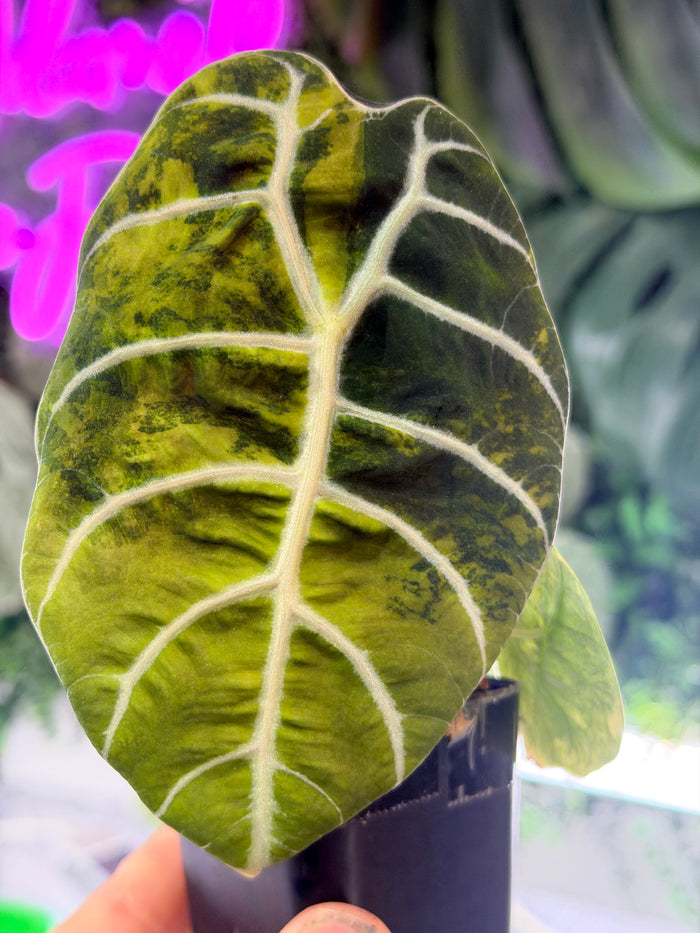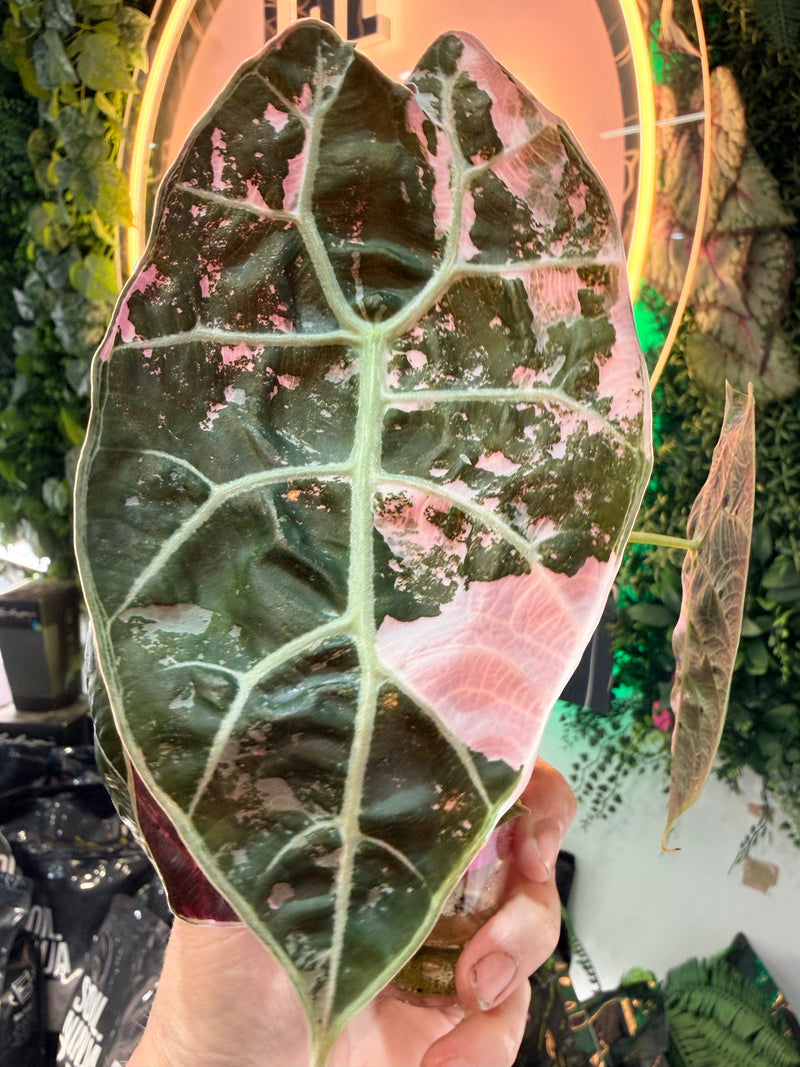

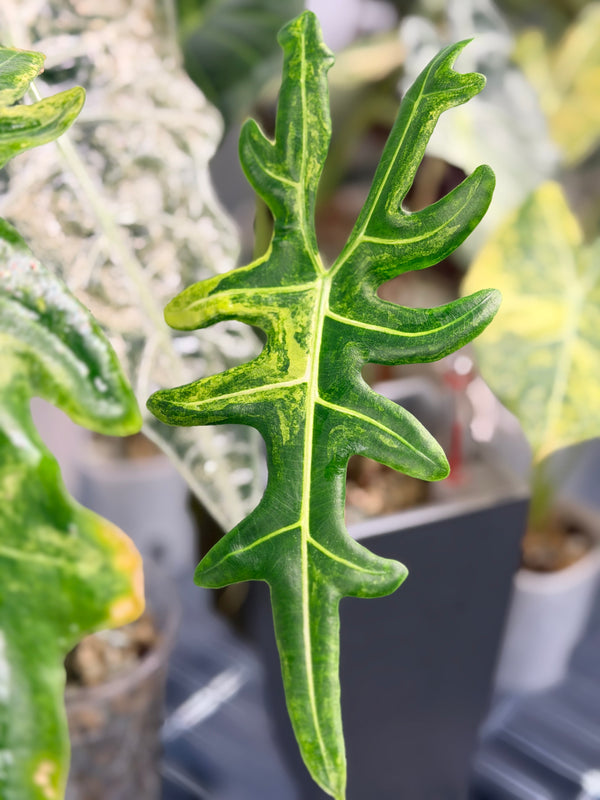
Alocasia portei aurea is the golden-variegated form of Alocasia portei, an arborescent species from the Philippines with deeply divided leaves. It is arguably the most dramatically scaled Alocasia species in regular collector cultivation, and the aurea form delivers golden-yellow sectors across those enormous, deeply lobed leaves at a visual scale that no compact jewel species can approach. This guide sets out what Aroidpedia records for the species, how to recognise it, and how to care for it. One thing needs saying at the outset: Aroidpedia has a species entry for Alocasia portei but no entry for an aurea cultivar, and its species page lists only a cream or yellow variegated form, so cultivar-specific detail is not documented.
What is Alocasia portei?
Aroidpedia describes Alocasia portei as a massive, arborescent and pachycaulous plant reaching about 6m. The erect stem can be around 40cm across at the base, thickening with age, and older parts of the stem develop a tessellated, bark-like surface. Several leaves cluster at the top, mostly held erect.
The blades are sagittate and deeply pinnatifid, dark green and coriaceous. The anterior lobe reaches about 1.5m and carries up to 10 linear-lanceolate, round-tipped segments with strongly crispate margins. Each segment bears its own primary lateral vein. The petioles also reach about 1.5m and are described as yellowish to dark green, mottled chocolate, sheathing the lower third.
Origin and naming
Aroidpedia records the species as endemic to Luzon in the Philippines, where it is anecdotally common and widespread in secondary forest at low to medium elevations, although botanical collections are rare, probably because of its size. The protologue appeared in Bonplandia in 1862 and tentatively placed the plant in Alocasia, section Schizocasia, from a single dried leaf. The species was described by Heinrich Schott in that year. Older books often use the name Schizocasia portei, and Aroidpedia also lists the trade name 'Malaysian Monster' and the local name Badiang, glossed as "Giant Taro" in Tagalog.
The species is named after the French botanist Marius Porte, born in Marseille. He left France in 1834, stayed in Brazil until 1859, then went to Borneo, Singapore and the Philippines. Aroidpedia credits him as reportedly the first to ship plants wrapped in sphagnum moss, which allowed new plants, particularly orchids, to reach Europe. He died of an unknown disease on Luzon in 1866.
How to identify Portei Aurea
The foliage is the giveaway. Where most Alocasia have a simple arrow or heart-shaped blade, Alocasia portei has a deeply cut, frond-like leaf with wavy margins, held on a mottled petiole. A golden-variegated plant shows that same architecture with yellow sectors in place of green, and the pattern differs from leaf to leaf. If you are unsure whether you are looking at this plant or one of its hybrids, the divided leaf and the trunk-forming habit are the features to check. In a well-lit position, a mature Portei Aurea is a statement plant of the first order: tropical architecture combined with vivid colour at the scale of a small indoor tree.
The aurea variegation
Aurea variegation is yellow or golden tissue with reduced chlorophyll that still retains carotenoids, so it can photosynthesise to a degree, unlike pure white sectors, which makes the Portei Aurea vigorous relative to albo forms. Aroidpedia does not describe an aurea cultivar of Alocasia portei, so we cannot say how stable the variegation is or how a given plant will develop. As with any chimeric variegation, the pattern might not carry over to corm-grown plants. Our guides to aurea variegation in Alocasia and the complete guide to variegation types explain the mechanism in more detail.
Aurea variegation on the deeply pinnatifid leaves of Alocasia portei operates differently from aurea on broad-bladed species. The leaf is divided into multiple linear-lanceolate segments, each with its own primary lateral vein, and the golden sectors distribute across these segments independently. A heavily variegated leaf can carry golden sectors on some segments while adjacent segments remain green, the segmented architecture of the blade creating a natural framework through which the aurea distribution moves. The overall effect is more complex than a single broad golden panel: each segment contributes its own colour proportion to the total composition, creating a mosaic of green and gold across the dissected leaf surface. The crispate, wavy margins interact with the aurea sectors at the edges, golden tissue following the undulation of each segment's margin, and the mottled chocolate petioles provide a warm-toned support that connects visually to the golden sectors, giving the whole plant a cohesive warm-toned character.
Portei Aurea care
This is general Alocasia care, and it applies to this plant. Give it bright indirect light with LED supplementation, 20-27°C and humidity of 60-80%. Water when the top 2-3cm of the substrate has dried. Large pots hold moisture for longer than small ones, so check the substrate before you water rather than watering to a routine. Use Fluval Stratum as the preferred substrate, and add a heat mat if the room runs cool.
Feed at half strength with our Alocasia feed from the plant feed range. Large leaves give pests plenty of surface, so inspect them regularly for spider mites and treat early with our pest control range. Our ultimate Alocasia care guide covers the fundamentals.
Propagation from corms
Corms are one of the most economical ways to grow more Alocasia. Our Alocasia corm propagation guide describes the self-wicking method using Fluval Stratum in the Corm Keeper, and growing Alocasia corms in Fluval Stratum goes into the substrate side.
How does it compare with similar plants?
Alocasia portei is a parent of several hybrids. Aroidpedia lists 'Thunder Waves' (also called 'Portora') and 'Low Rider', both odora × portei, and 'Tyrion', a dwarf mutation of 'Portora'. The Portora inherits the portei's dramatic scale and leaf division, combined with the cold tolerance and vigour of odora, which has made it a widely planted landscape plant in tropical and subtropical gardens globally. Other crosses include 'Paul Fernandez' (macrorrhizos × portei) and 'Ripple Effect' (alba × portei). Our Portora Aurea guide covers the best-known hybrid, and the Alocasia macrorrhizos species guide covers another very large relative. You can also browse the aurea variegated Alocasia collection.
Frequently asked questions
Where does Alocasia portei come from?
Aroidpedia records it as endemic to Luzon in the Philippines.
How large does it grow?
The species reaches about 6m with a stem up to 40cm across at the base. Cultivated size indoors depends on conditions and is not documented for the aurea form.
Is there a documented aurea cultivar?
Not on Aroidpedia, which lists a cream or yellow variegated form without cultivar detail.
Who was the plant named after?
The French botanist Marius Porte, who died on Luzon in 1866.
Will corm-grown plants keep the variegation?
Not necessarily, as chimeric variegation might not carry over.
We release Portei Aurea through our drop model. Join the collector list for early access and view our Alocasia Portei Aurea listing.
Questions about Alocasia portei aurea? Contact our team for guidance from specialists who grow rare Alocasia in our UK-based private nursery. We are happy to help you plan space, light and substrate for a large plant.
From the nursery