

Alocasia Portora Aurea is the golden-variegated form of Alocasia 'Portora', one of the largest Alocasia hybrids ever created. Aroidpedia records Portora as a cross of Alocasia odora and Alocasia portei, and this guide sets out what is documented about the hybrid, its parents and its naming, including what Aroidpedia does and does not record about an aurea form.
What is Alocasia Portora Aurea?
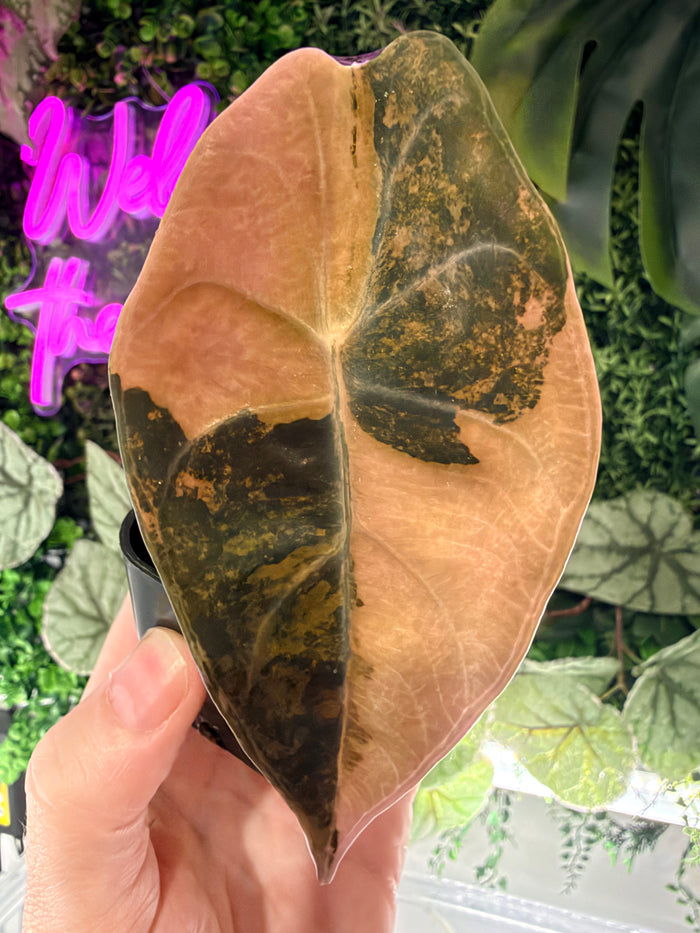
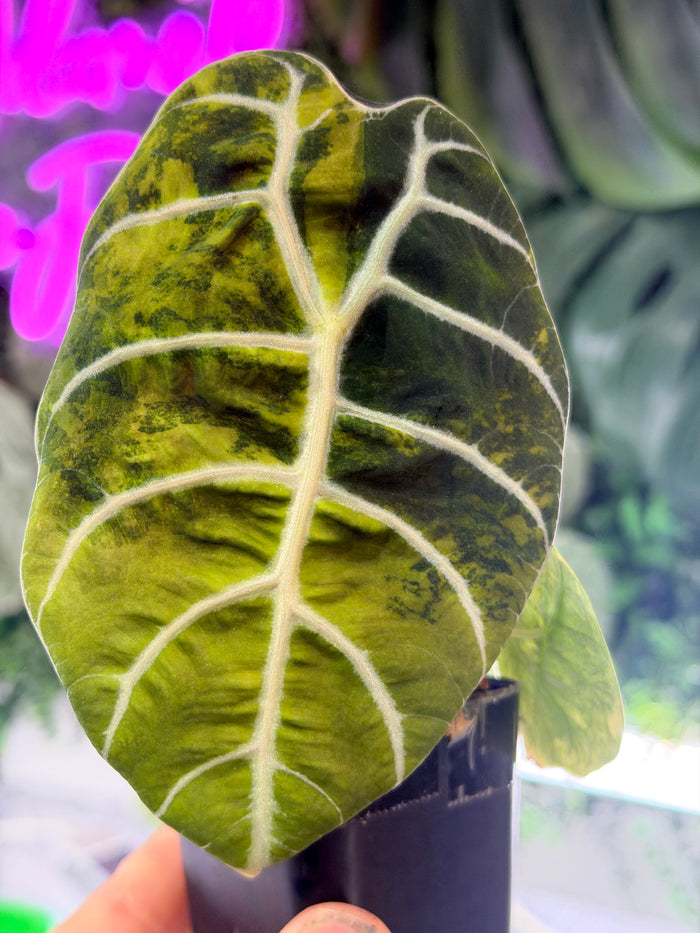
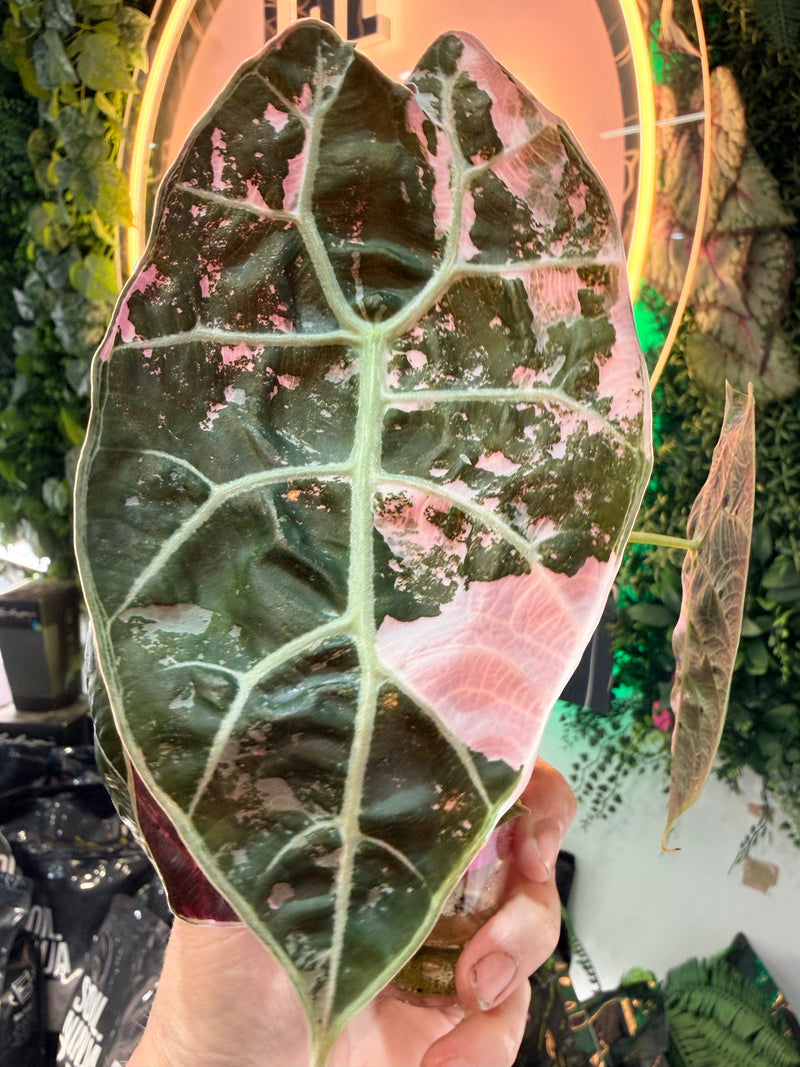
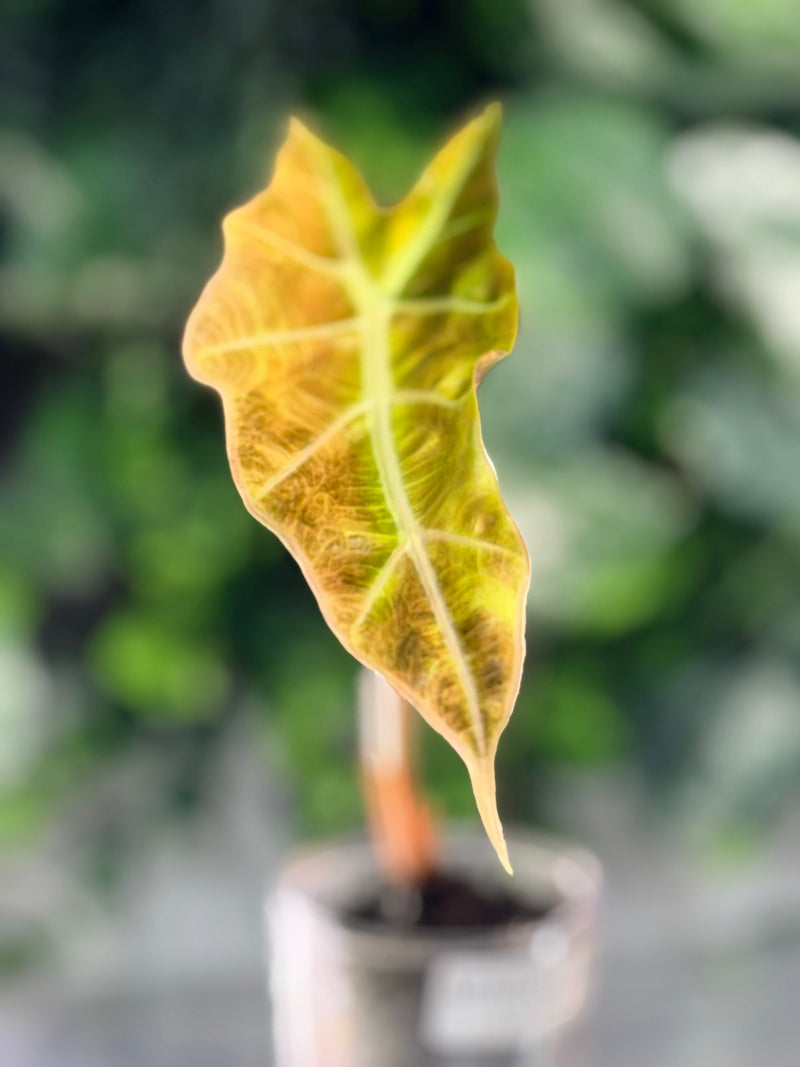
It is an aurea (yellow to golden) variegated plant of the Portora hybrid. Aurea variegation comes from reduced chlorophyll in the affected tissue, with carotenoid pigments retained, which is why the sectors read as gold, not white. Aroidpedia lists the variegation recorded for Portora as white and mint, and has no entry for an aurea form, so details specific to the aurea plant, such as how the gold is distributed across the leaf, are not documented there; we describe the distribution from our own plants below. The hybrid brings the dramatic leaf architecture of the portei lineage together with the cold-tolerant vigour of the odora lineage, and the aurea form adds vivid carotenoid-based colour to that.
Origin and naming: Portora, not Portodora
Aroidpedia records Alocasia 'Portora' as a hybrid made by LariAnn Garner of Aroidia Research, with Alocasia odora as the ovule (seed) parent and Alocasia 'Portei' as the pollen parent. Its separate entry for the species Alocasia portei states the same cross as A. odora × A. portei.
The name is often misspelled. Aroidpedia lists 'Portodora', 'Portadora', 'Portidora' and 'Portore' as incorrect synonyms, meaning 'Portodora' is the same hybrid under a wrong spelling, not a different plant. It also notes that a selection patented by Proven Winners as 'Emerald Isle' is treated as 'Portora', and describes that renaming as disregarding botanical nomenclature. Our guide to the Portodora Aurea × Antoro Velvet covers a separate cross that uses this hybrid as one parent.
The Portei parent
Aroidpedia describes Alocasia portei as a species endemic to Luzon in the Philippines, found in secondary forest at low to medium elevations. It is massive and arborescent, reaching about 6 m, with a trunk-forming, pachycaul stem up to roughly 40 cm across at the base that develops a tessellated, almost bark-like surface with age, and deeply pinnatifid, sagittate leaf blades whose anterior lobe can reach about 1.5 m. The leaves are not the simple arrow or heart shape of most Alocasia species but deeply dissected into linear-lanceolate segments, so the leaf reads more like a giant divided frond than the typical Alocasia blade. Each segment bears its own primary lateral vein, and the margins are strongly crispate, which gives the whole leaf a dynamic, textured quality at impressive scale. The petioles are mottled and the leaf undersides purple, adding colour complexity beyond the leaf surface. The species was described by Heinrich Schott in 1862. It is named for the French botanist Marius Porte, who explored tropical regions from 1834, shipped plants wrapped in sphagnum moss, and died on Luzon in 1866; he left Marseille in 1834, worked in Brazil until 1859, then moved to Borneo, Singapore and the Philippines, where he died from an unknown disease. Our Portei Aurea guide covers the species in its golden form.
Size and the two selections
Aroidpedia calls Portora one of the largest hybrids ever created, and notes a specimen shown by Garner at about 12 feet tall. The initial cross produced two groups. 'Portora Green' has green petioles and main veins and is the selection most often sold. 'Portora Red' has reddish or maroon petioles, main veins and spathe, and Garner has said it would be marketed as 'Thunder Waves' if released. Aroidpedia does not say whether that red selection reached the market. The hybrid's size and vigour have made it a widely planted landscape plant in tropical and subtropical gardens globally.
Related plants recorded by Aroidpedia include 'Tyrion', a dwarf mutation of Portora bred by Garner around 2017, and 'Sumo', a cross of Portora with Alocasia princeps. Aroidpedia does not record any hardiness figures for Portora; the cold tolerance we describe in the care section below is from our own experience.
How to identify Portora Aurea
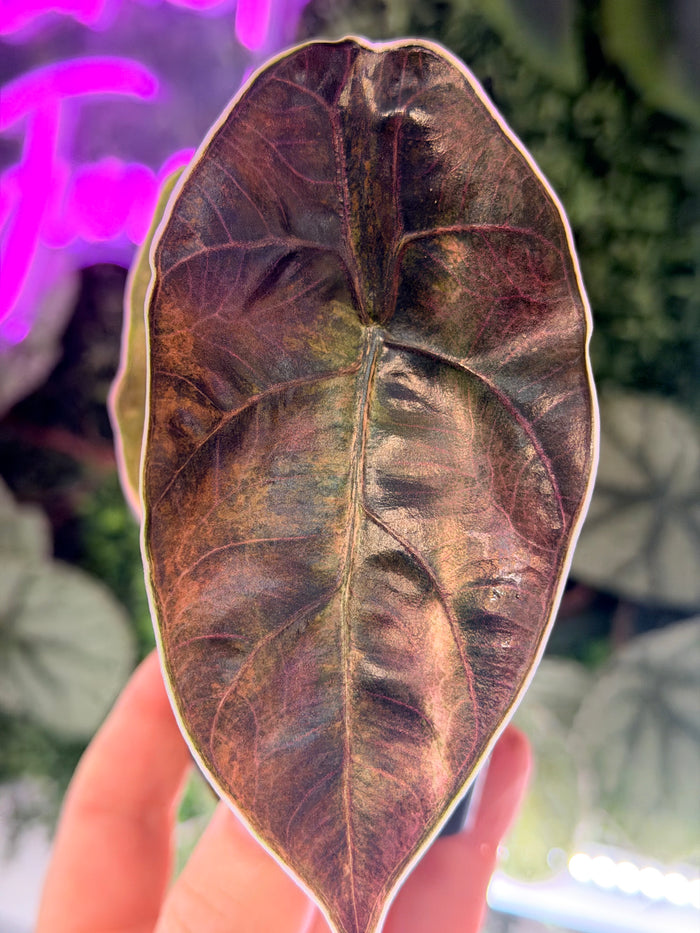
The documented identifiers are scale and colour at the petioles and main veins: green in the commonly sold selection, reddish or maroon in the red group. Because the parent species has deeply divided leaves, the hybrid might show some of that character, but Aroidpedia does not give a leaf description for Portora itself; what follows is our own description. In our experience the Portora inherits the portei's deeply divided leaf architecture, with multiple linear-lanceolate segments and crispate margins, expressed at a scale influenced by the odora parent's greater vigour and size potential, along with the odora's tolerance for a wider range of conditions. Golden sectors identify the aurea form, and in our plants they distribute across the segmented blade just as on pure portei, appearing on individual segments to create a mosaic of gold and green across the divided leaf. The hybrid's greater vigour means the aurea form grows more actively than portei alone, and the combination of the lobed leaf form, golden sectors and purple undersides makes a collector specimen of unusual visual richness. Chimeric variegation such as aurea can be unstable, so the pattern might vary from leaf to leaf. Compare it in the aurea variegated Alocasia collection, and read our guides to aurea variegation and variegation types.
Care for Alocasia Portora Aurea
This is general Alocasia care, and it applies to this plant. Give bright indirect light with LED grow light supplementation, a temperature of 20-27°C and humidity of 60-80%. The odora parent contributes some additional cold tolerance compared with pure portei, and in our experience the plant tolerates brief temperatures down to around 10°C without damage, but 20-27°C remains the optimal range for vigorous growth and vivid aurea expression. Water when the top 2-3cm of substrate has dried. Fluval Stratum is our preferred substrate, in a pot sized to the plant, and a heat mat helps if the room runs cool. Feed with our plant feed range at half strength. Large leaf surfaces are worth inspecting regularly for spider mites using our pest control range. For more, see our Alocasia care guide.
We release Portora Aurea through our drop model. Join the collector list for early access and view our Alocasia Portora Aurea listing.
Propagating from corms
Many collectors build their collection from corms, and our Alocasia corm propagation guide covers the self-wicking method: the corm sits in Fluval Stratum in the Corm Keeper, which supplies moisture without the corm sitting in water. See also growing Alocasia corms in Fluval Stratum and the corms collection. Chimeric variegation might not carry over to a corm-grown plant.
How Portora Aurea compares to similar plants
Portora Aurea shares its golden variegation with other aurea plants such as Portei Aurea, which is the species parent in its own golden form. It is also a parent in the Portodora Aurea × Antoro Velvet cross. Browse the wider Alocasia house plant range to compare scale.
Frequently asked questions
Is Portodora the same as Portora?
Yes. Aroidpedia lists 'Portodora' as an incorrect synonym of 'Portora'.
What is Portora a cross of?
Alocasia odora as the ovule parent and Alocasia portei (listed as 'Portei') as the pollen parent, made by LariAnn Garner.
How large does Portora get?
Aroidpedia calls it one of the largest hybrids ever created and notes a specimen about 12 feet tall.
Is there an aurea form on Aroidpedia?
No. Aroidpedia lists white and mint variegation for Portora and does not record an aurea form.
Will the gold variegation carry over to a corm?
Not necessarily. Chimeric variegation might not carry over to corm-grown plants.
Questions about Alocasia Portora Aurea or the Portei and Portora lineage? Contact our team for guidance from specialists who grow rare Alocasia in our UK-based private nursery. We will say plainly what is and is not documented.
From the nursery