
Currently sold out
PINK DRAGON LIME AUREA VARIEGATED
New plants go to the drop list first.
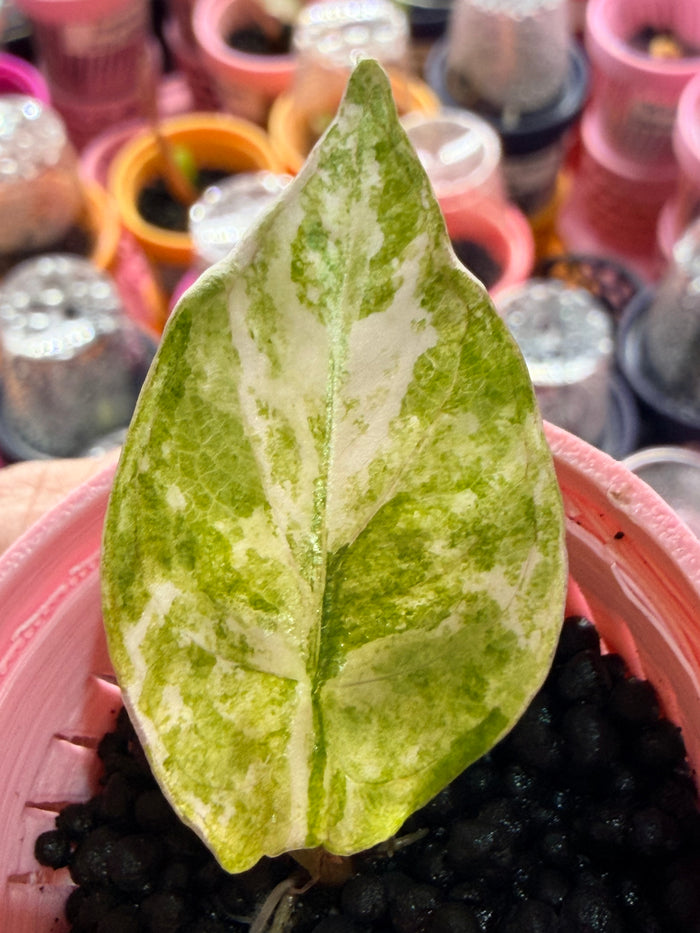
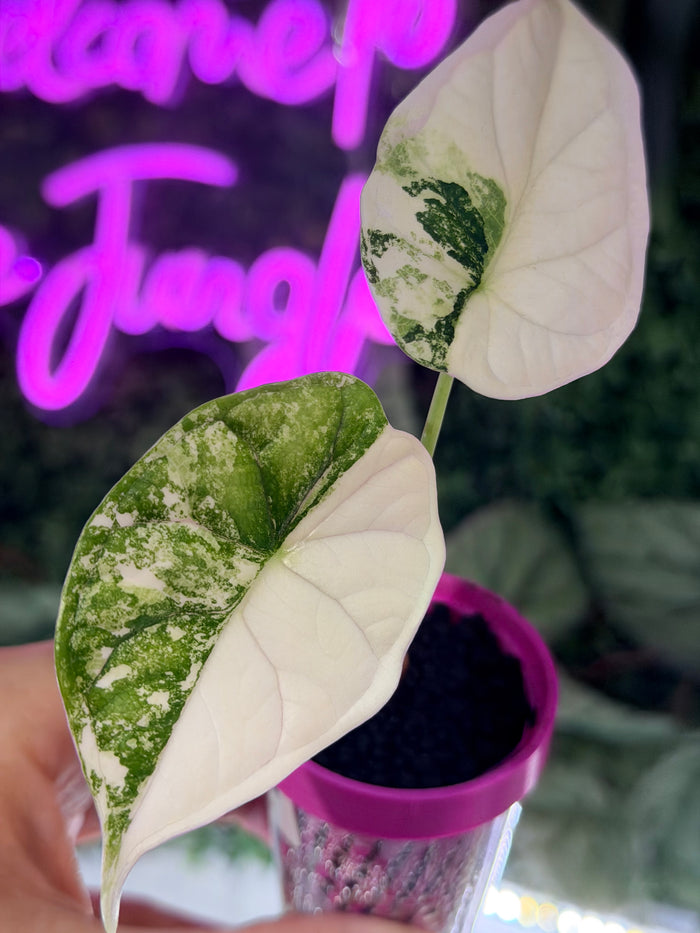
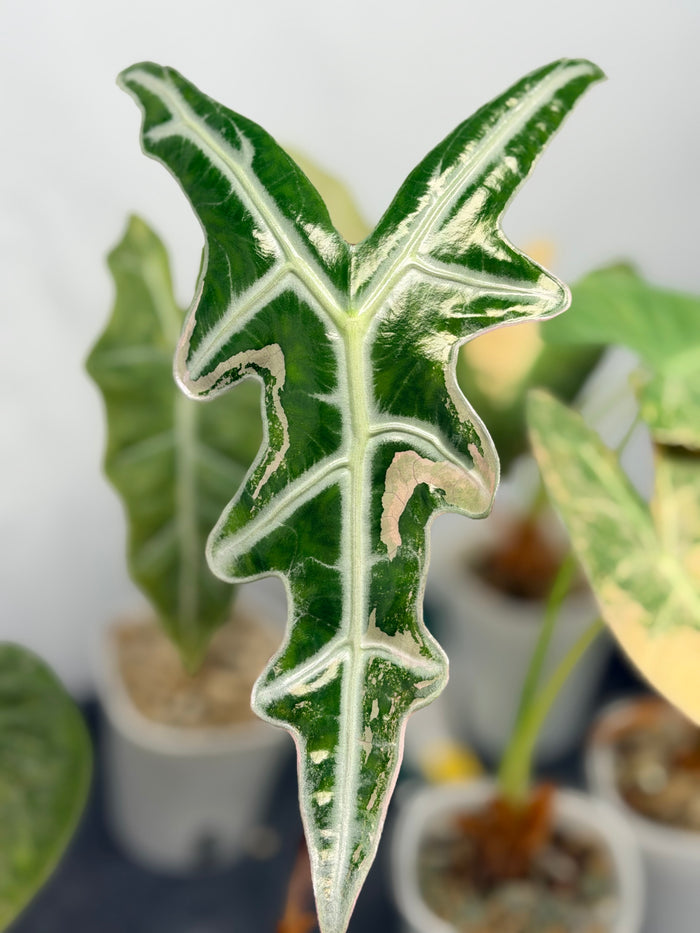
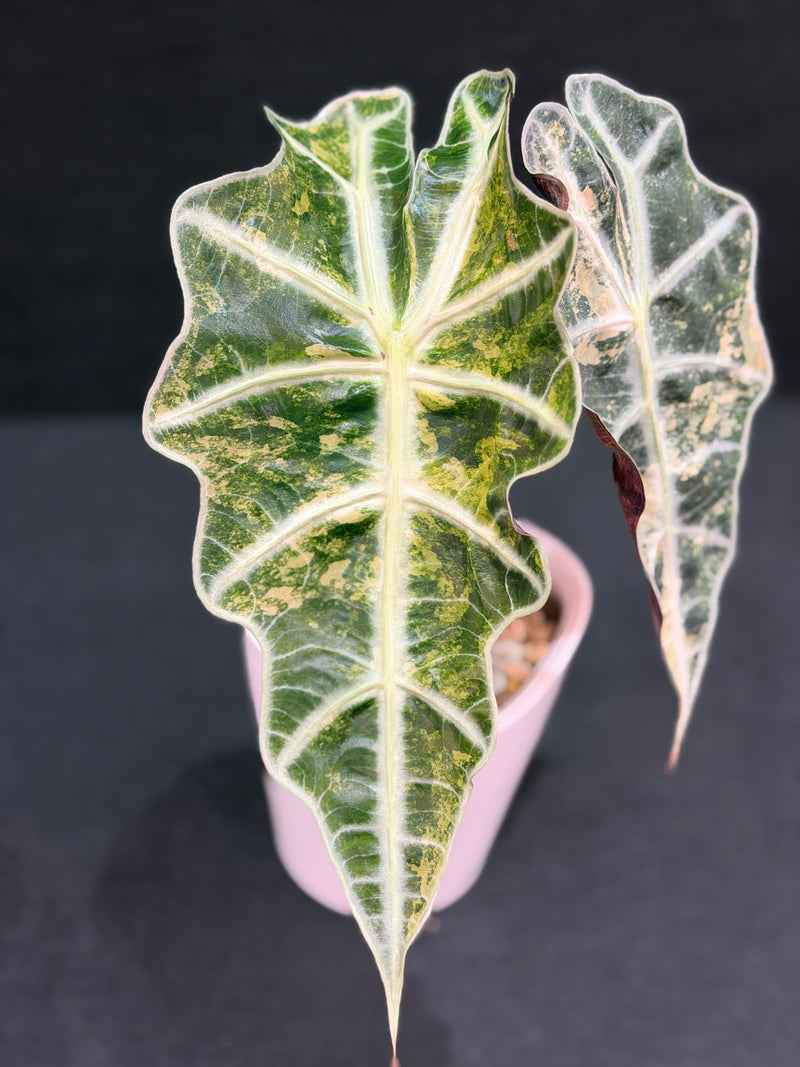
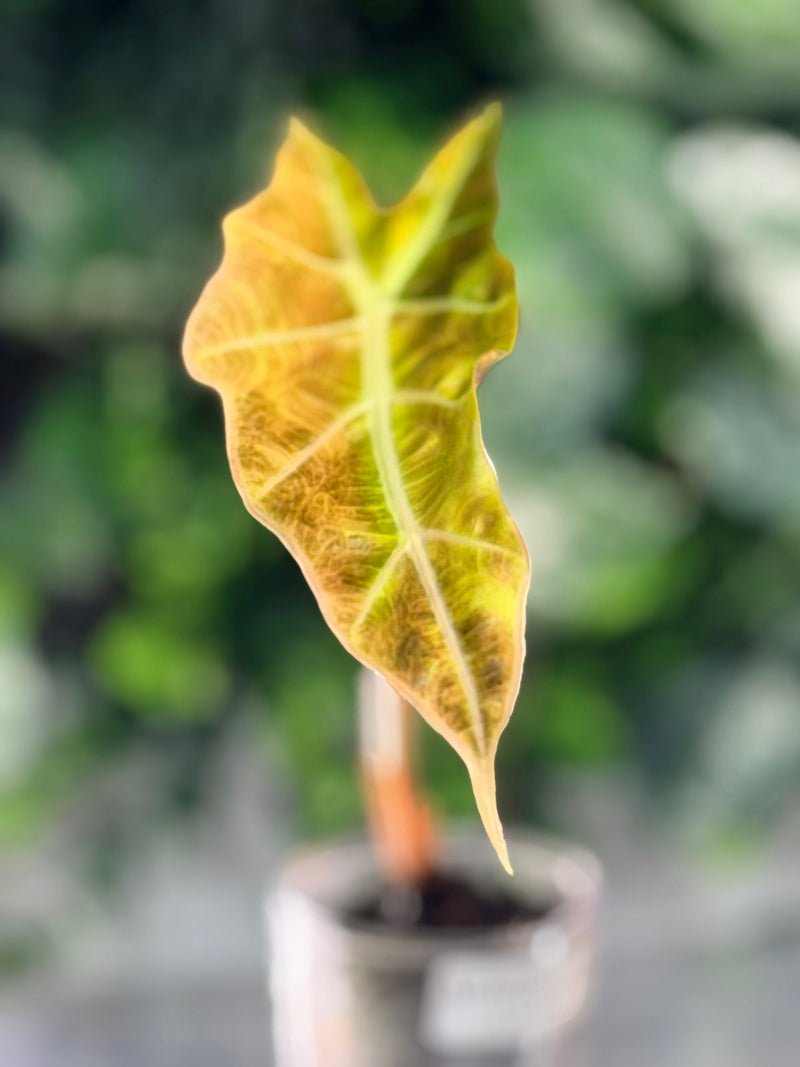
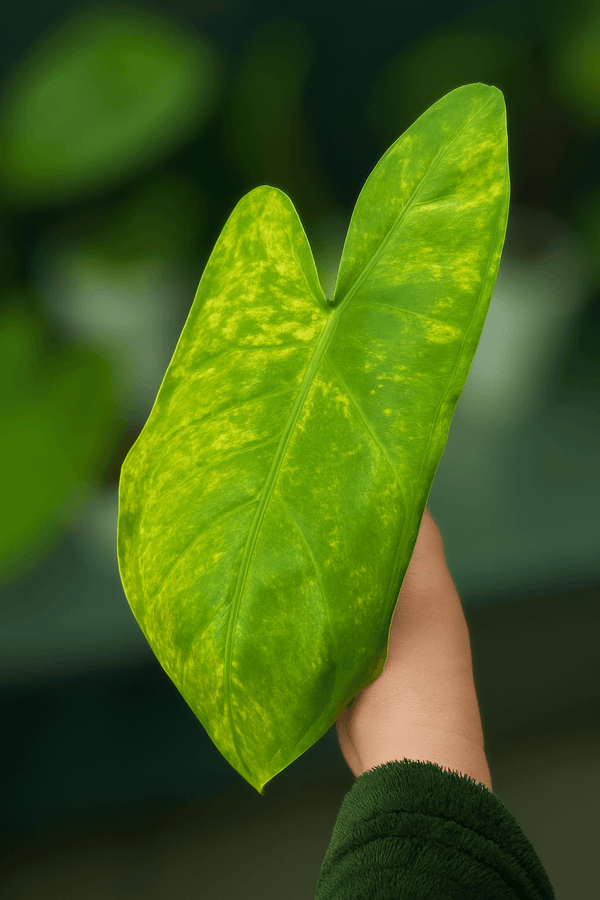
Join the drop listWithin the Pink Dragon variegated family, the Lime Aurea form occupies a distinct and particularly interesting position. Where the standard Pink Dragon Aurea expresses golden-yellow sectors that create a warm, luminous contrast against the deep green blade, the Lime Aurea form shifts that colour expression toward a cooler, chartreuse-green register, bright lime-yellow sectors that read differently against the same base foliage, and that interact with the cultivar's pink petioles and silver venation in a way that is genuinely unlike any other Alocasia in current cultivation.
This is not simply a paler version of the standard aurea form. The lime expression represents a distinct carotenoid profile, a specific balance of pigments that produces a more acid, citrus-toned yellow-green rather than the warmer, golden yellow of the standard aurea. In a collection context, the Lime Aurea and the standard Aurea complement each other rather than duplicating each other, and both sit distinctly alongside the Albo form. Together, the three Pink Dragon variants demonstrate just how dramatically colour expression can transform the visual character of a single base cultivar.
This guide covers the Lime Aurea specifically, what distinguishes it from the other Pink Dragon variants, the science behind its particular colour expression, and the care approach that best maintains its distinctive lime variegation. Those new to the Pink Dragon complex should also read our guides to the Pink Dragon Albo and Pink Dragon Aurea, which cover the species background and general care in fuller detail.
Understanding Lime Aurea Variegation
The distinction between standard aurea and lime aurea variegation in Alocasia is a matter of the specific carotenoid composition in the affected tissue. Carotenoids are a family of pigments, including carotenes (orange-yellow) and xanthophylls (yellow-green), that are present in all plant cells but typically masked by chlorophyll in healthy green tissue. In aurea variegation, chlorophyll synthesis is suppressed in the affected sectors, allowing the carotenoid pigments to dominate the visual expression.
The resulting colour, whether golden-yellow or lime-green, depends on which carotenoids are most concentrated in the affected tissue, and in what proportions they occur relative to residual chlorophyll. In lime aurea expression, a higher proportion of xanthophylls combined with some residual chlorophyll presence produces the distinctive acid-yellow-green colouration rather than the warmer golden of standard aurea. The lime sectors are therefore not entirely devoid of chlorophyll, they retain some, and this means they have a slightly higher photosynthetic contribution than the golden sectors of the standard aurea form.
In practical terms, the Lime Aurea form is vigorous and relatively resilient. The retention of some chlorophyll in the lime sectors means the plant's overall metabolic capacity is higher than in the albo form, and comparable to or slightly greater than the standard aurea. Growth rates are typically good, and the plant responds well to consistent care in a well-managed UK indoor environment.
The lime colour expression is influenced by light, temperature, and the plant's overall physiological state. Under optimal conditions, bright indirect light, consistent warmth, adequate humidity, the lime sectors are vivid and well-saturated, reading as a clear chartreuse against the deep green of the non-variegated tissue. Under lower light, the sectors may become greener as the residual chlorophyll becomes relatively more prominent. This light-responsiveness is a useful guide: if your lime expression is becoming less vivid and more uniformly green, increasing light levels is the appropriate first response.
Visual Character: What Makes This Form Distinctive
Part of what makes the Pink Dragon Lime Aurea compelling as a collector specimen is the specific colour combination it creates. The base cultivar already features an unusual palette, vivid pink petioles, deep green blades, silver primary venation, and burgundy undersides. The lime-yellow sectors add a fourth distinct colour note to this composition, and the result is a plant that challenges the eye in a different way from the warm-toned golden of the standard aurea or the high-contrast white of the albo.
Lime-green against deep green creates a tonal rather than a chromatic contrast, the colours are related rather than complementary, and the effect is more subtle than the stark division between white and green in albo variegation. But subtlety in this context does not mean less striking; it means differently striking. In good light, the lime sectors have a luminous quality, they appear to glow from within the blade rather than sitting on its surface, that is genuinely distinctive in the aurea variegated Alocasia world.
The pink petioles provide a complementary warm note that prevents the overall effect from reading as cold or purely green. This interplay between warm (pink stems) and cool (lime sectors) within a single plant is one of the Lime Aurea's most distinctive characteristics, and it is something that photographs do not always capture accurately, the plant tends to be more impressive in person than in images.
The Pink Dragon: Species Context
The Pink Dragon cultivar, across all its colour forms, traces its origins to Alocasia 'Aurora', introduced first in Thailand before being rebranded for European markets as 'Pink Dragon'. The cultivar sits within the Alocasia longiloba complex, whose wild relatives occur across tropical South-East Asia in Malaysia, Borneo, and the Philippines. This lineage is reflected in the Pink Dragon's elongated, structured leaf form, prominent venation architecture, and preference for the warm, consistently humid conditions of its ancestral habitat.
In cultivation, the Pink Dragon reaches a compact 50-80cm in height, a manageable scale for UK indoor collections that nonetheless delivers substantial visual impact. The vivid pink petioles and burgundy undersides are consistent across all colour forms, including the Lime Aurea, and represent the cultivar's most immediately recognisable characteristic beyond the variegation itself.
The Lime Aurea is a horticultural selection, a specimen that developed spontaneous aurea variegation of the lime type and was propagated vegetatively to preserve and distribute the trait. All Lime Aurea plants in circulation are therefore descended from variegated source material through vegetative propagation.
Care Requirements: Light Above All
As with the standard aurea form, light is the most critical environmental variable for the Pink Dragon Lime Aurea. The lime sectors' colour expression is directly related to light intensity, and maintaining vivid, well-saturated lime colouration requires consistently bright indirect light throughout the year.
In a UK context, this means positioning the plant within one to two metres of an east- or west-facing window, and supplementing with LED grow lighting. A full-spectrum LED providing 10,000-15,000 lux for 12-14 hours per day is the appropriate target for maintaining lime aurea expression.
The lime form is somewhat more tolerant of slightly lower light than the standard aurea, because of its higher residual chlorophyll content, the plant can still photosynthesise at lower efficiency in the lime sectors, which provides a metabolic buffer the golden-yellow aurea sectors do not have. However, this tolerance should not be interpreted as an invitation to grow the plant in low light; the lime colouration will become progressively greener and less vivid the further light levels drop below the optimal range.
Avoid direct sunlight, which risks leaf scorch, particularly on younger leaves where the cuticle is still developing. An east-facing window provides the ideal combination of good morning light without the intensity of afternoon direct sun.
Temperature and Humidity
The Lime Aurea's temperature and humidity requirements follow the same parameters as the other Pink Dragon variants: 18-27°C optimal, 15°C minimum, and ambient humidity maintained above 60%. In practice for UK collectors, these targets require deliberate environmental management, particularly humidity, which drops significantly in centrally heated homes.
A quality ultrasonic humidifier maintained at 60-70% around your collection is the most reliable approach. Grouping plants together and using a pebble tray beneath the pot provides additional humidity support. A heat mat beneath the pot protects the root zone from temperature drops that accompany cold floors, particularly in older UK homes where floor insulation may be limited.
Cold draughts are the most acute temperature threat. Position the Pink Dragon Lime Aurea away from external walls, uninsulated windows, and frequently opened external doors. Temperature consistency matters more than absolute warmth within the recommended range; a plant maintained at a consistent 20°C will perform better than one oscillating between 15°C at night and 25°C during the day.
Substrate and Watering
Free-draining, well-aerated substrate is essential. Fluval Stratum provides the volcanic mineral structure, appropriate pH range (5.5-6.5), and drainage characteristics that Alocasia roots require. For established specimens in a self-watering system, Lechuza PON in a Lechuza planter delivers consistent, controlled moisture delivery that suits the Pink Dragon's preference for consistently moist but never waterlogged substrate.
Water thoroughly when the top 2-3cm of substrate is dry, ensure complete drainage, and never allow the plant to sit in standing water. This typically means watering every 7-21 days depending on environmental conditions. The lime form's higher residual chlorophyll gives it slightly more metabolic resilience than the albo form during brief dry spells, but sustained drought stress will still cause leaf damage.
Feeding at half to two-thirds strength balanced liquid fertiliser every 2-3 weeks is appropriate. Avoid high-nitrogen formulations that drive excessive green growth at the expense of variegation quality. Our plant feed range includes balanced options well suited to Alocasia's nutritional requirements, and a CalMag supplement is a useful addition in areas with soft tap water.
The Pink Dragon Lime Aurea in a Collection Context
The Lime Aurea is most compellingly displayed alongside the other Pink Dragon variants, the standard form, the Albo, and the Aurea, where it demonstrates how dramatically colour expression transforms a single base cultivar. It also sits well alongside other lime-toned aurea Alocasia such as the Fornicata Lime Aurea and Gageana Aurea, where the shared lime-chartreuse palette creates a cohesive grouping while the different species lineages provide variety in leaf form and growth habit.
Within our broader aurea variegated Alocasia collection, the Lime Aurea represents a distinct chromatic position, cooler and more acid-toned than the golden and warm-yellow cultivars, but warmer and more complex than the strictly green-on-green variegated specimens. It fills a niche that no other single cultivar in the collection occupies.
We release Pink Dragon Lime Aurea through our collector drop model, with subscriber list members receiving advance notice and early access before wider availability. Join the collector list to be notified of upcoming releases, and view our current Alocasia Pink Dragon Lime Aurea listing for availability information.
Corms are one of the most economical ways to grow more Alocasia, and the method is the same whatever the cultivar. Our Alocasia corm propagation guide sets out the self-wicking approach we use ourselves, step by step.
Questions about the Pink Dragon Lime Aurea, lime aurea variegation care, or collecting aurea Alocasia more broadly? Contact our team for specialist guidance from our UK nursery, where we grow and assess aurea variegated specimens regularly and are happy to support collectors building their collections.
From the nursery