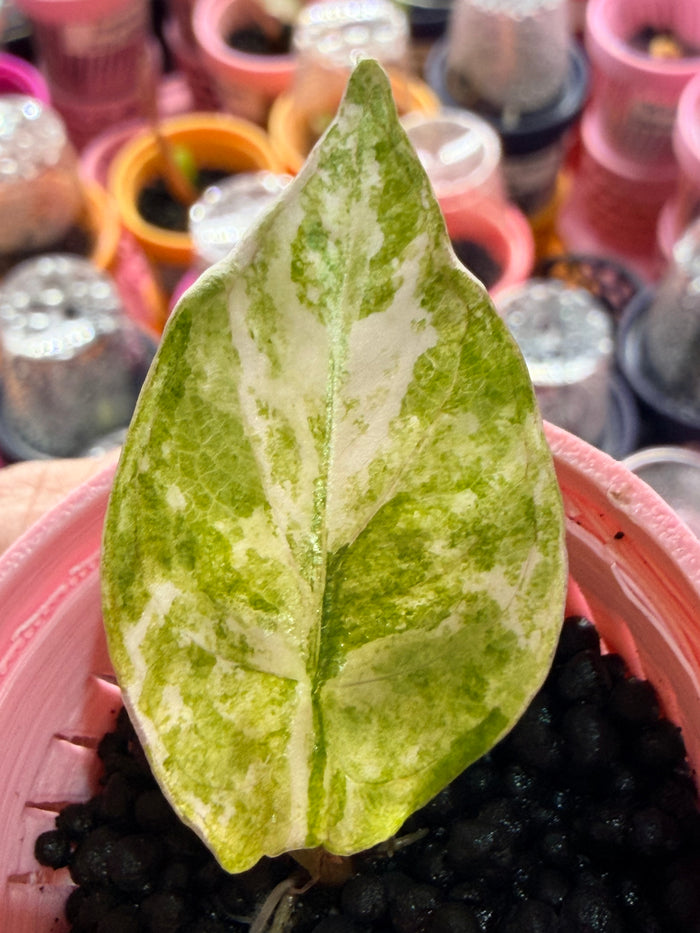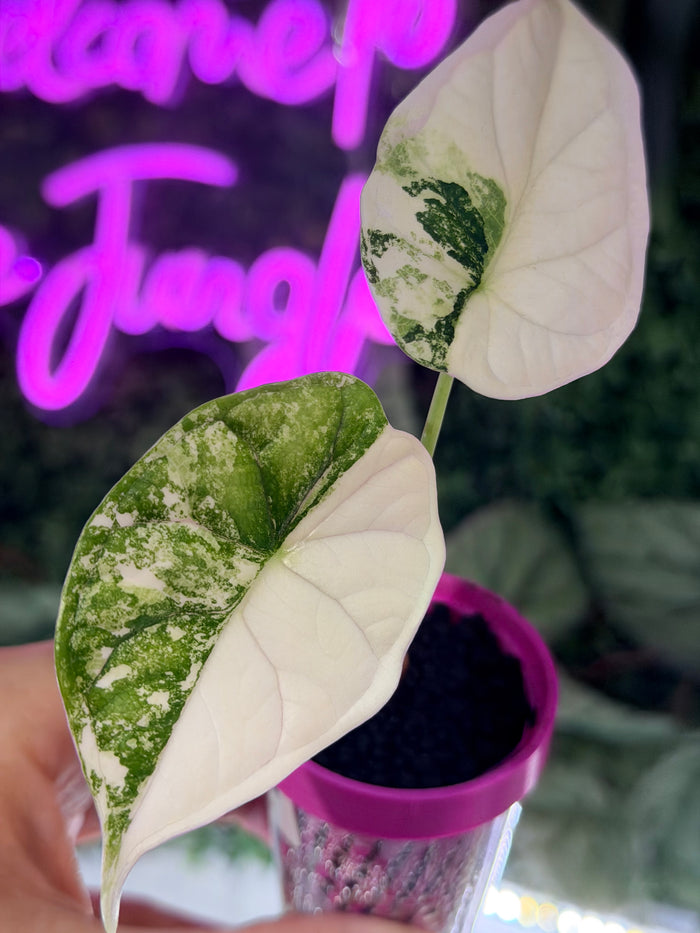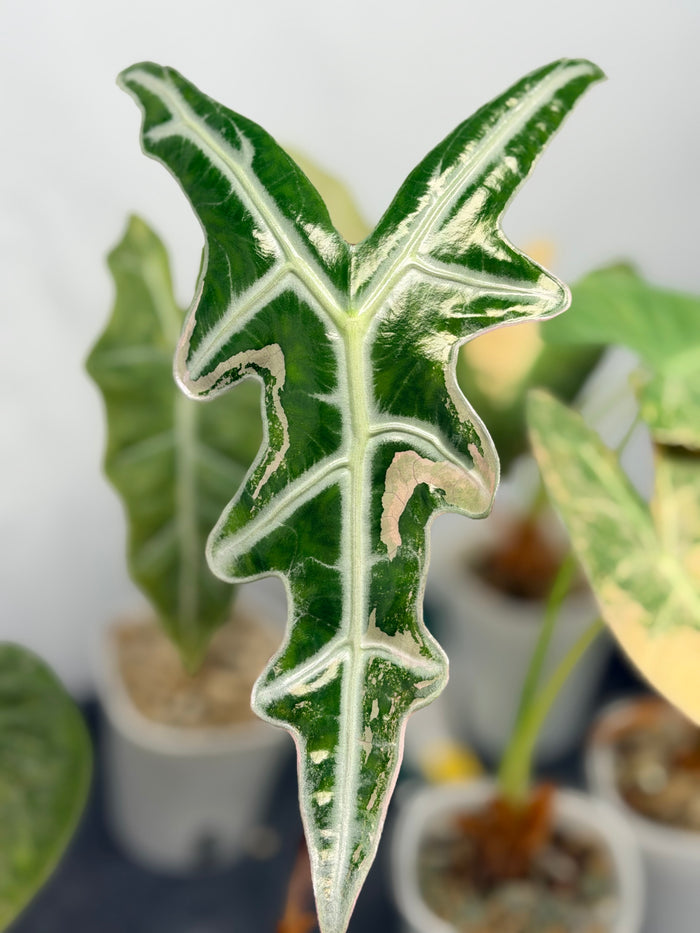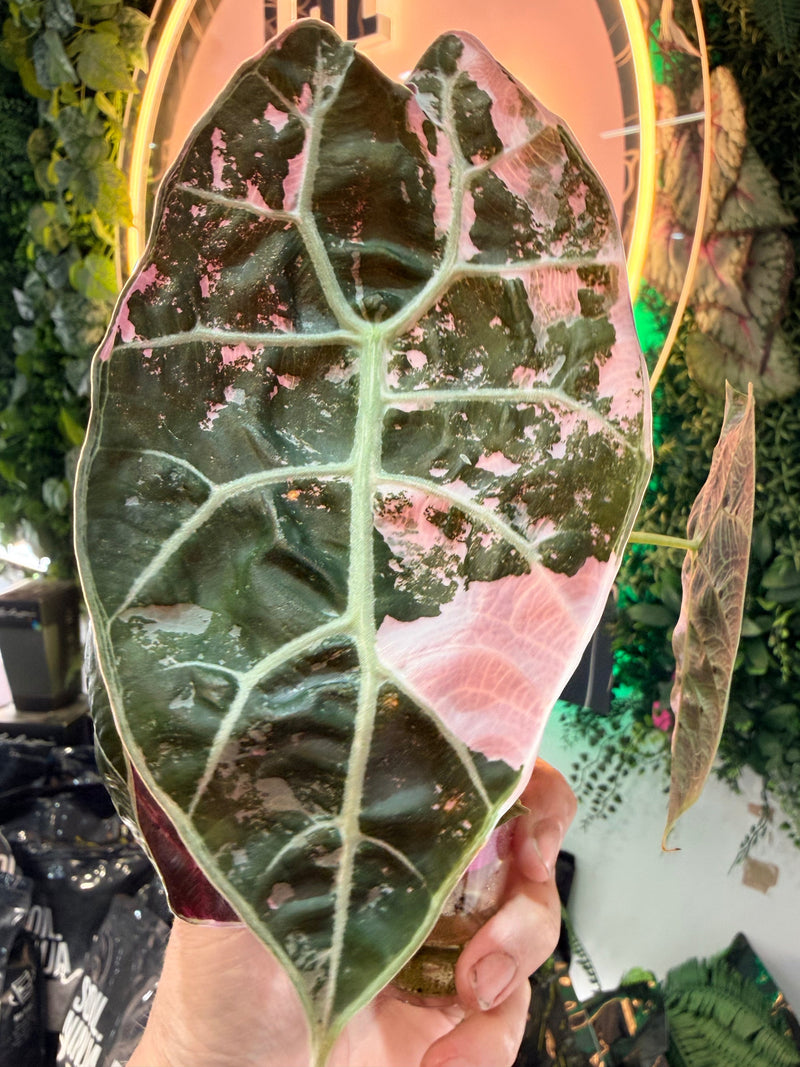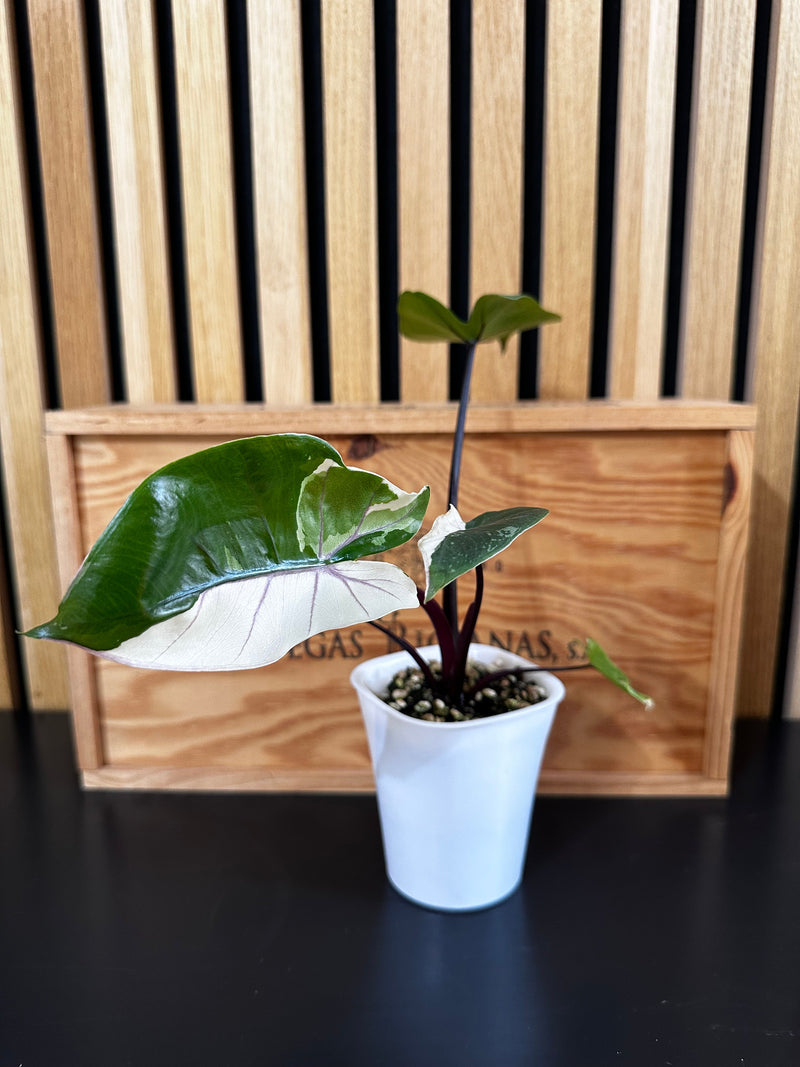

Few Alocasia cultivars manage to combine two genuinely distinct and remarkable characteristics in a single plant with the elegance that Alocasia Pink Dragon Albo achieves. The base form, known simply as the Pink Dragon, already commands serious attention among collectors for its vivid pink petioles, deep glossy green foliage, silver venation and dramatic burgundy leaf undersides. Add chimeric albo variegation to that foundation, and you have a collector specimen of an entirely different order: a plant where the structural drama of its petioles and the rarity of its white sectors create a visual tension that is, quite simply, extraordinary.
This guide covers everything a serious collector needs to understand about Alocasia Pink Dragon Albo, its origins, the botanical background of the base cultivar, the science behind its albo variegation, and the specific care requirements for maintaining both the plant's health and the integrity of its colour expression. If you are considering adding this specimen to your collection, or if you already own one and want to understand it more thoroughly, read on.
The Pink Dragon: Origins and Botanical Background
Understanding the Pink Dragon Albo requires first understanding the Pink Dragon itself, and that history is more complicated than many collectors realise. The cultivar now sold across Europe under the name 'Pink Dragon' was originally introduced in Thailand and the United States under the name Alocasia 'Aurora'. It entered the US market in the early 2000s as part of a breeding programme and was later rebranded for the European market as 'Pink Dragon', a name that captures both its vivid petiole colouration and the dragon-like quality of its deeply veined, structured foliage.
Botanically, the Pink Dragon is linked to the Alocasia longiloba complex, a group of Alocasia species whose wild relatives are distributed across tropical South-East Asia, principally Malaysia, Borneo, and the Philippines. The longiloba complex is characterised by elongated, arrowhead-shaped foliage with pronounced primary venation, and this lineage is clearly visible in the Pink Dragon's leaf architecture: the blade is broadly ovate with defined anterior lobes, the venation is prominent and silvery on the upper surface, and the overall posture is upright and architectural. The compact habit, typically 50-80cm in height with a 30-50cm spread, makes it ideally suited to indoor cultivation, and it is this combination of visual impact and manageable scale that drove its popularity as a collector plant.
The Pink Dragon should not be confused with the Alocasia baginda cultivars, Silver Dragon, Dragon Scale and their relatives, which represent an entirely separate species complex. The baginda cultivars are jewel Alocasia with distinctively textured, armour-like foliage; the Pink Dragon sits in its own lineage with a different leaf texture, different petiole character, and different growth habit. This distinction matters for collectors because it affects care requirements, propagation characteristics, and the way the plant responds to environmental conditions. You will find our full rare and exotic Alocasia collection includes representatives from multiple lineages, each with their own distinct character.
What Makes the Albo Form Exceptional
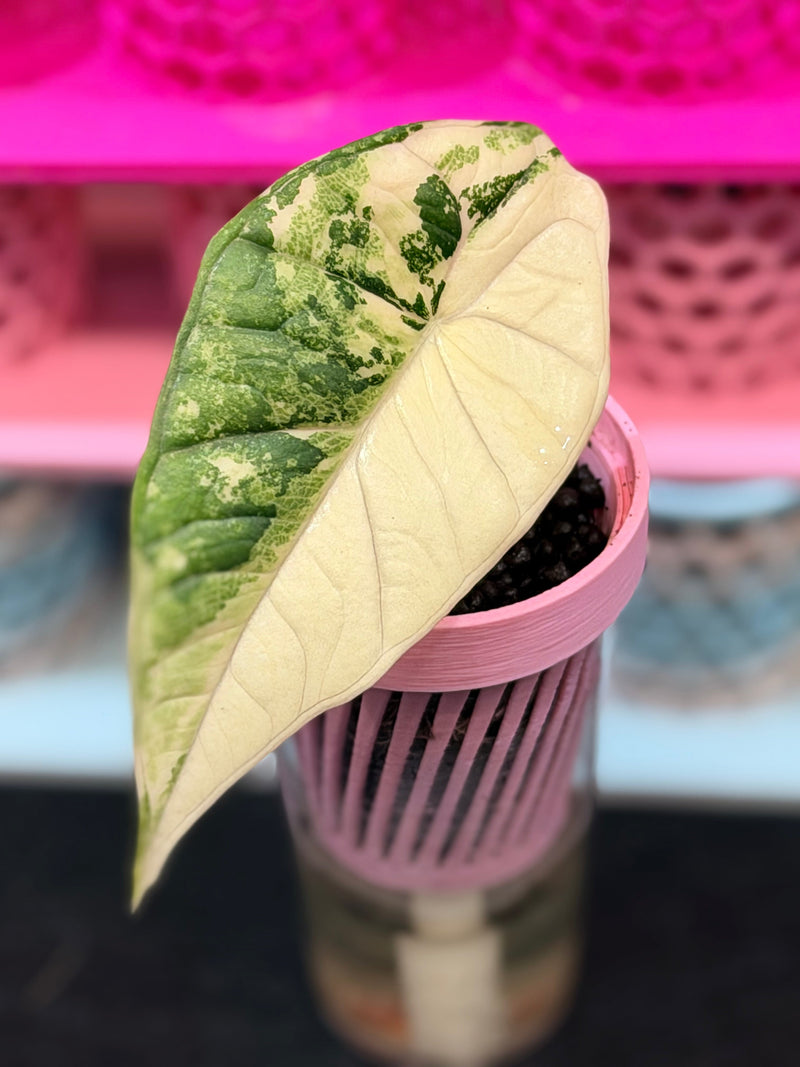
Albo variegation in Alocasia is a chimeric condition, a spontaneous genetic mutation affecting the chloroplast genome in such a way that certain cell lineages lose the ability to produce chlorophyll. The result is sectors of white or cream tissue alongside normally pigmented green tissue. In the Pink Dragon Albo, this already distinctive base cultivar carries that chimeric mutation, meaning that the white sectors appear against the deep green of the blade whilst the vivid pink petioles and silver primary venation remain fully intact. The visual contrast is remarkable: white sectors against near-black green foliage, bounded by silver venation, with a pink stem rising from the soil.
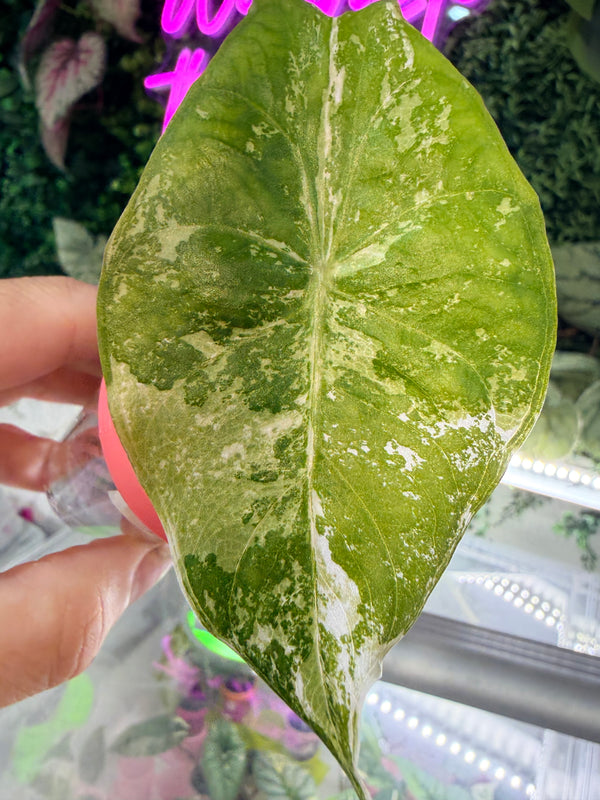
The nature of chimeric albo variegation is inherently unpredictable. Because it arises from cellular mutation rather than from stable genetic inheritance, no two leaves will display the same pattern of white and green tissue. Some leaves may carry broad white sectors, occasionally covering a third or more of the blade. Others may show fine white streaking or smaller irregular patches. And some leaves, particularly during periods of rapid growth or environmental stress, may emerge predominantly green with only minimal white expression. This unpredictability is not a defect; it is the fundamental character of albo variegation, and collectors who understand this embrace the variation rather than seeking uniformity.
What distinguishes the Pink Dragon Albo from other albo Alocasia in terms of collector appeal is the layering of rare characteristics. Most albo Alocasia express their variegation against a straightforwardly green base. In this cultivar, the base is already unusual, dark, glossy, structured, with pink stems and burgundy undersides. The albo sectors read differently against this background than they would against the matte green of a Frydek or the simpler leaf architecture of an Amazonica. The result is a plant that rewards close attention: the more you look, the more you notice.
For a deeper understanding of how albo variegation works at a cellular level, our complete guide to Alocasia variegation types covers the mechanisms in full, from the chimeric mutation itself to the factors that influence sector size and distribution.
Acquiring a Pink Dragon Albo: What to Look For
Because albo variegation is unstable and cannot be reliably produced from seed, every Pink Dragon Albo specimen is a product of vegetative propagation, division of an existing variegated plant. This limits supply significantly, and it means that the plants available in the market range considerably in quality of variegation expression.
When evaluating a Pink Dragon Albo for your collection, the key considerations are: the current state of variegation, the overall health of the plant, and, where visible, the growth point. A plant with a single highly variegated leaf may be in the process of reverting toward greener growth, or it may simply have produced one exceptional leaf among consistently variegated new growth. Wherever possible, ask to see multiple consecutive leaves or recent growth history before committing. A plant that has produced three or four leaves with consistent white sectors is a more reliable collector specimen than one that has produced a single standout leaf and nothing else noteworthy since.
Root health matters too. The Pink Dragon is more susceptible to root rot than many of the harder, more drought-tolerant Alocasia species. Any plant showing yellowing lower leaves, soft petioles, or a musty smell at the base should be approached with caution regardless of how impressive its variegation appears. Our complete guide to Alocasia root rot explains what to look for and how to assess root health before purchase.
We offer our own Alocasia Pink Dragon Albo specimens through our drop model, releasing limited quantities to our subscriber list with early access before any public availability. If you are not already on our list, you can join the collector drop list to be notified of upcoming releases.
Light Requirements: Getting the Balance Right
The Pink Dragon Albo has more nuanced light requirements than the standard form, and understanding why is important for long-term success. The white sectors in chimeric albo variegation contain no chlorophyll, they cannot photosynthesise. This means the green portions of each leaf carry the full metabolic burden of the plant, and those green sectors need to be working efficiently to support healthy growth. Insufficient light reduces photosynthetic output from the already-limited green tissue, leading to slower growth, smaller leaves, and increased risk of variegation instability as the plant prioritises survival over colour expression.
Bright, filtered indirect light is the appropriate target. In practical terms for UK growing, this means a position within one to two metres of an east- or west-facing window, where the plant receives good ambient light without direct sun exposure. South-facing windows can work if the direct sun is filtered by a sheer curtain or the plant is positioned to the side of the window rather than directly in front of it. North-facing positions are generally insufficient, particularly where ambient light levels are low.
Supplementary LED grow lights are strongly recommended for UK collectors. A full-spectrum LED at 10,000-15,000 lux, run for 12-14 hours per day, will sustain the plant without the growth stall that inadequate natural light causes. More importantly for the albo form, consistent light levels help maintain variegation stability, sudden drops in light availability can prompt the plant to push greener growth as a survival response.
Direct sun exposure, even for short periods, risks scorching the white sectors. Because the white tissue contains no chlorophyll to buffer incoming light energy, it is far more vulnerable to heat and UV damage than green tissue. A single afternoon of direct sun can cause brown, papery patches on white sectors that were perfectly healthy the day before. Position accordingly.
Temperature and Humidity: Matching the Plant's Origins
The Pink Dragon's origins in the tropical forests of South-East Asia, via its longiloba-complex ancestry, tell you a great deal about its environmental preferences. These are plants from habitats characterised by consistent warmth, high ambient humidity, and relatively stable seasonal temperatures. Replicating those conditions in a UK home requires deliberate effort.
Temperature should be maintained between 18-27°C throughout the year, with a minimum of 15°C. The Pink Dragon is not frost tolerant and will begin to suffer below 13°C, so any cold draughts from windows, external doors, or poorly insulated walls represent a genuine risk. A heat mat positioned beneath the pot can maintain substrate temperature, which matters for root health even when air temperatures remain acceptable.
Humidity is the more challenging variable for UK collectors. The Pink Dragon prefers ambient humidity of 60-80%. Most UK homes, particularly with central heating, sit at 30-50%, significantly below optimal. The consequences of inadequate humidity are predictable: crispy leaf edges, browning on white albo sectors (which are more susceptible than green tissue), and reduced growth rate. A dedicated ultrasonic humidifier is the most reliable solution for an indoor collection, set to maintain humidity above 60%. Grouping plants together helps create a more humid microclimate, and placing the pot on a pebble tray filled with water (ensuring the pot base does not sit in the water) provides additional localised humidity.
Avoid misting directly onto the leaves. Misting creates wet spots that remain on the leaf surface, particularly on the textured undersides, and these wet spots are ideal environments for fungal colonisation. Ambient humidity management is always preferable to direct leaf wetting.
Substrate and Potting: Giving the Roots What They Need
The Pink Dragon's roots need excellent aeration and drainage. This cultivar's susceptibility to root rot means that any substrate which retains excessive moisture around the roots, or any pot that cannot drain freely, creates conditions where Pythium and Phytophthora root rot pathogens can establish and spread. Getting the substrate right from the start is far easier than treating root rot after the fact.
We recommend Fluval Stratum as the primary growing medium for Pink Dragon Albo. This volcanic substrate provides excellent aeration, maintains moisture without waterlogging, and supports the slightly acidic pH (5.5-6.5) that Alocasia roots prefer. Its granular structure creates the air pockets that Alocasia roots need for healthy respiration, and it resists compaction over time, a common problem with peat-based mixes that begin breaking down within months of use.
For established plants, our Lechuza self-watering planter system works well with Pink Dragon. The sub-irrigation approach delivers water from below, keeping the substrate consistently moist without the wet-dry cycling that can stress the plant. The Lechuza PON substrate is specifically formulated for use in these self-watering systems and provides excellent drainage characteristics.
Pot selection matters too. Terracotta pots offer good breathability and help prevent waterlogging through evaporation from the pot walls, but they dry out faster in centrally heated UK homes. Plastic or glazed ceramic pots retain moisture longer, which suits the Pink Dragon's preference for consistently moist (not wet) substrate. Whatever material you choose, ensure the pot has adequate drainage holes and never allow the plant to sit in standing water in a saucer.
Repot when the plant becomes clearly rootbound, visible roots emerging from drainage holes or a noticeably decreased rate of substrate drying between waterings are good indicators. The ideal time to repot is when the plant is entering an active growth phase, as root disturbance is recovered from most quickly. Size up by only one pot size at a time; excessively large pots retain more moisture than young or recovering roots can utilise, increasing rot risk.
Watering: The Most Common Source of Problems
More Pink Dragon plants are lost to overwatering than to any other cause. Understanding how to water correctly is therefore one of the most important skills for any collector growing this cultivar.
The approach is straightforward: water when the top 2-3cm of substrate has dried out, and water thoroughly until water flows freely from the drainage holes. This complete wetting followed by a period of partial drying mimics the rain-and-dry-period cycle of the plant's native habitat far more accurately than frequent, light watering. Never allow the plant to sit in standing water, remove any excess from the saucer promptly.
In practice, in a UK home, this typically means watering every 7-10 days. When growth slows significantly and evapotranspiration rates drop, you may water every 14-21 days or even less frequently. The key is always to check the substrate rather than follow a fixed schedule, different pot sizes, substrate types, temperatures, and humidity levels all affect how quickly the substrate dries.
Use room-temperature water rather than cold tap water. Cold water can shock the roots, which are accustomed to the relatively stable substrate temperatures of their tropical native habitat. If your tap water is heavily chlorinated, leaving it in an open container for 24 hours before use allows much of the chlorine to dissipate, which is gentler on the beneficial microbial communities in your substrate.
Feeding the Pink Dragon Albo
Feeding an albo variegated Alocasia requires a slightly different approach than feeding a fully green specimen. Because albo plants have reduced photosynthetic capacity, the white sectors produce no energy, they can be more sensitive to nutrient imbalances, particularly excess nitrogen, which promotes rapid green growth at the expense of variegation.
Feed at approximately half the recommended strength of your regular balanced liquid fertiliser, applied every 2-3 weeks. This gentler approach sustains healthy growth without overwhelming the plant's reduced metabolic capacity. Our plant feed collection includes options well suited to the Pink Dragon's needs.
Reduce feeding significantly when the plant's growth slows and nutrient uptake drops correspondingly. Continuing to feed at full rates when growth has slowed can lead to salt build-up in the substrate, which damages roots over time.
Calcium and magnesium are particularly important micronutrients for Alocasia. If you notice pale, interveinal yellowing on newer leaves, a symptom of magnesium deficiency, a CalMag supplement added to your regular watering regime will address this. CalMag is especially useful in areas where tap water is soft, as soft water naturally contains low levels of these minerals.
Maintaining Variegation: What Actually Works
This is the question every albo collector asks eventually: can variegation levels be maintained or improved through care practices? The honest answer is nuanced. You cannot create variegation where there is none, the chimeric mutation either exists in the cellular lineage or it does not. What you can do is create the conditions that prevent reversion and support the plant in expressing whatever variegation potential it carries.
Consistent, adequate light is the most important factor. Plants kept in low light tend to push greener growth as a survival adaptation, green sectors photosynthesise more efficiently, and under stress the plant effectively prioritises survival over colour expression. Maintaining bright indirect light year-round, with LED supplementation, gives the plant no metabolic reason to favour greener growth.
Avoid over-fertilising. High nitrogen inputs drive rapid vegetative growth, and rapid growth tends to produce less variegated tissue than slower, steadier growth. Patience with feeding schedules pays dividends in variegation quality over time.
Temperature stability matters too. Significant temperature fluctuations, cold nights followed by warm days, stress the plant in ways that can trigger greener, less variegated growth. Consistent warmth within the 20-25°C range supports both plant health and variegation stability.
Finally, if a new leaf emerges that is predominantly or entirely green, do not panic. This is normal behaviour in chimeric albo plants, and it does not indicate that the plant is reverting permanently. Monitor the next two or three leaves; if variegation returns, the chimeric state is stable. If four or more consecutive leaves emerge without any white sectors, you may be dealing with a genuine reversion, and removing the fully green growth point (if the plant has multiple growth points) can sometimes encourage the variegated portions to continue developing.
Propagation: Understanding the Constraints
Propagating Pink Dragon Albo presents specific challenges that collectors should understand before attempting. Because the albo variegation is chimeric, arising from a genetic mutation in the cellular lineage rather than from a stable heritable trait, it cannot be reliably reproduced from seed. Seeds from a chimeric albo parent will almost always produce fully green offspring. Maintaining the variegation requires vegetative propagation: division of the rhizome, offset separation, or, in specialist tissue culture operations, careful micro-propagation from variegated tissue.
Division is the most accessible approach for home collectors. When the mother plant has produced offsets, small daughter plants growing from the base, these can be carefully separated once they have developed their own root system. The variegation of offsets is not guaranteed to match the parent: some offsets from a highly variegated mother will express strong variegation themselves; others may be minimally variegated or fully green. This unpredictability is inherent to chimeric propagation and should be expected rather than treated as a propagation failure.
Corm propagation is possible for the standard Pink Dragon and for mildly variegated specimens, but the chimeric nature of albo variegation means that corms harvested from a Pink Dragon Albo are more likely to produce green offspring than consistently variegated ones. Our Alocasia corm collection focuses on cultivars where corm propagation reliably expresses the parent's characteristics.
Common Problems and How to Address Them
Beyond root rot and variegation instability, covered above, the Pink Dragon Albo faces a handful of other common challenges that collectors should be aware of.
Spider mites are the most prevalent pest issue. They thrive in the warm, dry conditions that UK centrally heated homes create, and they are particularly damaging on the thin-textured leaves of the Pink Dragon. Inspect the undersides of leaves regularly, particularly along the petiole attachment points, for the characteristic fine webbing. Early detection allows treatment with neem oil or a quality insecticidal soap before populations establish. Our pest control range includes effective options for addressing spider mite and other common aroid pests.
Thrips cause characteristic silver streaking on leaf surfaces, often mistaken initially for variegation. On close inspection, thrips damage has a different texture and distribution to genuine albo sectors; it tends to appear as scratched or burnished areas rather than cleanly bounded white patches. Systemic treatment may be required for established infestations.
Yellowing leaves have multiple possible causes: overwatering (the most common), underwatering, low light, cold damage, or nutrient deficiency. Methodically work through each possibility rather than applying a blanket treatment. The most useful diagnostic step is always to check the roots first, healthy white or light tan roots indicate the issue lies above the substrate; brown, mushy roots confirm overwatering or root rot as the primary problem.
Crispy leaf edges on the white sectors specifically are almost always a humidity issue. The white tissue is more susceptible to desiccation than green tissue, and low ambient humidity shows up there first. Increase humidity and the problem typically resolves in subsequent new growth, though damaged leaves will not repair themselves.
The Pink Dragon Albo in Your Collection Context
The Pink Dragon Albo occupies a specific and valuable niche in a collector's Alocasia collection. It is not the most dramatic of the albo Alocasia, that distinction belongs to cultivars where the entire leaf surface is more dramatically sectored. But it is arguably the most visually complex: a plant where pink stems, green and white bladed foliage, silver venation, and burgundy undersides all contribute to an effect that rewards sustained observation.
Paired with other members of our albo variegated Alocasia collection, the Frydek Albo, Sinuata Albo, Dragon Scale Albo, it represents a distinct lineage and character within the albo collecting world. Paired with the standard Pink Dragon or the Pink Dragon Aurea, it demonstrates how dramatically variegation transforms a base cultivar's visual impact.
We release Pink Dragon Albo specimens through our drop model, with subscriber list members receiving early access before any wider availability. If you are serious about acquiring one, the best approach is to join our collector list, where drop announcements go out to subscribers first.
Questions about the Alocasia Pink Dragon Albo, albo variegation care, or building your rare Alocasia collection? Contact our team for expert guidance from specialists who grow and assess variegated Alocasia daily in our UK-based private nursery. We are here to support collectors at every stage, from first acquisition to advanced collection management.
From the nursery