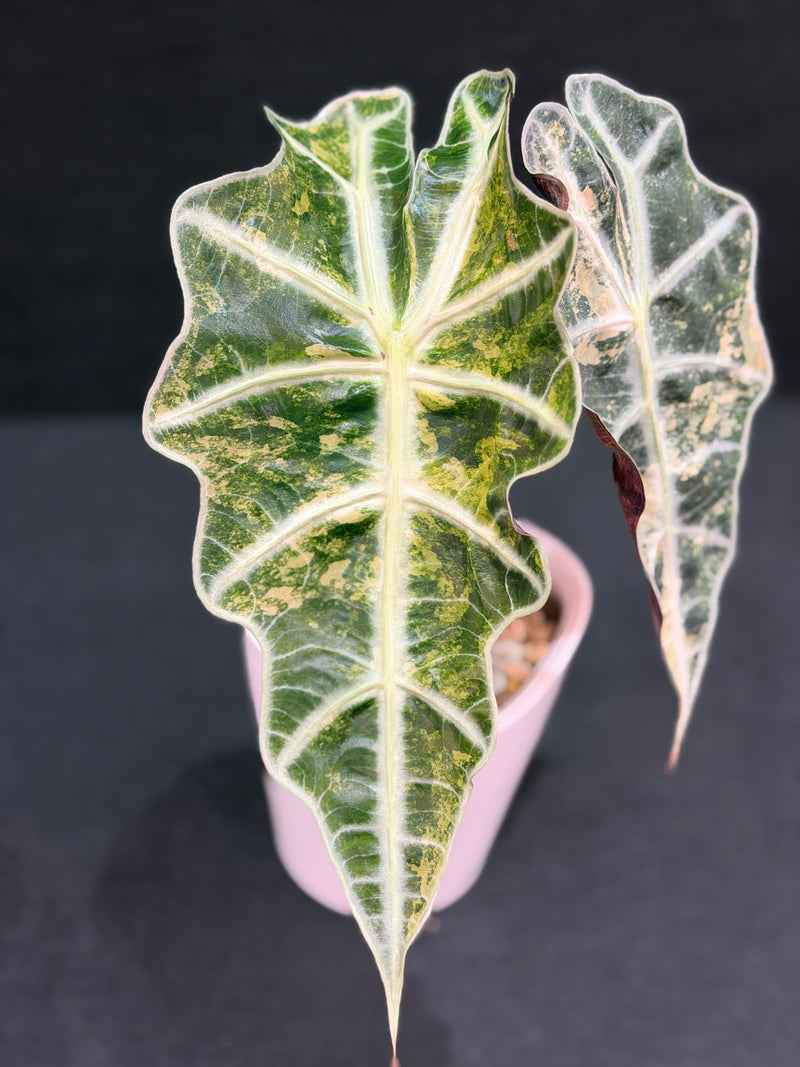

Not every collector plant needs a centuries-long botanical pedigree or a formal species description to earn its place. Alocasia 'Bambino' is a case in point, a Dutch cultivar introduced around 2008, most likely a hybrid or mutation involving Alocasia longiloba, that took the dark-green, white-veined aesthetic of the Amazonica family and compressed it into one of the most manageable sizes available in the genus. Where Alocasia 'Amazonica' and 'Polly' make medium-scale demands on growing space, Bambino offers the same architectural leaf character at a scale that fits a shelf, windowsill, or compact growing area without sacrifice of visual impact.
Aroidpedia documents 'Bambino Arrow', the closely related cultivar name, as a Dutch introduction circa 2008, likely a cross or mutation of Alocasia longiloba, with Bloemenbureau Holland having made early mention of the plant. The Bambino sold in the UK market relates to this same origin, with the slender, arrow-shaped leaves, dark green with prominent white venation, purple-flushed abaxial surfaces, and compact rosette growth habit that characterise the Dutch-developed cultivar.
This guide covers the longiloba and Amazonica family background that sits behind Bambino, the compact cultivar's distinctive character, and complete UK care guidance.
The Background: Amazonica Family and longiloba Heritage
Why Bambino Looks Like Amazonica
Alocasia 'Bambino' carries the visual signature of the Amazonica family, dark metallic green leaves with prominent white to silver venation and deeply lobed margins, because it shares either parentage or very close ancestry with that family. Aroidpedia documents Bambino Arrow as "likely an Alocasia longiloba cross", placing it within the same genetic framework as the longiloba × sanderiana cross that produced 'Amazonica'. The cross of longiloba with various partners consistently produces leaves in this aesthetic register: glossy-to-semi-matte dark green, white veination, deep lobing, purple or reddish abaxial surfaces.
The difference between Bambino and the standard Amazonica or 'Polly' forms comes primarily from scale and leaf proportions. Bambino produces narrower, more elongated arrow-shaped leaves rather than the broader, more ovate blades of 'Amazonica'. The compact rosette habit, typically 30 to 45 cm in height, reflects either the longiloba parentage expressing in smaller form, or a deliberate selection from tissue culture for compact growth.
The Amazonica Hybrid Family Context
The longiloba × sanderiana cross that produced Alocasia 'Amazonica' has been one of the most productive genetic pairings in the genus. Aroidpedia documents the family: 'Amazonica' by Salvadore Mauro at Amazon Nursery in 1950s Florida, 'Polly' by Bill Rotolante as a polyploid mutant, 'Purpley' as a colour variant, 'Venom' as a morphological mutation by Mason Lee, 'Jean Merkel' as an independently created version of the same cross, and now the Dutch Bambino forms as a more recent expression of longiloba genetics in compact form. Each represents a different facet of what the same essential genetic combination can produce.
Understanding this heritage makes Bambino a more interesting plant to own. It is not simply a small decorative Alocasia; it is an expression of one of horticulture's most productive aroid crosses, packaged in compact form by Dutch growers who recognised that not every collector has the space or growing conditions for a plant that reaches 90 cm.
The Cultivar: Bambino Character
Physical Characteristics
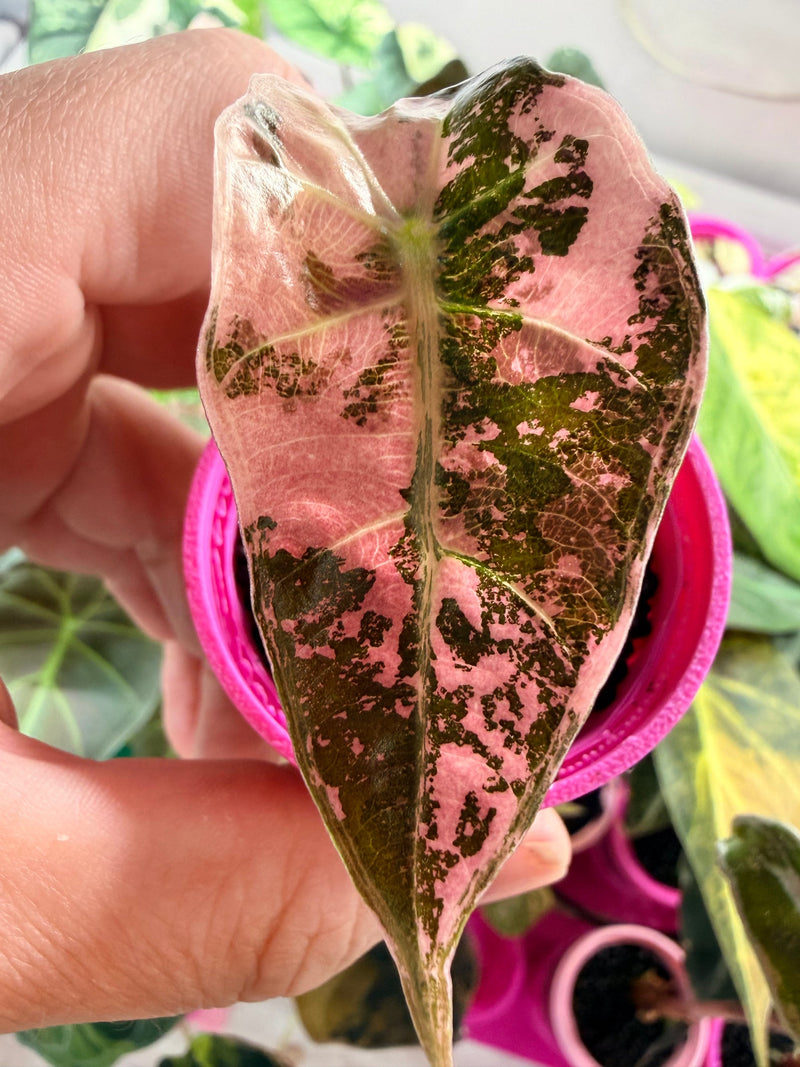
The leaves of Bambino are narrower and more elongated than 'Polly', distinctly arrow-shaped rather than broadly ovate, giving the plant a slightly more refined, less aggressive silhouette. The dark green adaxial surface carries prominent white primary venation, with the marginal areas of the blade also white. The abaxial (underside) surfaces are deep purple, a characteristic shared with 'Amazonica' and 'Polly' that reflects the longiloba/sanderiana genetic heritage.
Growth habit is compact rosette, typically 30 to 45 cm in height, with leaves emerging from a central rhizome system. Each leaf is proportionate to the overall plant scale, smaller than 'Polly' individually, but held with the same architectural upright character. The plant does not sprawl; it grows as a neat, organised display of successive leaves from a central point.
Aurea Variegated Form
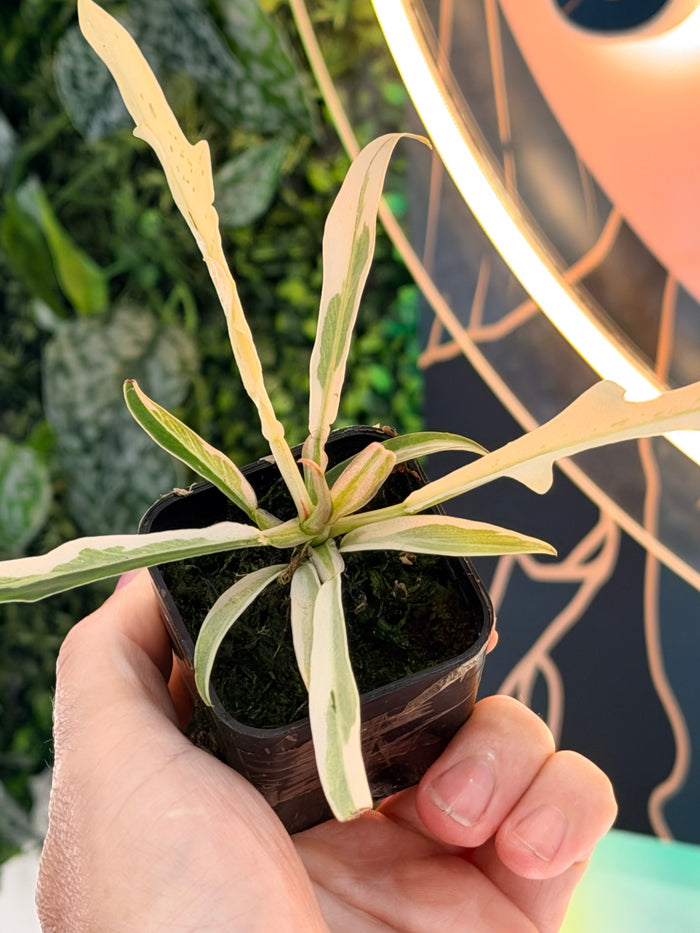
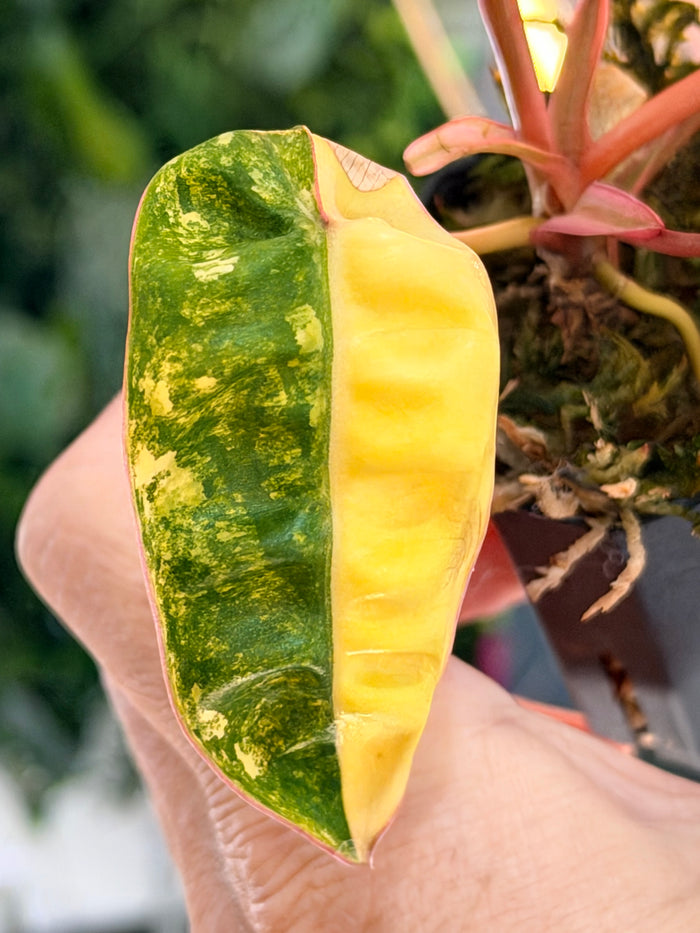
An aurea (golden) variegated form of Bambino is available in our collection, the Alocasia Bambino Aurea, which applies golden-yellow chimeric variegation to the compact dark blade. Against the white venation of the base plant and the dark green background, aurea variegation adds warmth and complexity to a plant that already carries high visual contrast in its standard form.
Growing Alocasia Bambino in the UK
Light
The longiloba / Amazonica family background indicates adaptation to filtered tropical forest light, the same ecological setting as most of the Philippine and Southeast Asian Alocasia. Bright indirect light from a south or east-facing window, or supplemented with LED grow lights through UK winter, is ideal. Bambino handles lower light conditions somewhat more tolerantly than the specialist jewel forms, as the unvariegated form has fully functional photosynthetic capacity across the entire leaf. Even so, inadequate light leads to progressively smaller, less well-developed leaves and reduced growth momentum.
Substrate and Watering
The compact size of Bambino makes substrate choice particularly important, a small plant in oversized substrate with excess moisture retention is more vulnerable to root rot than a larger plant in the same conditions. Fluval Stratum in an appropriately proportionate pot provides the drainage and aeration the Amazonica family root system requires. Allow the top 2 cm to dry between waterings; the small root mass means moisture is retained longer than in larger specimens.
Temperature and Humidity
The longiloba and Amazonica care range, 18 to 27°C and 60 to 75 percent humidity, applies. Bambino is among the more adaptable of the collector Alocasia in UK home conditions, sharing the commercial robustness of the Amazonica family. Cold draughts remain the primary risk. During UK winter, reduce watering frequency and maintain minimum root zone temperature above 15°C.
Dormancy and Propagation
Bambino may enter a resting period through UK winter, shedding leaves and appearing to die back to the rhizome. The corm remains viable and will regrow when conditions improve. Do not discard a dormant plant. Propagation via offsets and corms is straightforward, the compact growth form means new offsets are produced reliably from the rhizome base. Our Corm Keeper propagation system supports corm germination for compact Alocasia types.
Collector Context
Bambino occupies a specific practical niche, maximum visual impact per unit of space. For collectors in limited growing environments, or for those building a diverse collection that benefits from scale variety rather than uniformity, Bambino provides the Amazonica family aesthetic at a scale that allows multiple specimens to coexist comfortably where a single 'Polly' might otherwise dominate. Alongside the Alocasia Amazonica parent type and the Alocasia Venom mutation, it represents the range that one productive genetic combination has produced across different growers and growing contexts.
Questions about Alocasia Bambino, the Amazonica family, or compact Alocasia care in UK conditions? Contact our team for guidance from specialists at our UK-based private nursery.