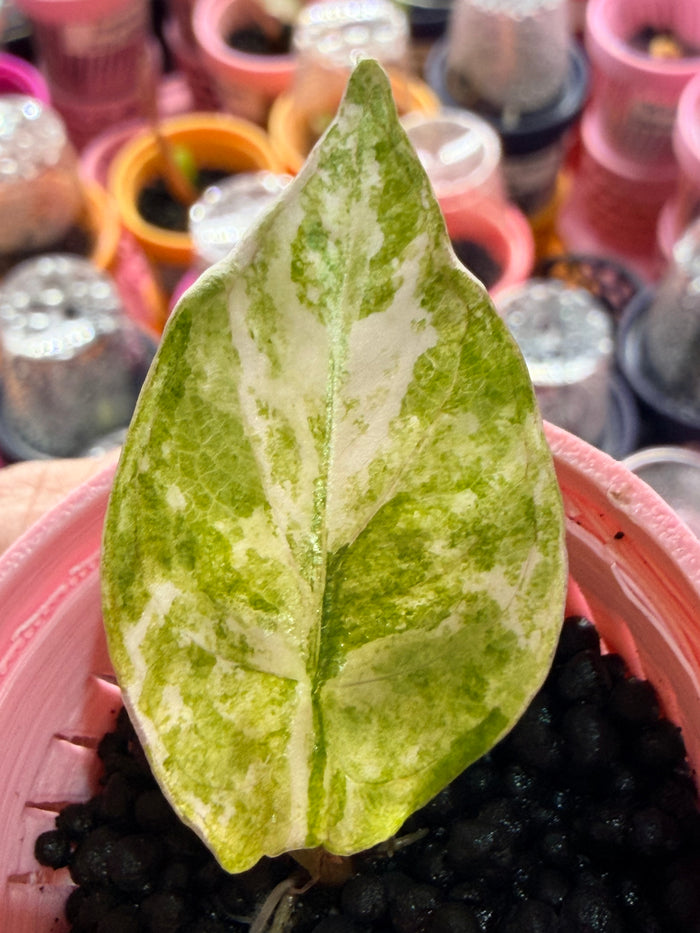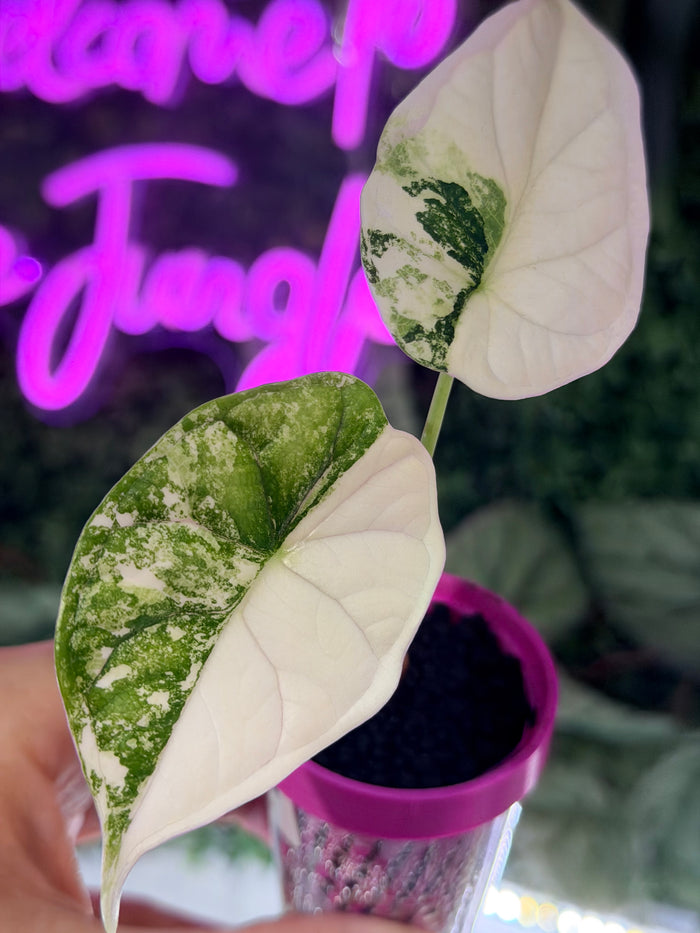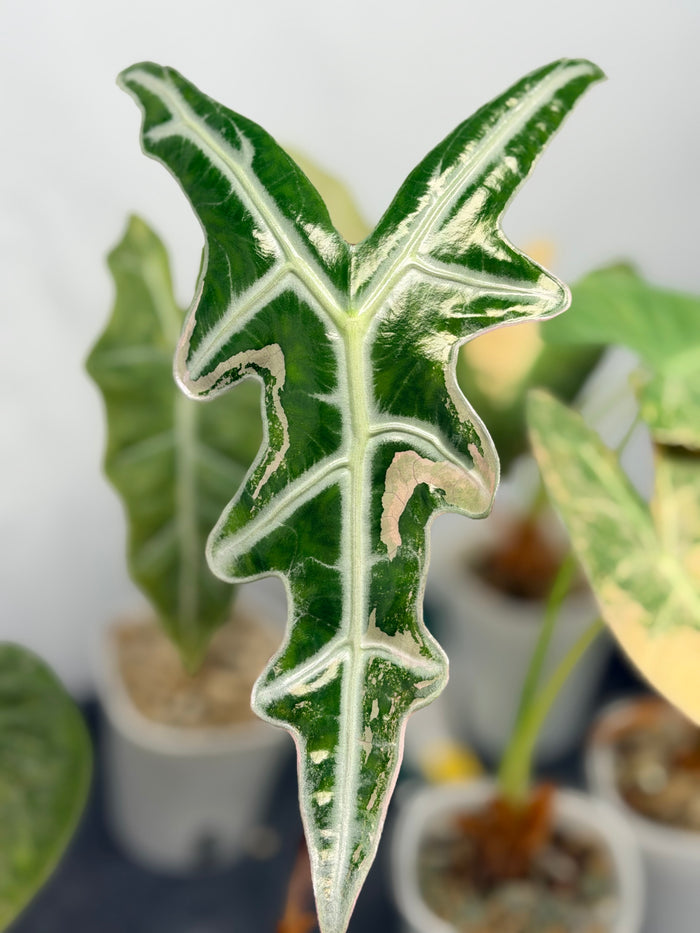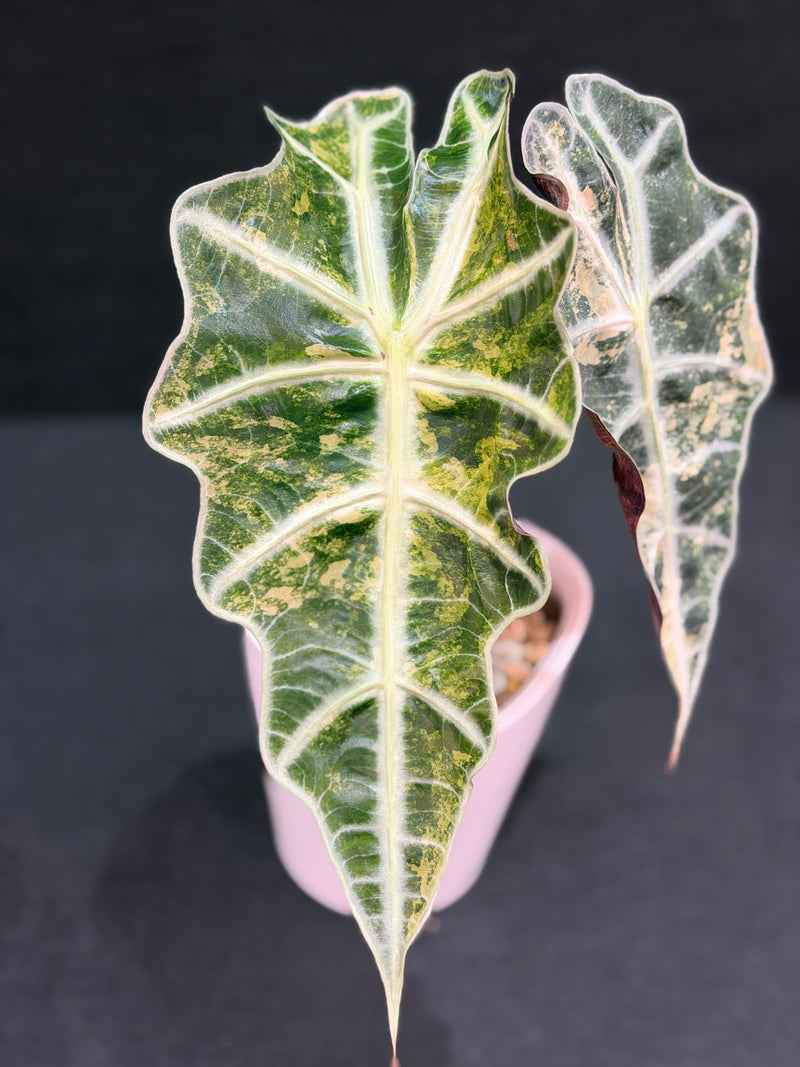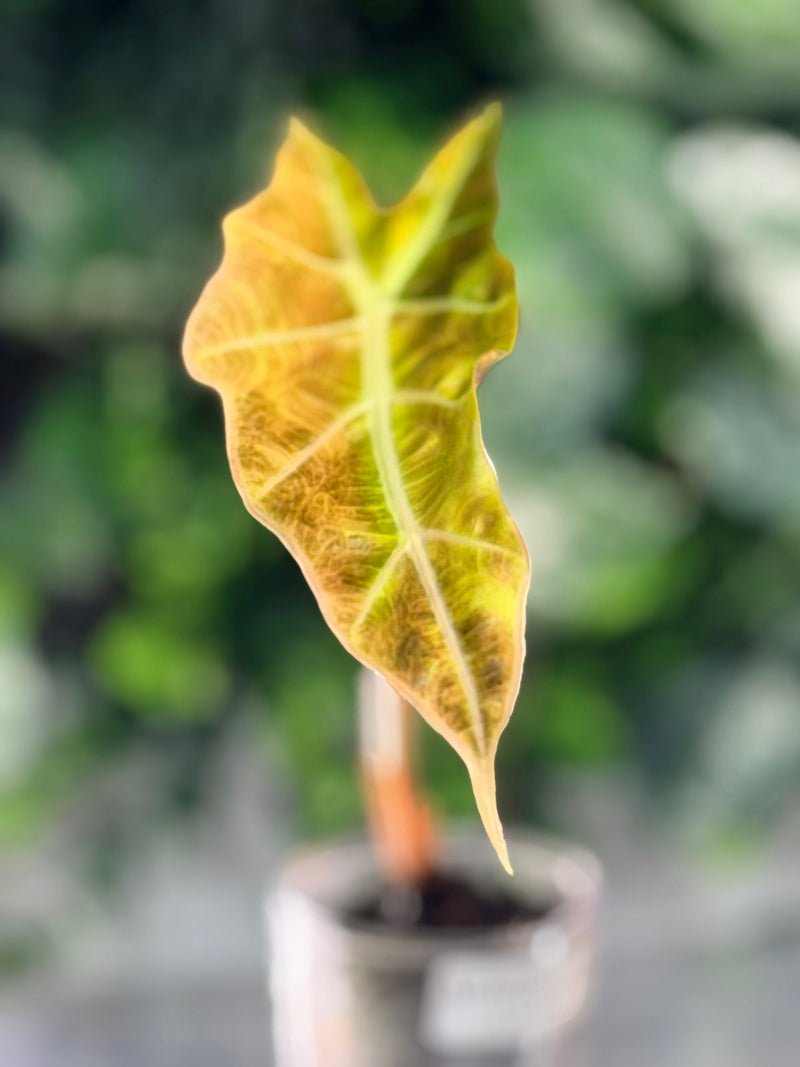

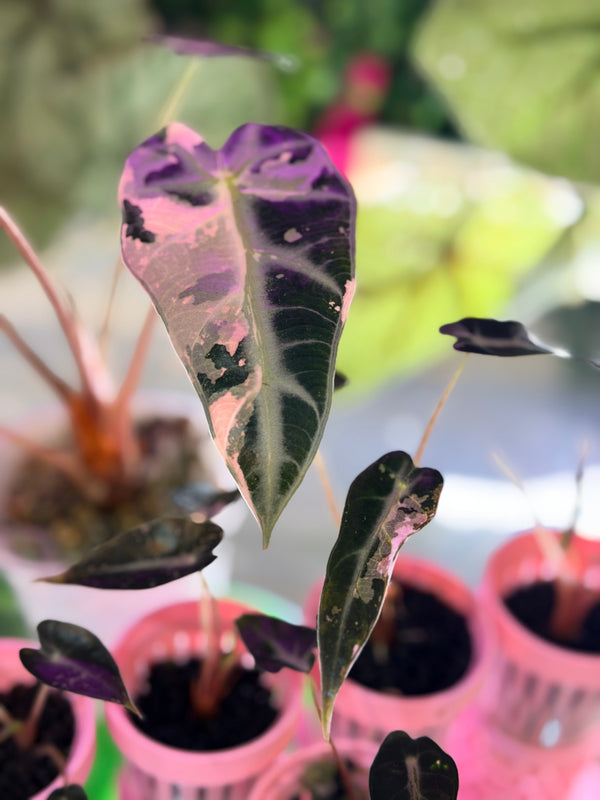
Alocasia Bambino Pink Variegated sits at a fascinating intersection in the rare plant world, it carries the compact, refined form of the beloved Bambino Arrow cultivar, elevated by one of the most sought-after and biologically unusual expressions in the entire genus: genuine, stable pink variegation. For collectors who understand what that means, and for those just beginning to explore the deeper end of Alocasia collecting, this guide covers everything worth knowing about this extraordinary little plant.
Whether you've just secured one from our Alocasia Bambino Pink Variegated listing, or you're researching before committing to a purchase, what follows is a thorough account of this cultivar's origins, its botanical character, and precisely what it takes to keep it thriving in a UK home environment.
Origins and Botanical Background
The story of Alocasia 'Bambino Pink' begins with its parent cultivar, Alocasia 'Bambino Arrow', a compact Dutch selection introduced around 2008, believed to be a cross or mutation involving Alocasia longiloba, a Southeast Asian species known for its narrow, lance-shaped foliage and pronounced venation. Bloemenbureau Holland, the Dutch floral industry body, listed this cultivar under the name Alocasia 'Bambino Narrow', which reflects the plant's most immediately striking characteristic: those slender, elegantly tapering arrowhead leaves that set it apart from the broader-lobed Alocasia × amazonica 'Polly' that most people encounter first.
'Bambino' is Italian for 'small child' or 'little one', and the name is entirely apt. Where many Alocasia eventually demand serious vertical space, species like Alocasia macrorrhiza or even the mid-sized Alocasia zebrina can easily reach over a metre indoors, the Bambino Arrow cultivar tops out at around 30–40 cm, making it a genuinely practical choice for collectors working with limited shelf or cabinet space.
The 'Pink' designation refers to the variegated form of this cultivar, in which cells within the leaf tissue fail to produce chlorophyll in the normal way, instead expressing anthocyanin pigments that produce the distinctive pastel pink colouration. This is the same biological mechanism that drives pink variegation in other highly prized Alocasia, including the exceptional Alocasia Balloon Heart Pink Variegated, and it is precisely this rarity that makes stable pink expression so valuable in the collector market. For a deeper explanation of how and why this happens at the cellular level, our guide to pink variegation in Alocasia covers the science in full.
What Does the Bambino Pink Actually Look Like?
This is a plant that rewards close attention. The leaf blades are typically 15–18 cm long and around 5 cm wide, narrow by Alocasia standards, with a sharp, pronounced tip and gently undulating margins. The base of each leaf has the characteristic posterior lobes of the arrow or hastate leaf shape, framing the prominent central midrib and bold lateral venation that runs in vivid contrast to the darker leaf ground.
On a standard Bambino Arrow, that leaf ground is a deep, glossy bottle green, rich, almost lacquered in appearance, with bright white venation and a distinctly purple underside that collectors of this cultivar often find as appealing as the upper surface. In the pink variegated form, this baseline character remains, but the leaf canvas becomes something else entirely.
Patches of creamy white appear where chlorophyll is absent, this is the albo sector of the variegation, common to many multi-tonal variegated Alocasia. Where anthocyanin expression occurs alongside or independently of those chlorophyll-absent cells, the tissue takes on soft blush and pastel pink tones that range from barely-there watercolour washes to saturated, definite pink sectors depending on the individual plant and the conditions it's grown in. Each leaf that unfurls is genuinely unique. No collector owns exactly the same plant as any other.
The undersides of pink variegated leaves retain that characteristic purple flush, though in heavily variegated sections the colouration may be more muted. Overall, the effect is of extraordinary botanical complexity in a very small package, which is precisely why the Alocasia Bambino Pink Variegated commands genuine collector attention.
Why Pink Variegation Is Genuinely Rare
It's worth pausing here because the word "rare" is significantly overused in the houseplant market, often applied to anything that isn't stocked by the nearest supermarket. Pink variegation in Alocasia is rare in a more meaningful, biological sense, and understanding why helps collectors make sense of availability, pricing, and care requirements.
Most variegation in plants involves the absence of chlorophyll, the green photosynthetic pigment, in certain cells. This produces white or cream sectors (albo variegation) or, in the case of degraded chloroplasts, yellow-gold colouration (aurea variegation). Both of these occur through well-documented mechanisms that breeders and tissue culture labs have learned, to varying degrees, to work with. Our complete guide to Alocasia variegation types covers this in depth.
Pink variegation, however, involves the active expression of anthocyanins, pigments produced by a different metabolic pathway entirely. These pigments are produced in response to a complex interplay of genetic factors and environmental conditions, including light intensity, temperature fluctuation, and cellular stress responses. Because the expression depends on so many variables, stable pink tones are notoriously difficult to achieve consistently, plants that show excellent pink under one set of conditions may fade or shift under different growing environments.
This is why pink variegated Alocasia tend to command higher prices and more collector attention than equivalent albo or aurea forms. The colouration is genuinely harder to produce, harder to maintain, and far less predictable. When you acquire a Bambino Pink with strong, defined pink sectors, you're working with a plant that needs attentive, informed care to maintain that expression.
Light Requirements: The Single Most Important Variable
For Alocasia Bambino Pink Variegated, light is not just important, it is the primary environmental factor governing both plant health and the quality of pink variegation expression.
The Bambino Pink requires bright, indirect light. This means consistent illumination without any direct sun contact with the leaf surface. Direct sun exposure, particularly from a south or west-facing window, will scorch the leaves, the variegated sections, which lack the full protective pigment load of green tissue, are especially vulnerable. A south-facing windowsill is too much. A north-facing room with no supplemental lighting is not enough.
The practical sweet spot in a UK home environment is typically an east or west-facing windowsill where the plant receives good natural light for several hours without the intensity of peak midday sun. In a north-facing room, or wherever natural light levels are limited, supplemental LED grow lighting becomes important, not just for general health, but specifically to support anthocyanin expression and maintain the pink colouration. Insufficient light is one of the primary reasons pink variegation fades or fails to develop in new growth. Our LED grow lights collection includes options suited to growing Alocasia indoors.
The target light intensity for strong variegation expression is broadly 10,000–20,000 lux for the active growing period. A decent PAR meter or lux app on your phone is a worthwhile investment if you're serious about maintaining premium specimens.
Temperature and Humidity
Alocasia Bambino Pink is a warm-conditions plant with limited cold tolerance. The optimal temperature range indoors is 20–27°C, and the plant should never experience temperatures below 15°C. In practice, this means keeping it well away from cold draughts, exterior walls, doors that open to the outside, and poorly-insulated windows are all potential problem areas in UK homes.
Humidity is equally non-negotiable. UK homes typically sit at 30–50% relative humidity in normal conditions, and this is simply not adequate for the Bambino Pink to thrive and express strong variegation. The target is 60% or above, with 65–70% producing noticeably better results. A small ultrasonic humidifier in the growing area is the most reliable way to achieve this consistently. Grouping plants together raises ambient humidity modestly, and placing the pot on a tray with water and pebbles provides a small localised boost, though neither approach fully substitutes for a humidifier if your home is dry.
Cold air combined with low humidity is the most common cause of brown leaf margins and tip damage on Bambino Pink, a problem that disproportionately affects UK collectors. If your pink variegated specimens start showing crispy edges, the cause is almost always the combination of reduced natural light, cold draughts, and central heating drying out the air simultaneously.
Watering and Substrate
The Bambino Pink shares the watering requirements common to most compact Alocasia: consistently moist substrate, never waterlogged, with good drainage to prevent the root saturation that leads to root rot. Allow the top 2–3 cm of the growing medium to dry slightly between waterings, and then water thoroughly, allowing excess to drain freely from the bottom of the pot.
The substrate choice matters significantly for this cultivar. A chunky, well-structured aroid mix with good air porosity is ideal, something along the lines of a blend of quality potting compost, fine orchid bark, and perlite, which holds sufficient moisture whilst preventing the compaction and waterlogging that damages Alocasia roots. Fluval Stratum is an excellent primary substrate component for Bambino Pink, offering the right balance of moisture retention and drainage whilst maintaining the slightly acidic pH that Alocasia species prefer. Rockwool Cubes are a reliable alternative growing medium, particularly if you're establishing young plants or working with specimens that have needed root rehabilitation.
Reduce watering frequency when growth slows, to avoid root issues in cooler, less evaporative conditions.
Feeding Programme
During active growth, feed your Bambino Pink monthly with a balanced liquid fertiliser diluted to half the recommended strength. Young plants and recently acquired specimens benefit from even more cautious feeding initially: wait until you observe active new growth before introducing any fertiliser at all, and begin at quarter strength before building up.
Overfeeding in low-light, low-growth conditions contributes to salt buildup in the substrate and can cause root burn that's difficult to diagnose until leaf symptoms appear weeks later. Our plant feed collection includes options appropriate for Alocasia. Superthrive is part of every feed we mix at the nursery, a vitamin B1 and kelp supplement that supports root development and helps plants settle after repotting or a change of conditions.
Pot Selection and Repotting
The Bambino Pink is a compact plant that does well slightly root-bound, it doesn't need to be repotted frequently, and moving up pot size too quickly can actually cause problems by leaving excess wet substrate around the root zone where the plant isn't actively absorbing moisture. Repot only when roots are visibly emerging from the drainage holes, and move up by no more than one pot size at a time.
Any pot used must have adequate drainage holes. Terra cotta wicks moisture away too aggressively for Alocasia and tends to dry the substrate too quickly, a glazed ceramic or plastic nursery pot inside a decorative outer pot gives you better moisture control and the visual appeal of a quality container. At the Bambino Pink's mature size of 30–40 cm, a 12–15 cm pot is typically appropriate for an established specimen.
Common Problems and Solutions
Yellowing Leaves
The most frequent complaint with Bambino Pink is yellowing foliage. The cause is almost always one of three things: overwatering and resulting root stress, insufficient light causing the plant to shed older leaves it can no longer sustain photosynthetically, or natural ageing as the oldest leaves complete their lifespan. Before assuming the worst, check the substrate, if it's consistently wet and not drying between waterings, the root zone may be compromised. Our Alocasia root rot guide covers identification and recovery in detail.
Brown Leaf Tips and Margins
Almost always a humidity or cold air problem in UK homes. Increase humidity, move the plant away from windows and exterior walls, and check that central heating vents aren't directing dry warm air directly at the foliage.
Fading Pink Variegation
If new leaves are emerging with less pink than established foliage, the cause is typically insufficient light. Increase light levels, either by moving the plant closer to a good natural light source or supplementing with LED grow lighting, and the next flush of growth should show improved colour expression. Temperature fluctuation can also suppress anthocyanin expression: try to keep the plant in a stable, warm environment.
Loss of Leaves
This is normal behaviour, not cause for concern. The Bambino Pink may shed leaves during low-light periods, entering a resting state. Maintain minimal watering, keep temperatures above 18°C, and the plant will resume growth when light levels recover. Do not mistake this for a dying plant and begin overwatering in an attempt to stimulate growth, this is a common and entirely avoidable cause of root rot in otherwise healthy specimens.
Pests
Like all Alocasia, the Bambino Pink is susceptible to spider mites and fungus gnats. Spider mites are most likely to appear in low humidity conditions, maintaining adequate humidity significantly reduces risk. Inspect new leaves regularly and treat early with a suitable insecticidal soap or neem-based solution. Fungus gnats are a substrate issue; avoid consistently wet conditions in the upper layers of the growing medium and consider a layer of horticultural grit on the surface to deter egg-laying.
The Bambino Pink as a Collector's Specimen
Within the context of a serious rare and exotic Alocasia collection, the Bambino Pink occupies a particular and valuable niche. It is not a statement plant in the way that a large, mature Alocasia zebrina or a well-established Alocasia 'Venom' might command attention across a room. It earns its place differently, as an exceptional close-up specimen, the kind of plant that rewards the collector who leans in and actually looks at what's in front of them.
The combination of compact form and genuinely complex variegation makes it one of those rare plants where the size is entirely beside the point. At 30–40 cm, the Alocasia Bambino Pink Variegated is something you can display on a shelf, position under a dedicated grow light, or group with other collector-grade compact specimens where its extraordinary colouration can be appreciated properly. Paired with similarly sized rare specimens, it creates exactly the kind of curated collector display that defines serious Alocasia culture.
Availability is genuinely limited. This is not marketing language, the combination of compact form, stable pink variegation, and the difficulty of producing healthy specimens means that significant numbers of Bambino Pink plants simply aren't commercially available at any given time. When stock is available, it moves quickly to collectors who understand what they're looking at.
If you would like to grow more plants of your own, our Alocasia corm propagation guide explains how to propagate Alocasia corms using the self-wicking method, including how to choose a healthy corm and what to expect while it sprouts.
Conclusion
The Alocasia Bambino Pink Variegated is a study in what makes rare plant collecting genuinely compelling. In a compact, shelf-friendly package, it delivers the botanical complexity of pink variegation, one of the most biologically fascinating and difficult-to-achieve expressions in the genus, alongside the refined, architectural elegance of the Bambino Arrow cultivar. For collectors who prioritise quality and botanical interest over sheer size, it represents one of the most rewarding Alocasia it's possible to grow.
With the right light, adequate humidity, attentive watering, and a well-structured substrate, this cultivar will reward your care with new leaves of extraordinary individual character, each one its own unrepeatable expression of deep green, creamy white, and soft pink. If you're ready to add one to your collection, you can find our current stock of Alocasia Bambino Pink Variegated here.
Questions about the Bambino Pink Variegated, pink variegation in Alocasia generally, or building your rare Alocasia collection? Contact our team for guidance from specialists who grow and study rare Alocasia in our UK-based private nursery. We're here to help both new collectors acquiring their first rare specimen and experienced growers refining their approach to keeping exceptional plants at their best.
From the nursery