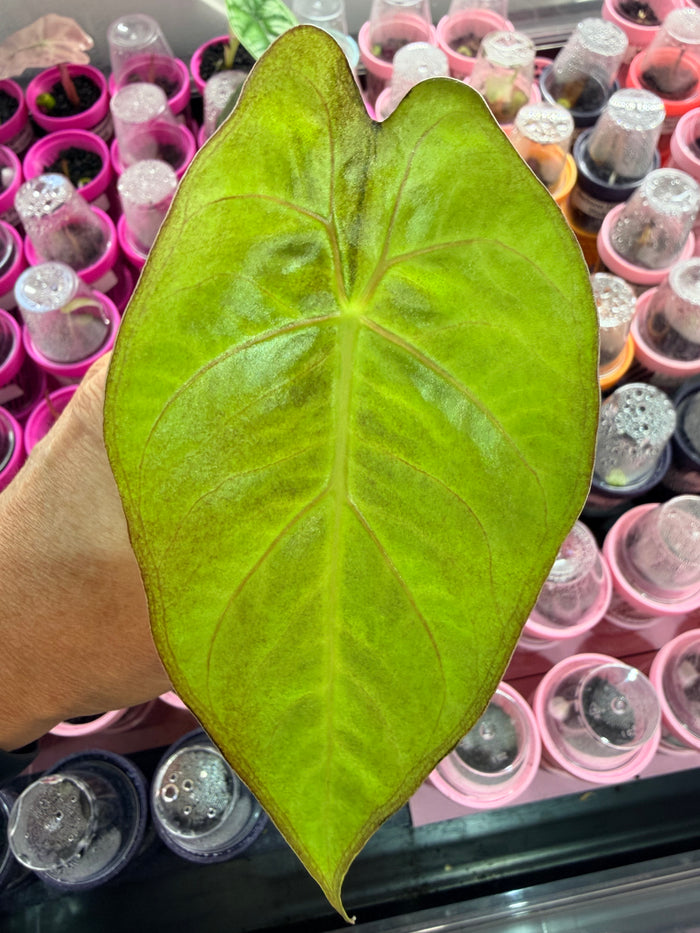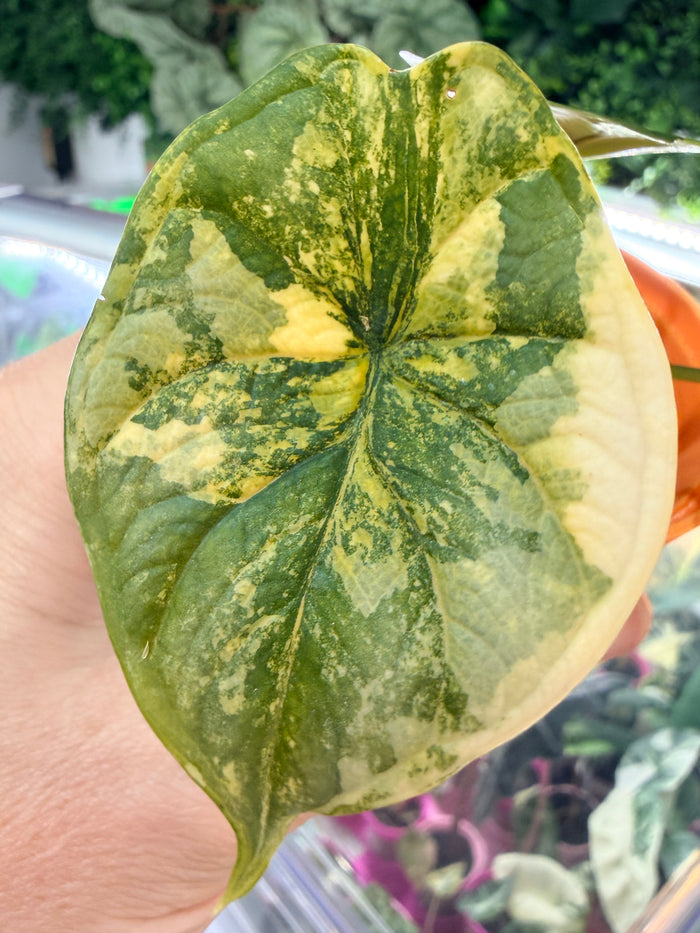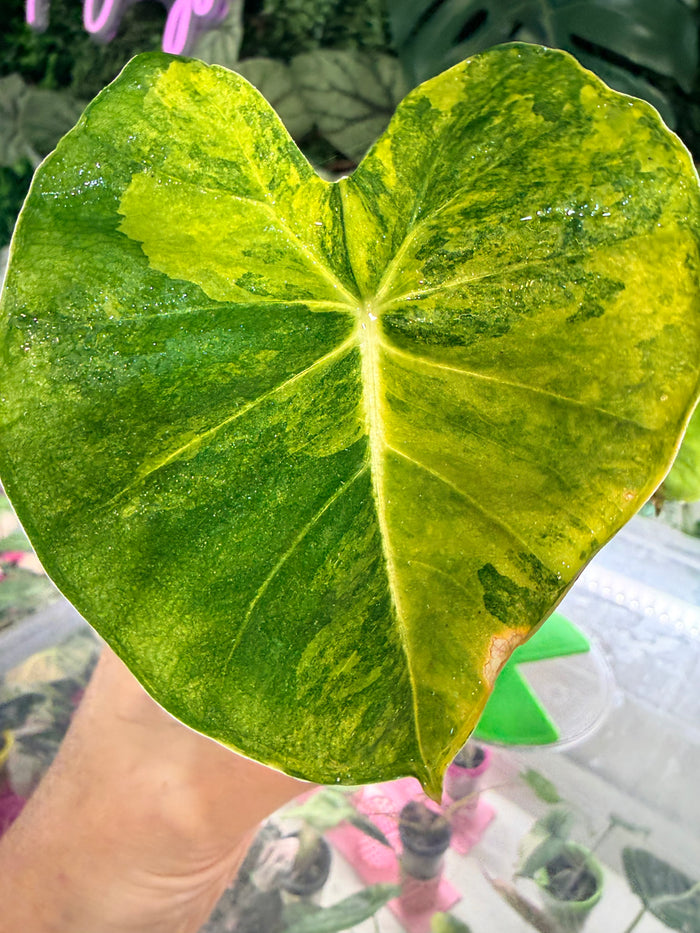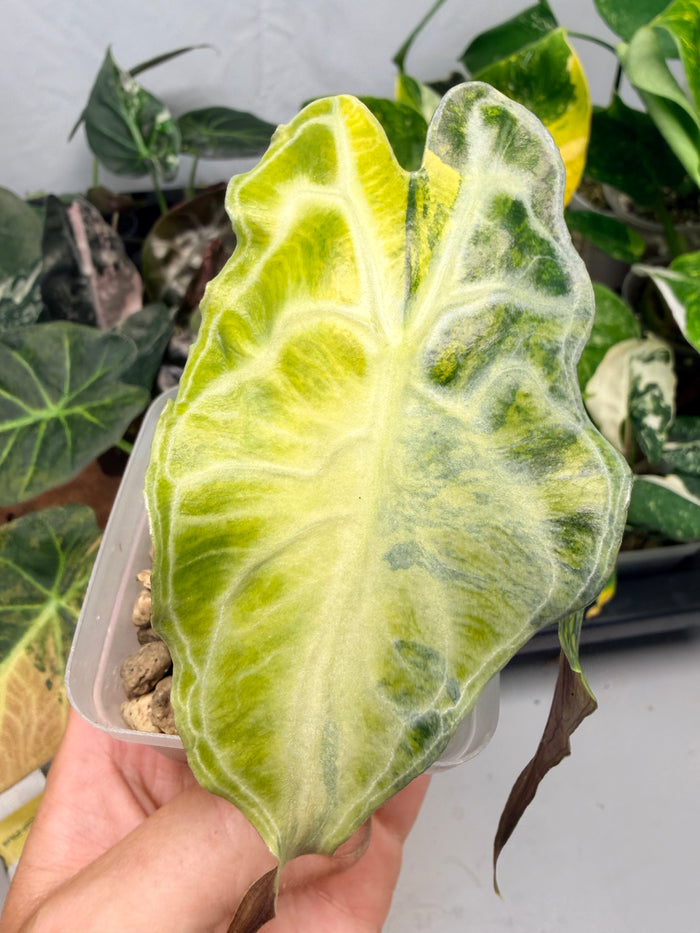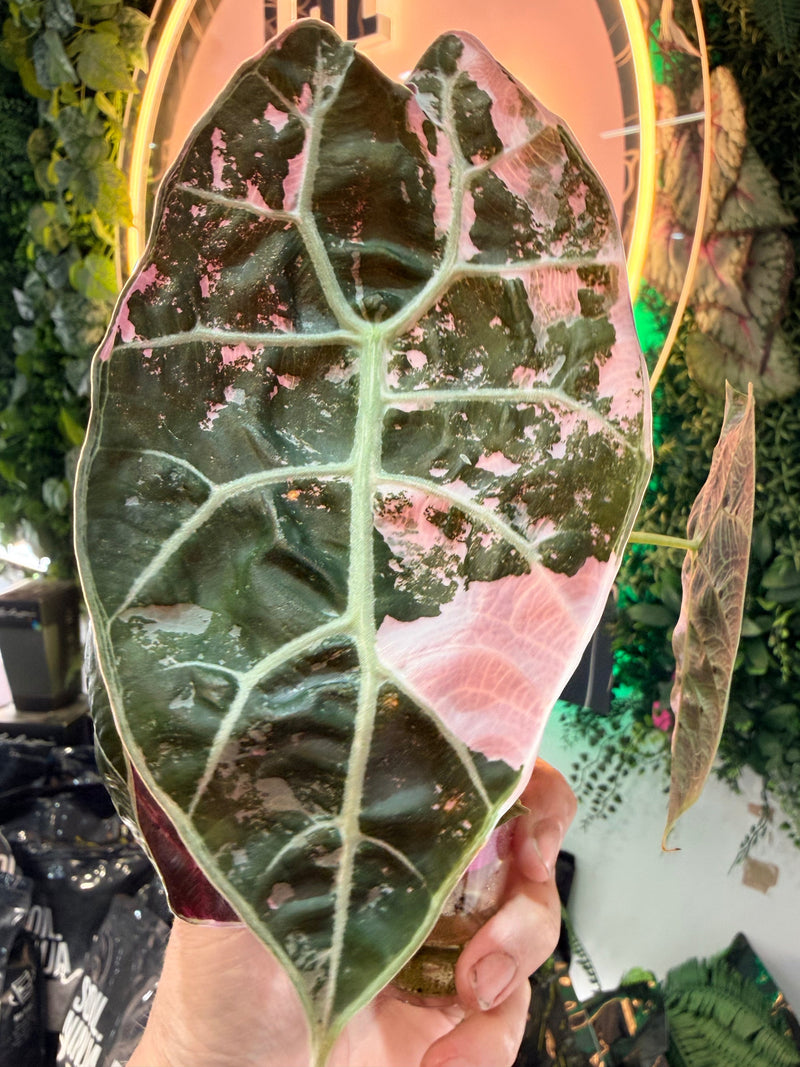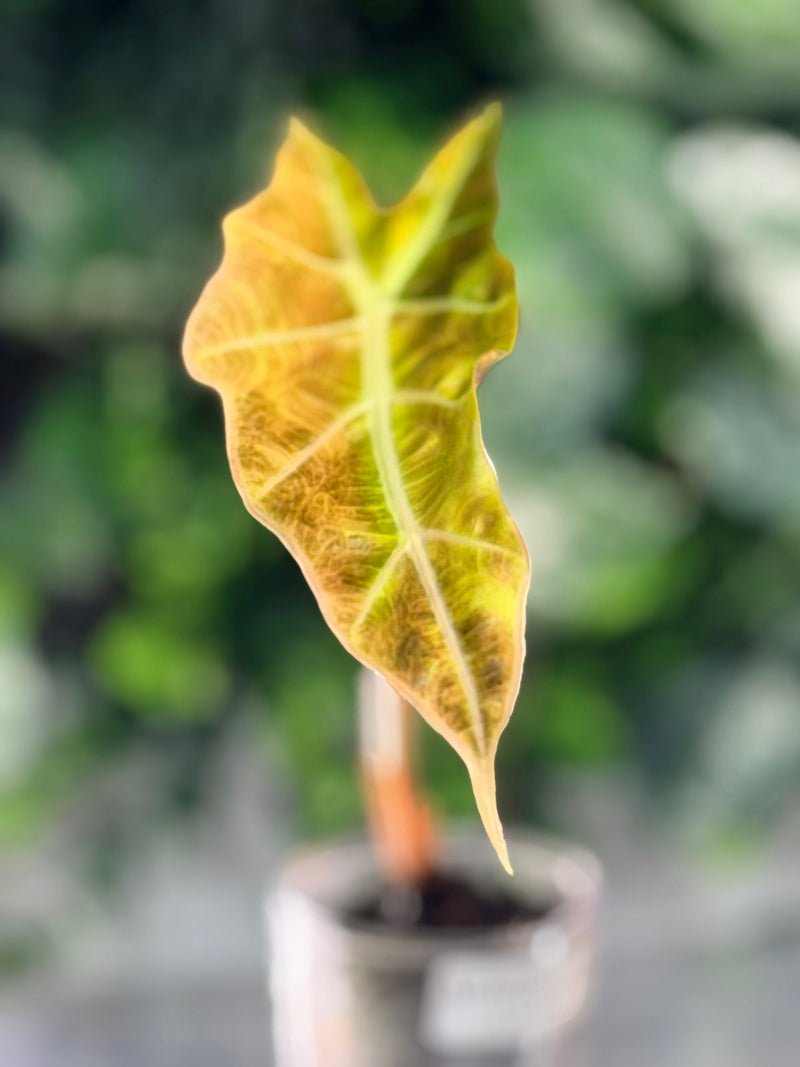

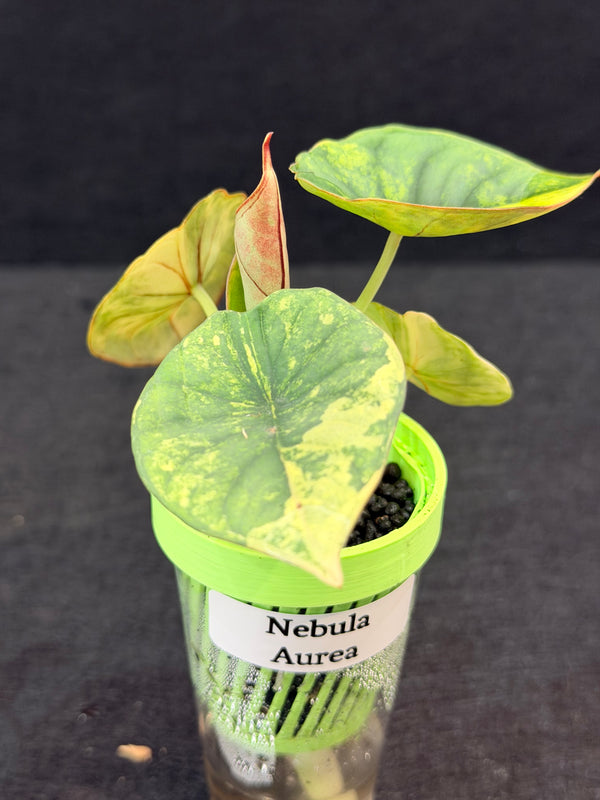
The Alocasia Nebula Aurea represents an unusual and particularly compelling collector proposition: a species whose standard form is already naturally variegated, carrying the smoky silver overlay across its bullate blade that gives the species its name, now expressing additional golden-yellow aurea sectors on top of that existing silver-grey base. The result is a plant where carotenoid-based aurea variegation interacts not with a simple green background but with the silver-grey, mist-like surface quality of Alocasia nebula itself, creating colour interactions that are genuinely specific to this cultivar combination and not reproducible on any other species.
Species Background: Alocasia nebula
Alocasia nebula is one of the most remarkable jewel Alocasia in cultivation, a species that occupies a unique position in the genus because its standard form is, in a meaningful sense, naturally variegated. The name says everything: nebula is Latin for mist, cloud, or haze, and Alistair Hay chose this epithet when formally describing the species in Curtis's Botanical Magazine in 2000 for two specific reasons, the uncertainty surrounding its origin, and the soft, silvery variegation pattern on its leaves that creates a hazy, atmospheric quality unlike any other Alocasia.
The species is endemic to Sarawak, Malaysian Borneo, thought to originate from limestone-rich forest at low elevation near Semenggoh, close to Kuching. It was observed growing there by Peter Boyce, Josef Bogner, and Alistair Hay independently in the mid-1990s, and has not been confirmed from wild populations since. In cultivation, it is widely described as the most challenging Alocasia to grow, prone to sudden collapse from root disturbance, temperature fluctuation, or inadequate care, but extraordinarily rewarding when conditions are right. The species' limestone origin has practical implications: it responds well to the addition of crushed dolomite to the substrate, which buffers pH toward the slightly alkaline conditions of its native limestone habitat.
The leaves are compact and jewel-scale, typically 20-30cm in cultivation, thick, bullate, and strongly coriaceous. The adaxial surface carries the characteristic silver-grey, slightly smoky colouration that gives the species its name: a base of deep green overlaid with a diffuse silver-grey that creates the impression of looking at the foliage through a fine mist. The primary and secondary venation is deep green to near-black, raised against the lighter silver-grey surface and creating a bold, grid-like pattern of extraordinary precision and visual impact. The undersides are reddish-purple, adding warmth when leaves catch the light at an angle.
Aurea Variegation on Alocasia nebula
Aurea variegation on the standard silver-grey surface of Alocasia nebula creates a visual effect that is more complex than golden sectors on a green-leaved species. The carotenoid-based golden-yellow sectors appear against a base that is already carrying a silver-grey overlay, not a warm green but a cool, slightly atmospheric tone. The golden aurea sectors therefore interact with a cool, silvery base rather than a warm green one, creating a warm-cool contrast that is different in character from standard aurea forms. In good light the golden sectors appear luminous against the silver-grey background; the dark near-black venation provides structural clarity through both variegated and non-variegated areas.
Aurea sectors retain some photosynthetic capacity, which is advantageous in a species as demanding as Alocasia nebula, the aurea form has slightly better metabolic resilience than a fully chimeric albo form would on this species. Light is nonetheless critical: consistent bright indirect light with LED supplementation from October to March maintains both growth and aurea colour expression through UK winters.
Care: The Demands of Alocasia nebula
Alocasia nebula is genuinely the most demanding Alocasia in mainstream collector cultivation, and the aurea form shares all of those demands. The species' limestone origin means it benefits from crushed dolomite added to the substrate to buffer pH slightly upward from the acidic range optimal for most Alocasia. Fluval Stratum provides the aeration and drainage the species requires, and a small addition of coarse dolomite supports the limestone-adapted root system.
Temperature must be maintained consistently at 20-27°C with no cold periods or draughts, sudden temperature drops are one of the most common causes of the sudden collapse that nebula is notorious for. Humidity at 70-80% is the target, higher than for most collector Alocasia. A dedicated humidifier is essential for UK collectors. Water when the top 2-3cm is dry, ensuring free drainage, and never allow standing water. Feed at quarter to half strength from our plant feed range during the growing season, the species' limestone habitat suggests caution with feeding levels. A heat mat beneath the pot maintains root zone warmth and stability. Terrarium or enclosed cabinet cultivation is strongly recommended, the controlled environment reduces the environmental fluctuations that trigger sudden nebula collapse.
We release Nebula Aurea through our drop model. Join the collector list for early access and view our Alocasia Nebula Aurea listing for availability.
Questions about Alocasia nebula, its variegated forms, or limestone-adapted Alocasia care? Contact our team for specialist guidance from our UK nursery.
From the nursery