Alocasia Puber Princess Lemon: The Complete Collector's Guide

Alocasia puber 'Princess Lemon' is the trade name for a lemon-yellow variegated form of Alocasia puber, a large, swamp-adapted species from Java, Peninsular Malaysia and possibly southern Sumatra. This guide explains what the plant is, what is and is not formally documented about the name, how to recognise it, and how to care for it as a collector's plant.
What is Alocasia puber 'Princess Lemon'?
'Princess Lemon' describes Alocasia puber with vivid lemon-yellow, aurea-type variegation. It is worth being plain about the status of the name. Aroidpedia, the aroid reference we rely on for species information, has a full entry for Alocasia puber but no entry for 'Princess Lemon'. That entry lists no cultivars or hybrids for the species, and simply notes that variegated forms in white and yellow exist. We therefore treat 'Princess Lemon' as a trade name for a yellow-variegated Alocasia puber, not as a formally registered cultivar with a documented origin, breeder or date.
That does not make it any less worth growing. It means the botanical facts in this guide come from the species, and the colour description comes from the plant itself. If you want to understand the variegation type, our guide to aurea variegation in Alocasia covers how yellow variegation behaves, and the complete guide to Alocasia variegation types places it alongside albo and pink forms.
The species behind the name: Alocasia puber
Aroidpedia records that Hasskarl first described the plant as Colocasia pubera, and that Schott moved it into Alocasia in 1856. The epithet refers to hairiness: the petioles and leaf veins are sparsely to densely hairy, and the peduncles are too. The spelling was later amended to puber by Backer and Bakhuizen. Aroidpedia also notes that no original type specimen has been located, so a later collection was designated as the neotype.
Its recorded distribution is West to Central Java, possibly southern Sumatra, and Peninsular Malaysia. Aroidpedia describes it as growing in open swampy areas and wet places within open forest, from sea level to about 1,000m. That wet-ground habitat is why the species is associated with liking moisture, although a container plant still needs a free-draining, well-aerated mix.
How to identify it
Size and leaf shape
Aroidpedia describes Alocasia puber as a robust herb with an erect to decumbent stem, petioles reaching roughly 1.1 to 1.5m, and sagittate (arrowhead-shaped) blades that can reach around 80cm by 70cm. Those are figures for the species in the wild. A container plant will take time, and generous light and feeding, to approach them, but the proportions explain why it is regarded as one of the more imposing Alocasia in cultivation.
Hairy petioles and veins
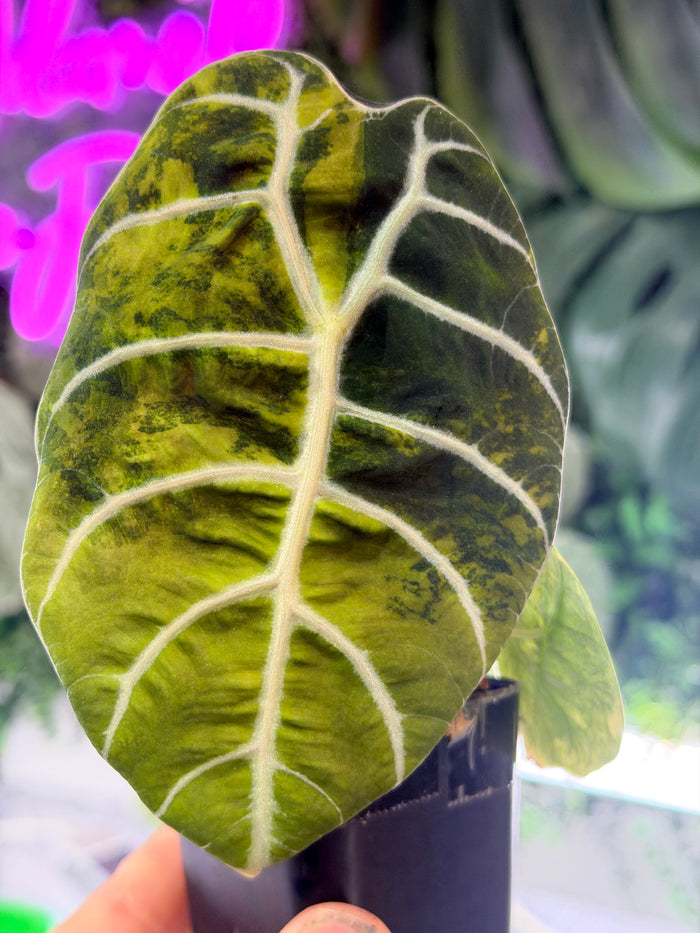
The hairy texture of the petioles and veins is the most useful identifying feature, and it is where the name comes from. Run a finger along a petiole and you should feel it.
The yellow variegation
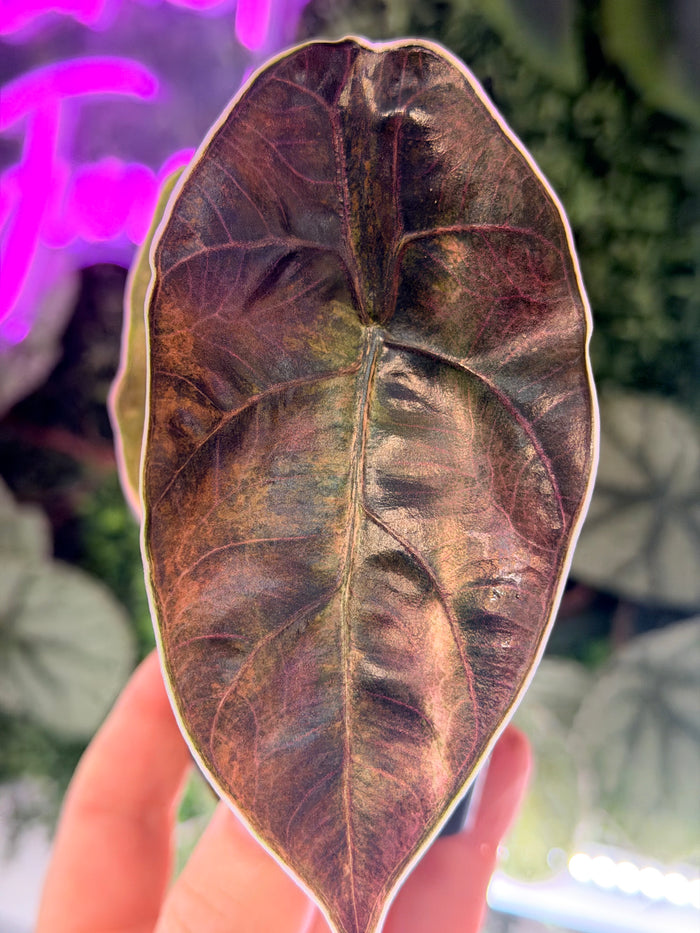
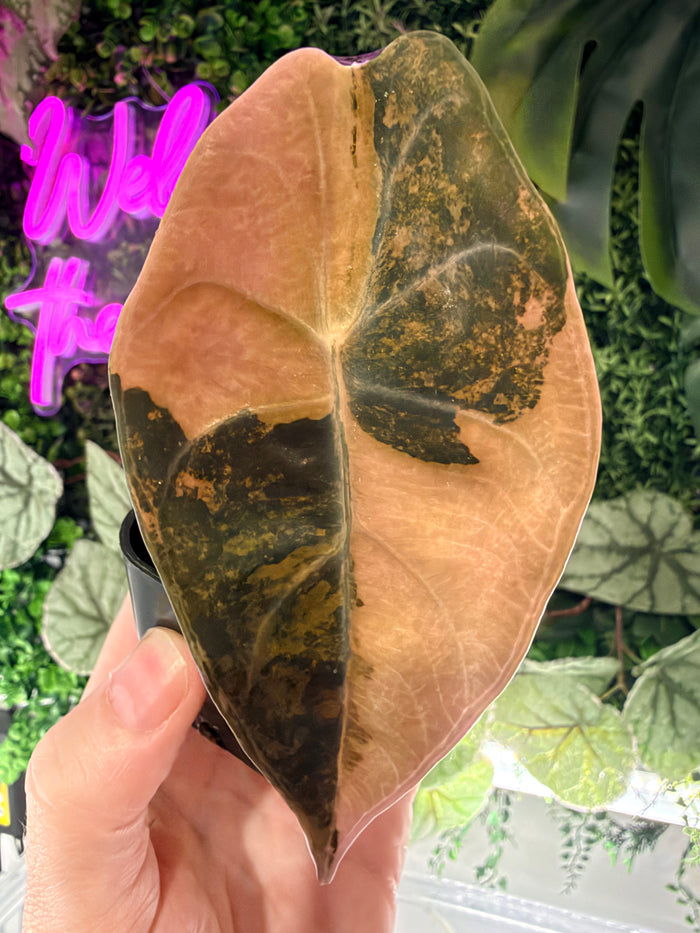
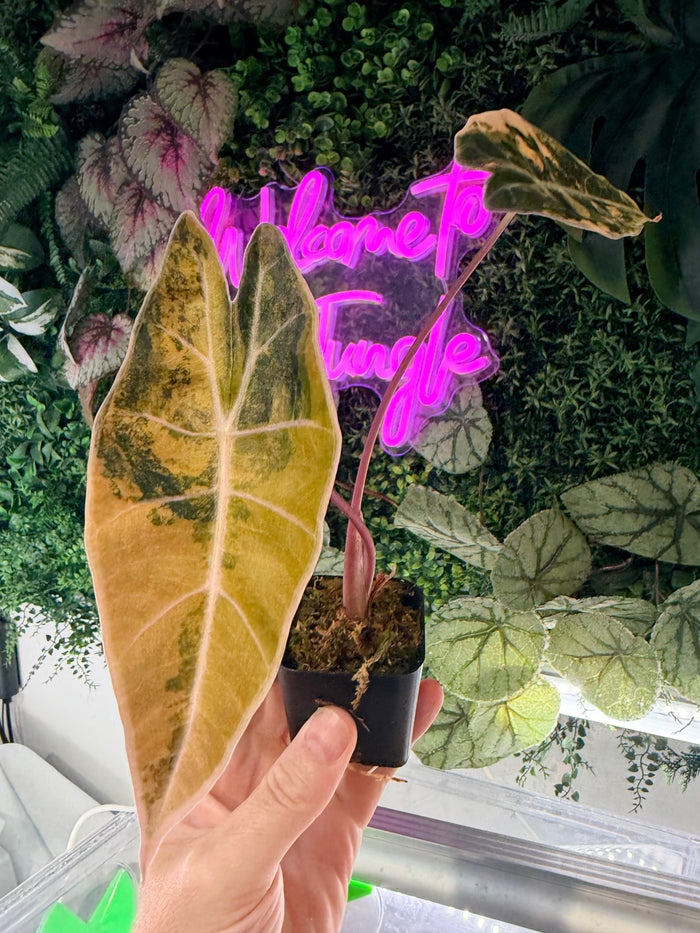
The colour associated with 'Princess Lemon' is a vivid, saturated lemon-yellow. On a species with such large blades, a yellow-variegated leaf reads clearly from across a room. As with any variegated Alocasia, the amount and pattern of yellow varies from leaf to leaf, and we would not promise a particular pattern on any individual plant.
Flowers
According to Aroidpedia, the inflorescences appear in clusters at the centre of the leaf crown, with an ivory-white spathe suffused with purple, 9 to 18cm long. Flowering is not something to expect of a young container plant, but it is a helpful confirmation of identity on a mature one.
Alocasia puber care
This is general Alocasia care that applies to this plant. For the full picture, see the ultimate Alocasia care guide; the essentials are below.
Light
Give bright, indirect light all year round. Light is critical for keeping the lemon colour vivid, and a large blade has a lot of surface to feed, so LED grow lights are well worth using alongside window light. Our article are LED grow lights worth it? sets out why. Keep harsh direct sun off the leaves.
Temperature and humidity
Aim for 20 to 27°C and humidity of 60 to 80%. If the room runs cool, a heat mat beneath the pot keeps the root zone comfortable.
Substrate and watering
Our preferred substrate is Fluval Stratum, which holds moisture while staying open and airy. Water thoroughly when the top 2 to 3cm has dried, and never leave the pot standing in water. Because this species comes from wet ground it is likely to tolerate steadier moisture than many Alocasia, but constant waterlogging still leads to rot. If you are concerned, read our guide to Alocasia root rot. Browse substrates and growing media and self-watering plant pots if you want to refine your set-up.
Feeding
A large plant uses a lot of nutrition. Feed at an appropriate strength from our plant feed range, and see the ultimate Alocasia plant feed guide for how to use it.
Pests
Spider mites are a persistent consideration on large leaves, where there is plenty of surface to colonise. Check the undersides of the blades regularly and act promptly at the first sign using our pest control range. For other problems, our Alocasia troubleshooting guide is a good first stop.
Propagating from corms
Alocasia can be multiplied from corms, and the process is straightforward with patience. Our Alocasia corm propagation guide explains how to choose a healthy corm and what to expect while it sprouts. We use the self-wicking method with Fluval Stratum in the Corm Keeper, which keeps moisture even without sitting the corm in water. Related reading: growing Alocasia corms in Fluval Stratum and how long a corm takes to sprout.
One honest caveat: chimeric variegation is not always passed on to plants grown from corms, so a corm-grown plant may come up greener than its parent. If yellow variegation is the aim, treat corms as a way to grow more plants and not a guarantee of the same pattern. Our corms collection is there if you wish to start this way.
How it differs from other variegated Alocasia
The practical differences with Alocasia puber are scale and texture: large leaves, long hairy petioles, and a species from wet ground. If you are comparing, our aurea variegated Alocasia collection shows other yellow forms, while the albo and pink variegated collections show the alternatives. For background on those, see understanding albo variegation and the mystery of pink variegation.
Where to find Alocasia puber 'Princess Lemon'
We release our rare Alocasia through our drop model. To hear about new plants first, join the collector list, or browse the new arrivals and Alocasia house plants collections.
Frequently asked questions
Is 'Princess Lemon' an official cultivar?
Not as far as we can verify. Aroidpedia has no entry for it and lists no cultivars for Alocasia puber, so we describe it as a trade name for a yellow-variegated form of the species.
How big does Alocasia puber get?
Aroidpedia gives blades of around 80 by 70cm on petioles of roughly 1.1 to 1.5m for the species. Container plants vary with light, feeding and pot size.
Does it need a lot of water?
It comes from swampy ground in the wild, so it is likely to tolerate steadier moisture than many Alocasia, but water when the top 2 to 3cm has dried and never leave it standing in water.
Where is Alocasia puber from?
Aroidpedia records West to Central Java, possibly southern Sumatra, and Peninsular Malaysia, where it is rare.
Will corm-grown plants be variegated?
Not necessarily. Chimeric variegation may not carry over to corm-grown plants, so results can vary.
Questions about Alocasia puber 'Princess Lemon' or large-form variegated Alocasia? Contact our team for guidance from specialists who grow rare Alocasia in our UK-based private nursery. We are happy to talk through light, substrate and pest management for large-leaved plants.