ALOCASIA ODORA CALIFORNIA MINT VARIEGATED: COMPLETE GUIDE TO THE RARE RECLASSIFIED SPECIES WITH EXTRAORDINARY BOTANICAL HERITAGE

Currently sold out
ODORA ‘CALIFORNIA’ MINT VARIEGATED
New plants go to the drop list first.
Join the drop listAlocasia Odora California Mint Variegated: Complete Guide to the Rare Reclassified Species with Extraordinary Botanical Heritage
Some plants are valued primarily for their visual characteristics. Others earn their significance through a combination of visual appeal, botanical rarity, and a documented heritage that places them at an interesting intersection of horticultural history and scientific revision. Alocasia Odora 'California' Mint Variegated belongs firmly in the second category. The mint variegation alone would make this a compelling collector specimen; the botanical heritage behind the 'California' cultivar designation elevates it into something genuinely unique.
This is a plant that, when you understand its history properly, you appreciate differently than you would from a simple product description. The reclassification of 2022, the LariAnn Garner connection, the distinction between the compact 'California' form and the standard Alocasia odora, all of these dimensions add depth to what is, at its most immediate level, a visually beautiful mint-variegated plant of unusual species character.
The Botanical Heritage: From gageana to odora 'California'
Alocasia odora 'California' has undergone a significant nomenclatural journey that serious collectors should understand. Previously known as Alocasia gageana, a name honouring 19th century Irish botanist Sir Thomas Gage, Bart., who served as a patron of botany, this compact form of Alocasia odora was reclassified in 2022 following research by Hay et al. that established its relationship to A. odora rather than as a distinct species.
The 'California' cultivar name was determined to have priority over all other names for this form, meaning it predates all competing names in the horticultural record and therefore, under the rules of cultivar nomenclature, takes precedence. The designation 'California' predates all other names for this form, which gives the cultivar name not just historical interest but nomenclatural authority.
The LariAnn Garner connection adds a further dimension of documented heritage. LariAnn Garner of Aroidia Research, an organisation whose hybridisation work has contributed significantly to the collector aroid world, is associated with this cultivar from at least the late 1970s. This places the cultivar's documented horticultural history across nearly five decades, creating a plant with an unusually long and well-documented record for a compact Alocasia form.
Alocasia odora 'California': Distinctive Characteristics
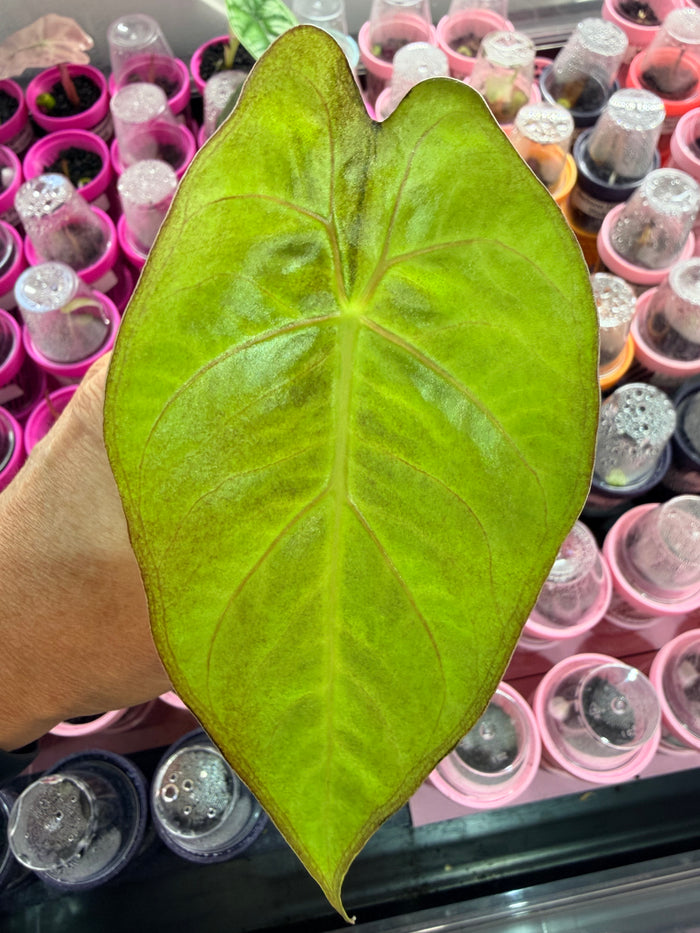
The 'California' cultivar is a rare compact form of the typically large-growing Alocasia odora, a characteristic that makes it particularly valuable for indoor collection use. Standard Alocasia odora can achieve considerable size, with specimens reaching 1.5–2m or more under good conditions. The 'California' compact form remains significantly more manageable while retaining the species' characteristic semi-peltate leaf shape with distinctive oval form and sunken lateral veins.
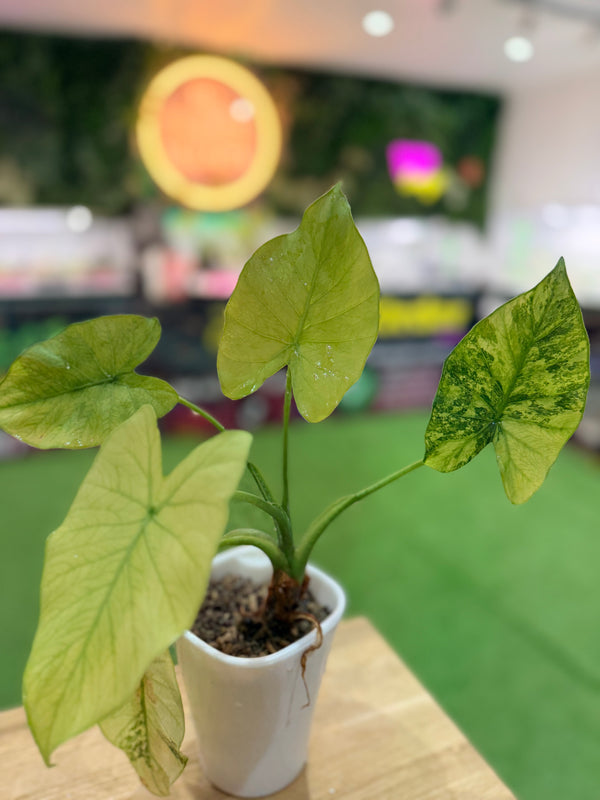
The semi-peltate leaf architecture, where the petiole attaches at or near (but not exactly at) the leaf margin, creating a different visual relationship between stem and blade than the standard cordate or sagittate Alocasia forms, is a distinctive botanical characteristic that gives 'California' an unusual aesthetic within the Alocasia genus. The oval (rather than arrow or heart-shaped) leaf form, combined with the semi-peltate attachment, creates a plant that reads differently from all the more familiar Alocasia forms.
Additionally, Alocasia odora 'California' produces numerous offsets (pups) and blooms readily in cultivation, characteristics that make it an active, productive plant for collectors interested in propagation and that confirm its distinct character from more reluctant-to-bloom collector species. The numerous offsets provide propagation material without the need for corm removal or division, making the cultivar particularly generous for collectors who want to build their stock or share with other collectors.
The Mint Variegation
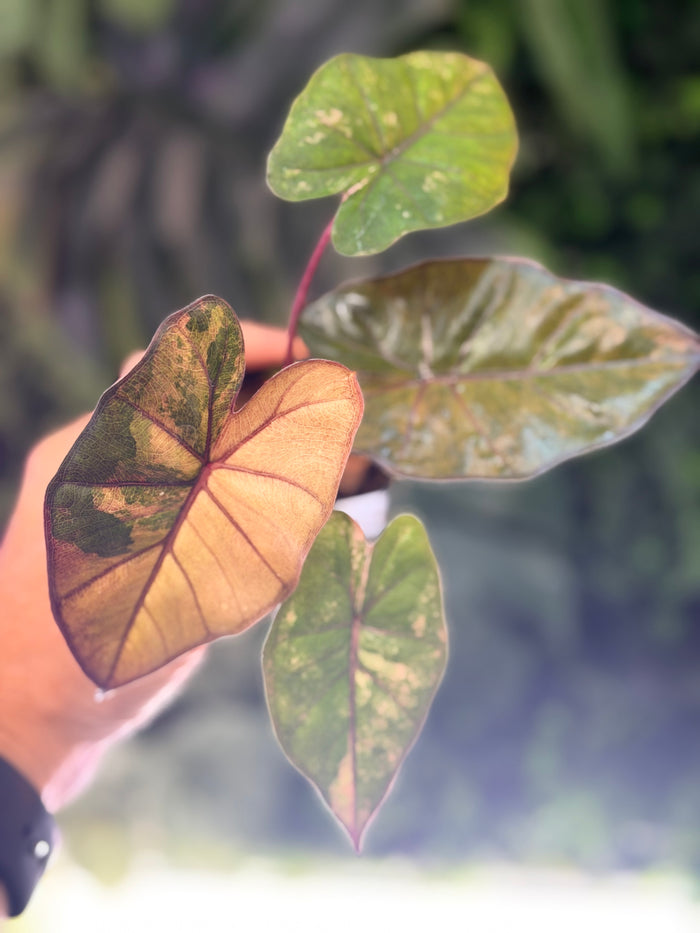
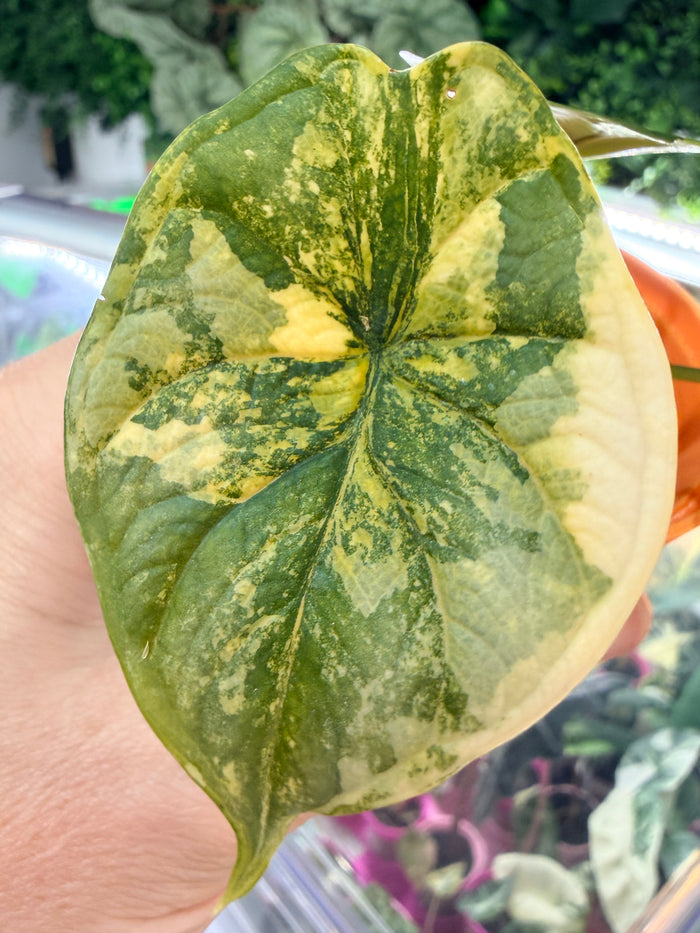
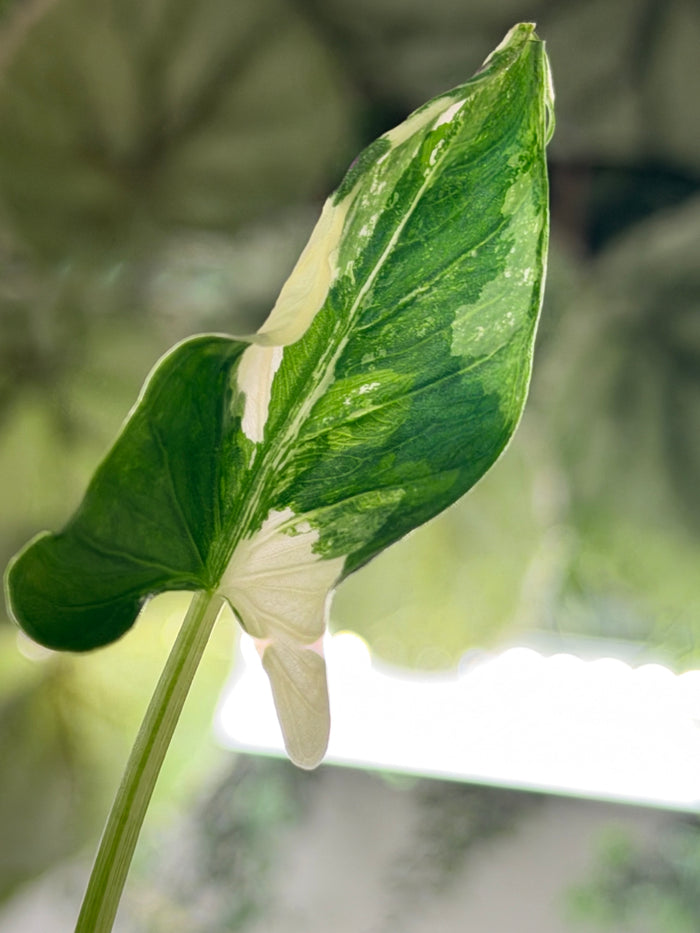
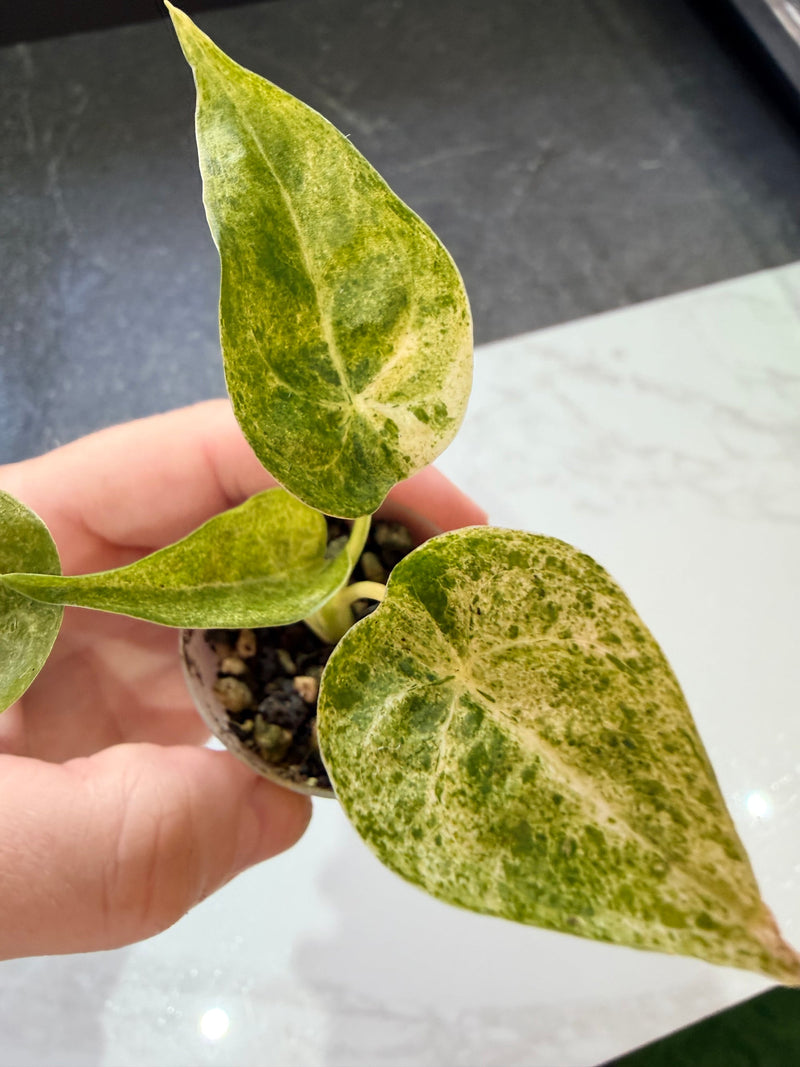
Mint variegation, soft, cool, pale green-to-white colouration that sits at the boundary of albo expression and standard green, is among the rarest colour types in the Alocasia hobby. Less common in appearance than albo (which is stark white), cooler and more refined than aurea (which is warm yellow-gold), and distinctly different from standard green-on-green tonal variation, mint sits in its own aesthetic space that appeals particularly to collectors who have developed refined preferences beyond the obvious bold-contrast forms.
On Alocasia odora 'California''s semi-peltate oval leaves, the mint variegation creates a gentle, luminous quality that is particularly effective. The oval leaf form, more rounded and less angular than the standard Alocasia arrow or heart, suits the soft mint colouration well. The semi-peltate attachment creates an interesting visual dynamic as the mint sectors distribute across the blade, following the leaf's own structure in organic, variable patterns.
As with all mint variegation in Alocasia, the expression varies between leaf cycles and is light-responsive. Good bright indirect light produces the clearest definition and the most vivid mint tones; lower light causes the mint to become less distinct from the surrounding green and the overall effect to flatten. This light-responsiveness makes it important to maintain adequate light provision, not just for plant health but for the variegation expression that makes this form worth having.
Our complete guide to Alocasia variegation types covers the botanical mechanisms behind mint variegation and explains why it is less common than albo or aurea types.
Growing Alocasia Odora 'California' Mint Variegated
Alocasia odora is a somewhat more resilient and adaptable species than many specialist collector Alocasia, its distribution across parts of tropical and subtropical Asia, and its history as both a cultivated ornamental and an occasional food plant, reflects a broader ecological tolerance than the jewel Alocasia that dominate the collector market. The 'California' compact form inherits this resilience while adding the specific requirements of mint variegation management.
Light
Bright indirect light for both healthy growth and mint expression clarity. The 'California' cultivar's compact form means it is well-suited to being positioned close to a window where light is brightest, position within 1–1.5 metres of a well-lit window.
LED grow lights maintain both growth and the mint expression quality. Alocasia odora in general is more tolerant of lower light than jewel Alocasia, but the mint variegation specifically needs adequate light for the tonal distinction between mint and standard green to remain apparent, without sufficient light, the variegation character becomes unclear.
Temperature and Humidity
Maintain 18–27°C, Alocasia odora has a broader temperature tolerance than many collector species, reflecting its wider natural distribution and cultivated history. The 'California' compact form can tolerate brief dips toward 15°C without damage, though consistent growing temperatures should remain above 18°C for active growth. This slightly broader temperature tolerance makes 'California' Mint Variegated one of the more practical collector Alocasia for UK growing conditions.
Target 60–75% ambient humidity, the standard odora requirement, which is somewhat less demanding than the jewel Alocasia or some of the more specialist species. The semi-peltate leaf form does not create the excessively high transpiration that deeply dissected or large-bladed species show, making 'California' less urgent in its humidity demands than forms like Alocasia brancifolia.
Substrate and Watering
Well-draining chunky aroid mix appropriate for all Alocasia. Fluval Stratum for corm or offset propagation, the numerous offsets produced by this cultivar make propagation straightforward, and Fluval Stratum provides excellent conditions for offset establishment. Water when the top 2–3cm is dry. Complete drainage essential.
Alocasia odora in general is somewhat less sensitive to brief substrate drying than the smallest jewel species, but consistent moisture management remains important, the compact 'California' form does not have large leaf blades to buffer against moisture stress as effectively as the larger species types.
Feeding
Half-strength balanced fertiliser during active growth. The mint variegation's light expression means nutritional stress would affect the variegation character before showing obvious plant health effects; conservative half-strength feeding maintains the variegation quality. The 'California' cultivar's numerous offset production represents a genuine ongoing nutritional demand during active growth, making consistent feeding during this period more important than for less prolifically offsetting species.
Stop feeding entirely when growth stops. Resume only when new growth is observed.
Propagation: Working with the Offset-Producing Character
The 'California' cultivar's tendency to produce numerous offsets makes it one of the more propagation-friendly collector Alocasia. Offsets can be separated from the mother plant when they have developed their own small root system, typically when they are 3–5cm in height and visibly rooting into the substrate. Our corm and propagation guide covers the establishment process for separated offsets, which is very similar to corm establishment in practice.
'California' Mint Variegated in the Broader Collection
For collectors whose appreciation has developed to the point where botanical heritage, nomenclatural history, and documented cultivar provenance matter as much as immediate visual impact, Alocasia odora 'California' Mint Variegated provides something genuinely rare: a plant where the story behind it is as interesting as the plant itself. The 2022 reclassification, the LariAnn Garner heritage, the priority of the 'California' cultivar name, and the compact form that makes the cultivar particularly valuable, all of these dimensions reward the collector who takes the time to understand them.
Visually, the mint variegation on the distinctive semi-peltate oval leaves creates a specimen unlike any other in a typical Alocasia collection. Species breadth, having forms that represent genuinely different botanical approaches to leaf architecture alongside the more common arrow-shaped and heart-shaped forms, is what elevates a collection from a quantity of plants into a genuine botanical representation of the genus. 'California' Mint Variegated contributes meaningfully to this breadth.
Questions about Alocasia Odora 'California' Mint Variegated, the 2022 reclassification, or how to grow this distinctive compact cultivar in a UK collection? Contact our team at The Alocasia Company, we grow the full odora range at our nursery and can advise on all aspects of care, propagation, and collection building.
If you are starting plants from corms, our Alocasia corm propagation guide walks through the self-wicking method we use in the nursery, from choosing a firm corm through to moving the sprouted plant on.