ALOCASIA MAHARANI AUREA: THE COMPLETE COLLECTOR'S GUIDE TO THE GOLDEN QUEEN

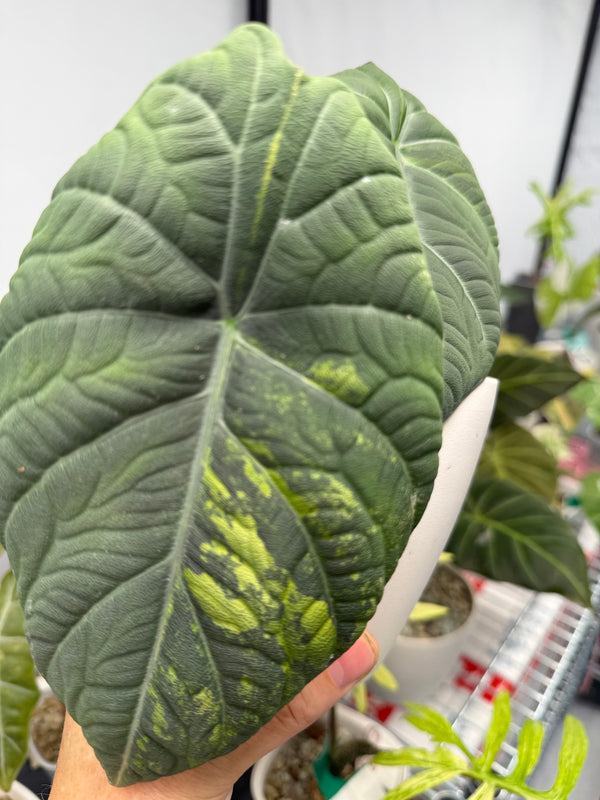
Among the jewel Alocasia hybrids that have captured serious collector attention over the past decade, Alocasia 'Maharani' holds a genuinely special position. Created by aroid botanist Peter Boyce at Malesiana Tropicals around 2009, it represents a textbook example of heterosis, the tendency of a crossbred individual to express qualities that exceed both parent species. The result is a compact, thick-leaved hybrid of extraordinary character: coriaceous grey-green foliage with the lighter venation of Alocasia reginula 'Black Velvet' and the structural robustness of Alocasia melo, combined into a plant that is arguably more beautiful and considerably hardier than either parent alone.
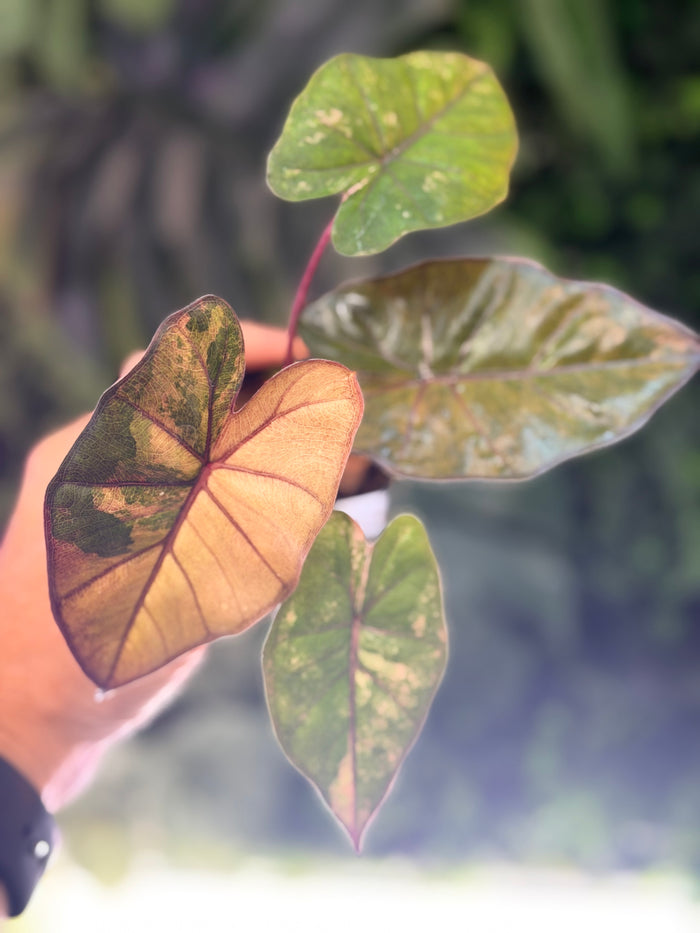
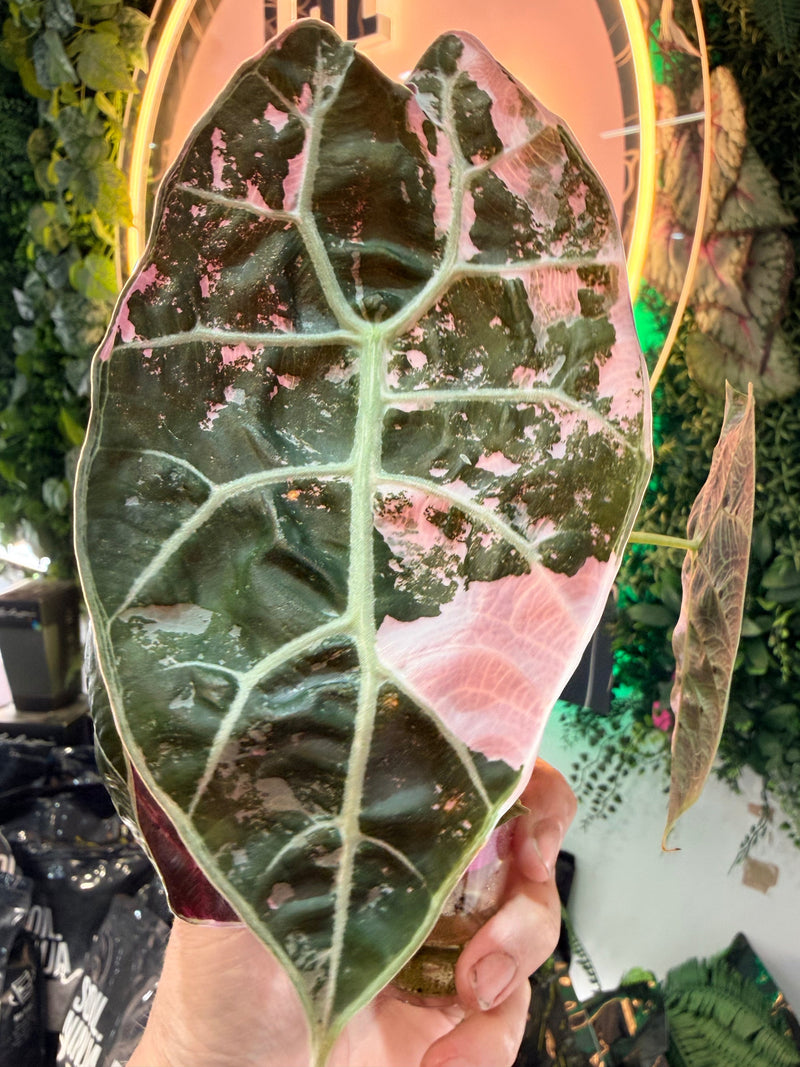
The Aurea form takes this further. Where the standard Maharani presents its distinctive grey-green foliage with characteristic light veining, the Aurea expresses golden-yellow variegation across those same thick, textured leaves, creating a visual contrast that is among the most striking available in the jewel Alocasia world. It is compact enough for any grow space, substantial enough in presence to serve as a genuine collection centrepiece, and rare enough that finding a quality UK-grown specimen requires knowing exactly where to look.
At The Alocasia Company, we grow our Alocasia Maharani Aurea from corm at our private UK nursery. Every plant is assessed before listing, variegation confirmed, root system established, and the plant in active growth. This guide covers the hybrid's origins, botanical context, care requirements, and what to expect when growing one in UK conditions.
The Origins of Alocasia 'Maharani': Peter Boyce and the Queen's Hybrid
Understanding what Alocasia 'Maharani' is requires understanding where it came from. The hybrid was created by Peter Boyce, one of the foremost aroid botanists of his generation, during his time at Malesiana Tropicals. Malesiana Tropicals produced a number of the most significant Alocasia hybrids of its era, and Maharani is among the best known of them.
The parentage is Alocasia reginula × Alocasia melo. Both parents are compact, thick-leaved jewel Alocasia from Borneo (Aroidpedia records A. reginula as believed to have originated in Borneo and as known only in cultivation), but they present quite differently.
Alocasia reginula 'Black Velvet' is one of the most recognised jewel Alocasia in cultivation. Its very dark, matt green leaf surface with contrasting whitish venation has made it an entry point for many serious collectors discovering the genus for the first time. It remains relatively compact throughout its life, with Aroidpedia recording it as a small herb to about 25cm tall, and is valued for its deep, matte leaf surface.
Alocasia melo is less commonly encountered in UK collections but is regarded by specialists as one of the most texturally extreme species in cultivation. Aroidpedia records it as endemic to Sabah, Malaysian Borneo, where it grows on ultramafic rock, highly specialised substrates low in nutrients but rich in heavy metals, and describes its strongly rugose, bullate foliage as a texture that appears unique in the genus. The leaves are stiff, almost rigid, with deeply impressed venation that creates a sculptural, almost geological quality. The upper surface is a deep, somewhat bluish green, and the abaxial (underside) surface is uniformly light green.
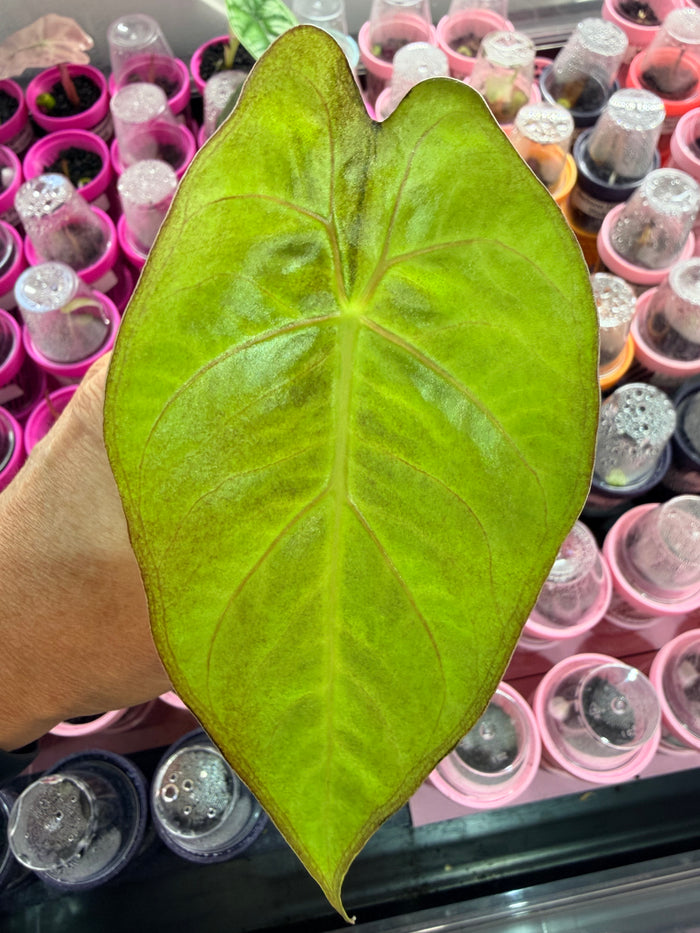
The hybrid, named after the Hindi word for queen (महारानी), as a direct homage to one of its parents, inherits the best qualities of both. The leaves are thick and coriaceous like melo but less extreme in texture, allowing for more graceful growth. The venation is distinctly lighter than melo's uniform colouration, a clear marker that distinguishes the hybrid from the parent species at a glance. The abaxial surface retains the red colouration of Alocasia reginula 'Black Velvet', which deepens as the plant matures from juvenile to adult growth. And the overall habit is compact, hardy, and notably forgiving compared to many rarer Alocasia.
Heterosis: Why 'Maharani' Outperforms Its Parents
The term heterosis, sometimes called hybrid vigour, describes a phenomenon observed across many plant and animal species where the hybrid offspring of two distinct parent lines displays superior characteristics to either parent. In the context of Alocasia 'Maharani', this manifests in several practical ways that matter to collectors.
Aroidpedia describes the hybrid as hardy and as a prime example of heterosis. Both Alocasia reginula and Alocasia melo are regarded as somewhat more demanding than many Alocasia species, melo in particular requiring very careful substrate management given its native adaptation to ultramafic soils. In our experience the hybrid is hardier than either parent: it tolerates a wider range of conditions, recovers more readily from stress, and maintains growth through the fluctuations that challenge many tropical Alocasia in UK homes.
It also produces offsets more freely than melo, which is slow to propagate, while retaining the compact size that makes both parents so desirable for indoor collectors working with limited space.
The result is a plant that delivers the visual drama of its parent species in a form that is more accessible to grow, more reliable in cultivation, and, in the Aurea form, more visually extraordinary than either parent.
The 2025 discovery that Alocasia 'Maharani' can produce viable pollen, demonstrated by Jacob Shephard, adds a further dimension of interest for the most serious collectors and hybridisers. Previously believed to be entirely infertile, this finding opens potential avenues for further hybridisation using Maharani's exceptional genetics. It is too early to know what those hybrids might look like, but the botanical significance of the discovery should not be understated.
Alocasia Maharani Aurea: Understanding the Variegation
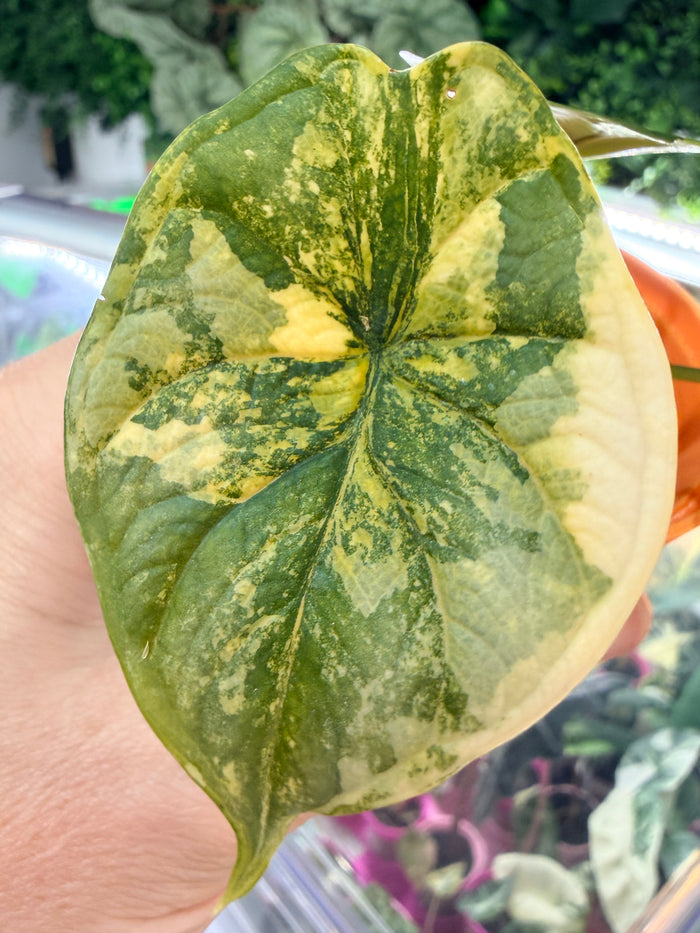
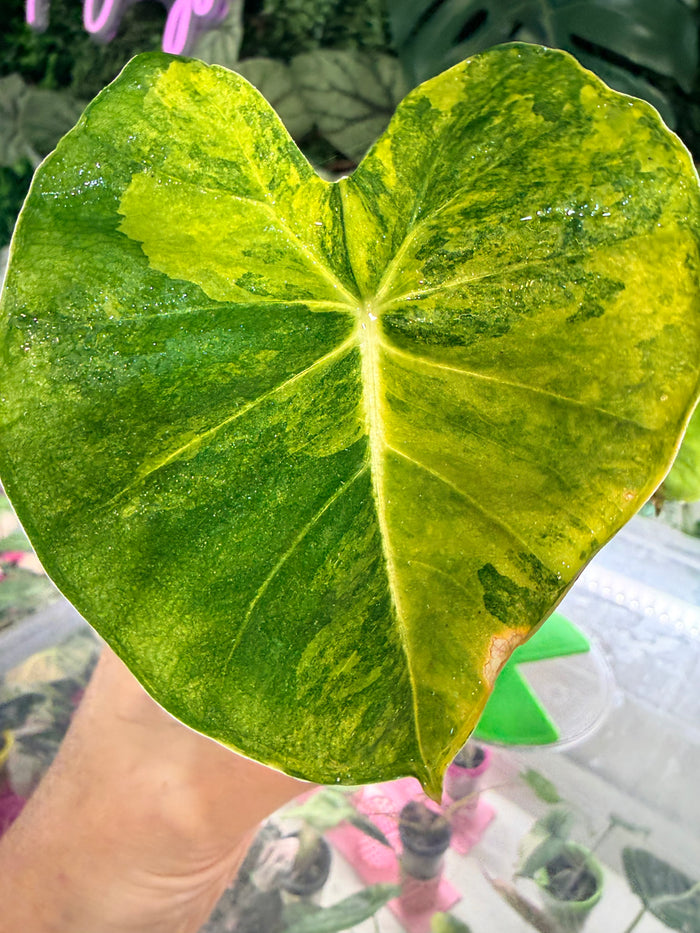
The Aurea form of Alocasia 'Maharani' adds a layer of complexity, and desirability, to an already exceptional hybrid. Aurea variegation in Alocasia describes the expression of golden-yellow colouration that arises from disruptions in chlorophyll distribution within leaf tissue. Where albo variegation produces white or cream sectors through the complete absence of chlorophyll, aurea produces warm yellow-gold tones through partial reduction, the cells contain less chlorophyll than the surrounding green tissue but retain some, producing the characteristic golden colour rather than white.
For a comprehensive exploration of the different variegation types found across the genus, our complete guide to Alocasia variegation types covers the science in full detail. The aurea variegation guide is particularly relevant for understanding what the Maharani Aurea expresses and why it behaves as it does.
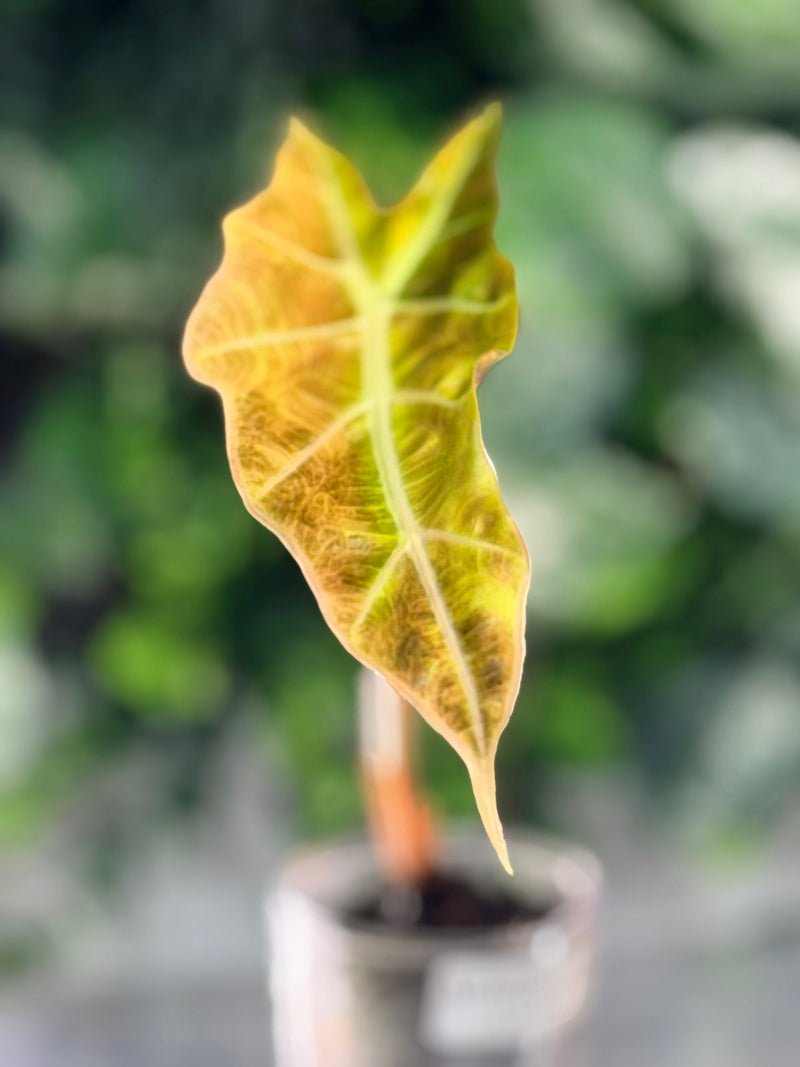
In practical terms, the aurea variegation on Maharani manifests as golden-yellow sectors, splashes, and marbling across the thick grey-green leaf surface. The contrast between the deep, textured base colour and the luminous aurea expression is particularly striking, the gold appears to almost glow against the muted grey-green ground, an effect amplified by the embossed leaf texture that creates shadow and depth within each leaf.
Aurea expression in the Maharani context is influenced by several factors that collectors should be aware of. Light intensity plays the most significant role, aurea variegation tends to be more vivid and well-defined under adequate light, while plants grown in insufficient light will often produce less saturated new growth with reduced golden expression. Temperature stability matters too, with cold stress and temperature fluctuation capable of affecting the quality of new leaves during development. Our LED grow lights collection is particularly relevant for UK collectors wanting to maintain strong aurea expression.
Both albo and aurea variegation can be tissue cultured, and the Maharani Aurea is reported to be available as a tissue culture plant in some markets. However, not all tissue culture lines maintain consistent variegation expression, and plants propagated from verified aurea mother stock at nursery level, as ours are, offer greater confidence in what you will actually receive. Our tissue culture acclimatisation guide is essential reading if you are working with TC plants for the first time.
Identifying Alocasia Maharani Aurea: Distinguishing Features
Given the number of jewel Alocasia in the collector market, understanding how to identify and distinguish Maharani Aurea from similar cultivars is worthwhile, both to understand what you are buying and to appreciate what makes it genuinely distinctive.
Versus Alocasia reginula 'Black Velvet'
The most obvious comparison is with the reginula parent. The key differences are leaf texture, Maharani is more structured in its surface than Black Velvet, and leaf colour, which in Maharani is a lighter grey-green compared to the very dark matt green of reginula. The venation in Maharani is less dramatically contrasting than in Black Velvet, where the whitish veins against the dark leaf are one of its most striking visual features. In the Aurea form, this distinction is partially obscured by the golden variegation overlay, but the underlying leaf structure remains clearly distinguishable.
Versus Alocasia melo
Distinguishing Maharani from melo is less immediately obvious to newer collectors, but straightforward once you know what to look for. Maharani has lighter venation, the hybrid's veins are distinctly paler than the uniform colouration of melo. The leaf texture in melo is considerably more embossed and rigid, with a sculptural quality that feels almost geological. Maharani leaves are thick and coriaceous but more flexible, with a smoother overall feel. The abaxial colour is the most definitive marker: melo has light green abaxials, while mature Maharani retains the red/burgundy underside colouration inherited from reginula. In the Aurea form, the golden variegation on the adaxial (upper) surface is absent in standard melo.
Versus Alocasia 'Silver Dragon'
The Alocasia baginda 'Silver Dragon' is another frequently compared jewel Alocasia in UK collections, also compact and textured. Aroidpedia records it as showing silver interveinal colouration on the upper leaf surface, varying in strength with available light, with the veins remaining dark green. Maharani's texture is more uniformly embossed, and its colouration is a grey-green ground with lighter veining rather than a silver interveinal pattern.
Growing Alocasia Maharani Aurea in the UK: Complete Care Guide
Substrate and Potting
Maharani Aurea benefits from the same substrate approach as other jewel Alocasia, well-draining, aerated, moisture-retentive without becoming waterlogged. Given its melo parentage, it is best kept in well-drained substrates, and it is less tolerant of waterlogged conditions than many other Alocasia.
Our preferred substrate for Maharani at the nursery is Fluval Stratum, which provides excellent drainage and aeration while maintaining the slight acidity that benefits Alocasia root systems. For growers building their own aroid mix, a blend of coco coir, perlite, and fine orchid bark provides a good foundation. The proportion of perlite should be generous, 30% or more, to ensure adequate drainage.
Pot sizing follows the standard jewel Alocasia approach: use the smallest pot that comfortably accommodates the current root system. Maharani, like both its parents, is particularly sensitive to the anaerobic root conditions that develop in oversized pots with excess wet substrate. This is especially important at the corm and juvenile stages, where the root system is establishing and waterlogged conditions can prevent root development entirely. Our self watering corm pots with humidity dome provide an ideal propagation environment for Maharani corms.
Light Requirements
Adequate light is critical for Maharani Aurea specifically because light intensity directly influences aurea variegation expression. Under insufficient light, new leaves will emerge with reduced golden colouration, a greener, less saturated appearance that does not reflect the plant's true potential. Under good light, the aurea sectors are vivid, well-defined, and striking.
For UK collectors, the position recommendation is bright, indirect light, an east or west-facing window, or a position within 60–90cm of a south-facing window with some diffusion. Crucially, supplemental LED grow lighting should be considered essential, as natural light levels in the UK are insufficient to maintain active growth and variegation quality in a plant that responds this closely to light intensity.
A target range of 10,000–15,000 lux is appropriate for Maharani Aurea. This is achievable under most quality LED grow lights positioned correctly, and will produce notably better results than relying on ambient window light.
Temperature and Humidity
Maharani Aurea is somewhat more cold-tolerant than some rarer Alocasia, reflecting its hybrid vigour, but the standard care guidelines apply: optimal growth between 20–26°C, with substrate temperature as important as air temperature for root function. Below 15°C, growth will slow or cease. Below 10°C, cold stress becomes a genuine risk.
For UK growers, the practical concern is cold draughts from windows and the colder temperatures found near external walls and unheated conservatories. Position Maharani away from these microclimates.
Humidity targets of 60–80% relative humidity will produce the best growth and variegation quality. UK homes typically operate at 30–50% ambient humidity, making supplemental humidity management worthwhile, a quality ultrasonic humidifier positioned near your collection is the most effective approach. At lower humidity levels, reduce feed strength slightly to avoid nutrient burn, as the vapour pressure deficit increases significantly at ambient UK indoor humidity levels.
Watering
The standard Alocasia watering approach applies to Maharani: water thoroughly when the top 2–3cm of substrate is dry, allow excess to drain freely, and never allow the plant to sit in standing water. The thick, coriaceous leaves of Maharani mean it can withstand slightly longer intervals between waterings than thinner-leaved Alocasia, but the substrate should never be allowed to dry out completely.
Water temperature is worth noting, room temperature water avoids the cold-shock response that can temporarily inhibit root uptake. In hard water areas, filtered or collected rainwater is preferable over time, as calcium carbonate accumulation in the substrate will affect both pH and drainage over successive waterings.
Feeding
Maharani Aurea is a steady feeder during active growth. Our standard approach at the nursery is a dilute, consistent feed programme applied with every watering, using a balanced liquid fertiliser at approximately half the recommended strength. This maintains steady nutrition without the peaks and troughs that stress jewel Alocasia root systems.
Our plant feed collection and targeted nutrients support the feed programme, with magnesium supplementation particularly useful for maintaining the quality of aurea variegation expression. Reduce feed frequency and strength when growth slows, and wait until new growth is actively emerging before resuming the full feeding programme. Superthrive is part of every feed we mix at the nursery, a vitamin B1 and kelp supplement that supports root development and helps plants settle after repotting or a change of conditions.
Growing Maharani Aurea from Corm
One of the most rewarding ways to add Maharani Aurea to your collection is growing from corm, watching the hybrid develop into its first leaves, and then tracking the aurea expression as it establishes. Our Alocasia Maharani Aurea corms are harvested from verified aurea mother plants at our nursery, giving you the best possible foundation for successful germination.
The propagation requirements for Maharani corms follow the standard approach for jewel Alocasia: warmth (25–30°C at the root zone), consistent humidity above 70% in the immediate environment of the corm, and a well-aerated substrate that prevents waterlogging while retaining appropriate moisture. Our Corm Keeper propagation system with Corm Crown maintains these conditions effectively, and Fluval Stratum remains our preferred substrate at the propagation stage.
An important note on corm propagation for variegated forms: aurea variegation expression cannot always be confirmed at the corm stage. Corms from aurea mother plants carry the genetic potential for variegation but the expression in the resulting plant will be confirmed once leaves begin developing. This is the honest reality of working with variegated Alocasia from corm, and it is why we clearly communicate this in our listings rather than guaranteeing what every individual plant will express. Our full corm propagation guide covers everything you need to know about the process from corm through to established plant.
Once the corm has established roots and produced its first leaf, transition to a slightly larger vessel using your chosen substrate mix, and begin a dilute feed programme alongside consistent warmth and humidity. The juvenile stage of Maharani development is characterised by smaller, rounder leaves, the full adult leaf form, with its characteristic grey-green ground and aurea expression, develops progressively as the plant matures.
Alocasia Maharani Aurea in a Collection Context
Understanding where Maharani Aurea sits within a broader collection helps collectors make the most informed decisions about acquiring one. It is a jewel Alocasia, compact, grow-space friendly, and suitable for collectors who appreciate the botanical precision and density of the smaller Alocasia forms rather than the architectural scale of larger species.
Within the jewel Alocasia world, it occupies a distinct position. Alocasia reginula 'Black Velvet' is the more widely available entry point, dramatic in its own right but produced in considerable quantity through tissue culture. Alocasia melo is less common but available from specialist sources. Maharani itself sits above both in collector esteem for its hybrid qualities, and the Aurea form sits above the standard Maharani for its combination of the hybrid's structural character with the additional visual dimension of golden variegation.
It pairs naturally with other jewel and semi-jewel Alocasia in a collection, Alocasia Melo Aurea, Alocasia Black Velvet Gold, and the various aurea variegated Alocasia in our collection all complement it without competing directly. For collectors building a jewel Alocasia focused section, Maharani Aurea is among the highest priority additions.
It is also worth noting that the plant's comparative hardiness, a direct product of its hybrid vigour, makes it a reasonable recommendation for collectors who are building their first rare Alocasia collection. It is less forgiving of neglect than a common Alocasia zebrina or Alocasia amazonica, but it is genuinely more resilient than many of the rarer single-species jewel forms, and it rewards attentive care with consistent, satisfying growth.
Pest and Disease Management
Maharani Aurea faces the same pest pressures as other jewel Alocasia grown in UK indoor conditions. Spider mites are the most consistent threat, thriving in the warm, dry conditions of centrally heated UK homes, and capable of establishing on the compact growth of jewel Alocasia before they are easily detected. Regular inspection during watering, with particular attention to the undersides of leaves where mites congregate, is the most effective preventative approach.
The thick, coriaceous leaves of Maharani are somewhat less susceptible to the rapid desiccation damage that spider mites cause on thinner-leaved Alocasia, but a significant infestation will cause visible stippling and eventual leaf decline if left untreated. Our pest control range covers the products we use at the nursery for spider mite and thrips management.
Maintaining adequate humidity is the single most effective preventative measure for spider mites, they struggle to establish in consistently humid conditions, making humidity management both a care requirement and a pest prevention strategy simultaneously.
Root rot is the other primary risk, arising almost always from substrate that retains too much moisture or pots that are too large. If you notice the plant declining, dropping leaves, losing vigour, or producing very small new growth, unpot and inspect the root system. At the first sign of root rot, remove affected roots, allow remaining root tissue to dry briefly, and repot into fresh Fluval Stratum in an appropriately sized vessel. Our root rot guide covers identification, treatment, and recovery in full detail.
The Maharani Aurea at The Alocasia Company
Every Maharani Aurea in our collection has been grown from corm at our private UK nursery, from verified aurea mother plant stock, assessed at each stage of development, and listed only when the plant is genuinely established and showing confirmed variegation expression. We do not source externally or restock from wholesale suppliers.
Our rare plant drop system ensures that when exceptional specimens become available, our collector subscriber list gets first access. If you are serious about adding one to your collection, joining the list is the most reliable way to be notified when the next drop opens.
The complete range of aurea variegated Alocasia in our collection includes a number of cultivars that complement Maharani Aurea in a jewel-focused setup. Browse the full Alocasia collection for the range we grow at each stage of development, corms, juveniles, and mature plants.
Questions about Alocasia Maharani Aurea, its care requirements, or where it fits in a UK collection? Contact our team for guidance from specialists who grow this hybrid at our private UK nursery. We are happy to advise on substrate, propagation, or which stage of development is right for your experience level and setup.