ALOCASIA BRANCIFOLIA 'PINK PASSION ALBO PINK': COMPLETE GUIDE TO THE RARE PINK-STEMMED DISSECTED-LEAF COLLECTOR'S ALOCASIA

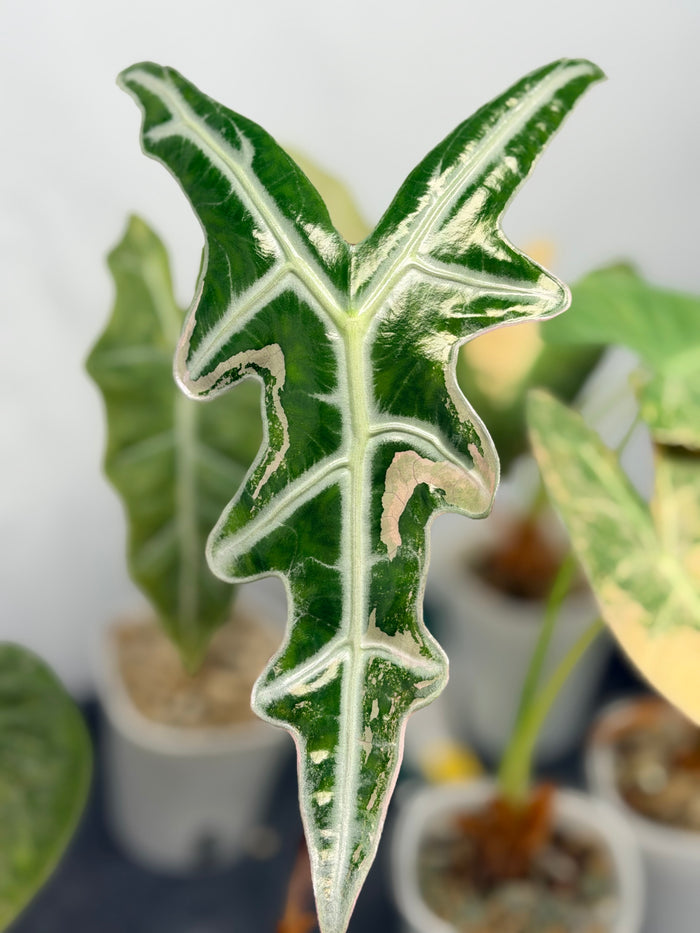
The first thing most collectors notice about Alocasia Brancifolia 'Pink Passion Albo Pink' is not the pink, though the pink is extraordinary. It is the leaves. Alocasia brancifolia produces one of the most architecturally unusual leaf forms in the entire genus: deeply dissected, pinnatifid blades that give the plant a structural complexity found in almost no other cultivated Alocasia. On zebra-striped petioles that further distinguish it from everything nearby, these divided, claw-like leaves create a plant that collectors who know their Alocasia recognise immediately as exceptional.
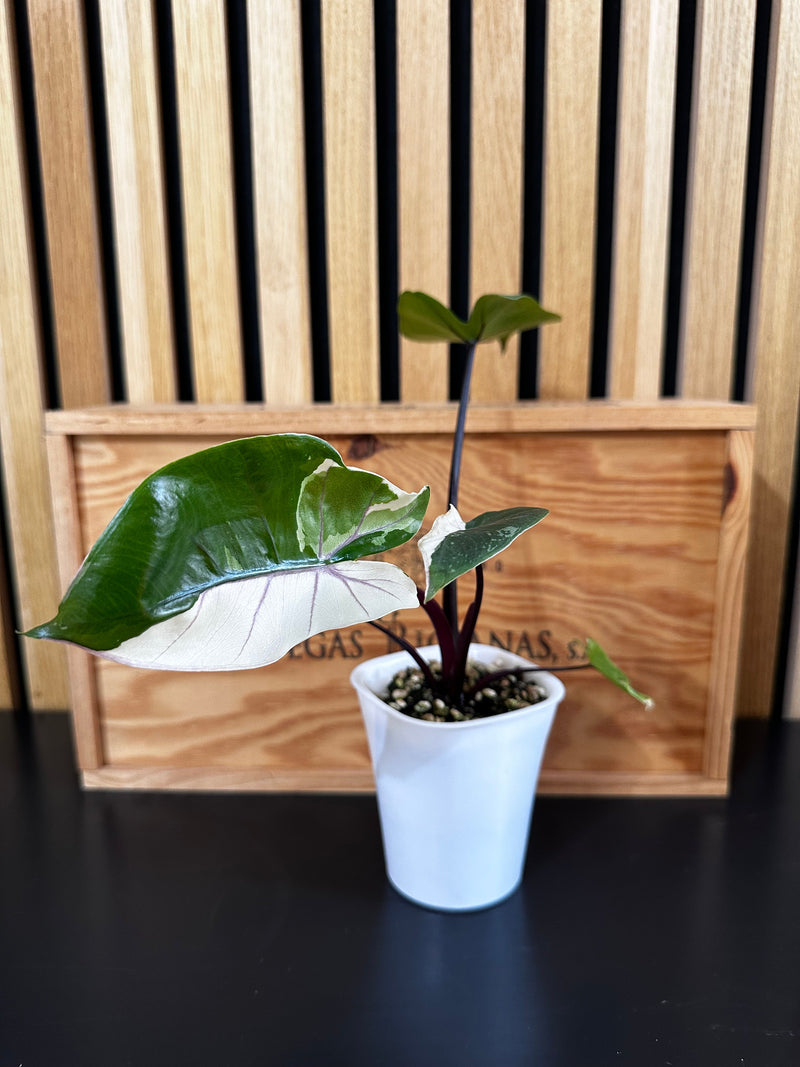
Add to this fundamental distinction the vivid pink-speckled petioles of the 'Pink Passion' cultivar selection and the white albo variegation of the Albo Pink form, and you have a plant of extraordinary layered appeal, one where the species character, the cultivar character, and the variegation type are all genuinely exceptional in their own right, and together create something that very few collector Alocasia anywhere in the world can match.
The Species: Alocasia brancifolia: A History in Brief
Alocasia brancifolia has a botanical history that collectors who appreciate provenance will find genuinely interesting. According to Aroidpedia, the species was first described in 1863 under the genus Xenophya in the Annals of the Lugduno-Batavi Botanical Museum at Utrecht University in the Netherlands. It was later reclassified into the genus Alocasia in 1898 under the name Alocasia acuta, and finally combined into Alocasia brancifolia by botanist Alistair Hay, one of the most important Alocasia taxonomists of the modern era, in his monograph Aroids of Papua New Guinea.
The heterotypic synonyms are numerous and reflect the taxonomic complexity of early Alocasia classification: Alocasia acuta, Alocasia acuta var. angustipartita, Alocasia acuta var. tigrina, Arum fasciculatum, Schizocasia acuta, and others. This naming history is characteristic of many Alocasia that were described multiple times from different specimens before their relationships were properly understood, a reminder that the modern genus is the product of significant taxonomic detective work.
The specific epithet brancifolia is formed from the Latin branca (a paw or claw) and folia (leaf), a direct reference to the species' most distinctive characteristic, the deeply dissected, claw-like leaf form that makes it immediately recognisable.
Distribution and Natural Habitat
Alocasia brancifolia is native to the Moluccas (Maluku Islands) and New Guinea, a distribution that encompasses parts of eastern Indonesia and Papua New Guinea. Wikipedia notes it as "native to the Moluccas and New Guinea," and Aroidpedia's entry confirms a distribution consistent with these island groups. The species grows in humid tropical forest conditions, in temperatures consistently warm year-round, typically 23–32°C during the day, with minimum temperatures not dipping below approximately 18°C. Rainfall is substantial, average humidity is high, and light is bright but filtered through forest canopy.
Understanding this habitat context helps growers: brancifolia's preference for consistently warm, humid, bright-but-filtered conditions is not arbitrary but directly reflects the conditions of the New Guinea rainforest understory where it naturally grows.
The Aroidpedia entry notes a complexity worth mentioning: brancifolia has been occasionally mistaken for Alocasia portei, which differs in its much larger size, well-developed posterior costae, and inflorescence structure. This confusion is understandable given the shared deeply dissected leaf character, but the two plants are distinct species with different size potential and structural characteristics.
The Leaf Form: What Makes brancifolia Unique
The deeply pinnatifid (feathery or divided partway to the midrib) leaf blades of brancifolia are its most extraordinary botanical characteristic. Each leaf is divided into multiple lobes or segments extending significantly toward the central vein, an arrangement that creates the "branching paw" character that the species name celebrates. This dissected form is highly unusual in Alocasia: most members of the genus produce entire (undivided) or at most shallowly lobed leaf blades. Brancifolia's deep dissection puts it in a small minority of cultivated Alocasia with truly divided leaf architecture.
The zebra-striped petioles, similar in character to those of Alocasia zebrina, a well-known cultivated species, add further visual interest below the leaves. These mottled, striped stems create a structural quality that makes the plant interesting even when no leaf is at its best. Aroidpedia notes that the species is "variable with regard to the width of the segments of the pinnatifid blades, and the degree of mottling on the leaf sheath, petiole, and to a lesser extent the spathe", natural variation within the species that is entirely normal and expected.
The 'Pink Passion' Cultivar
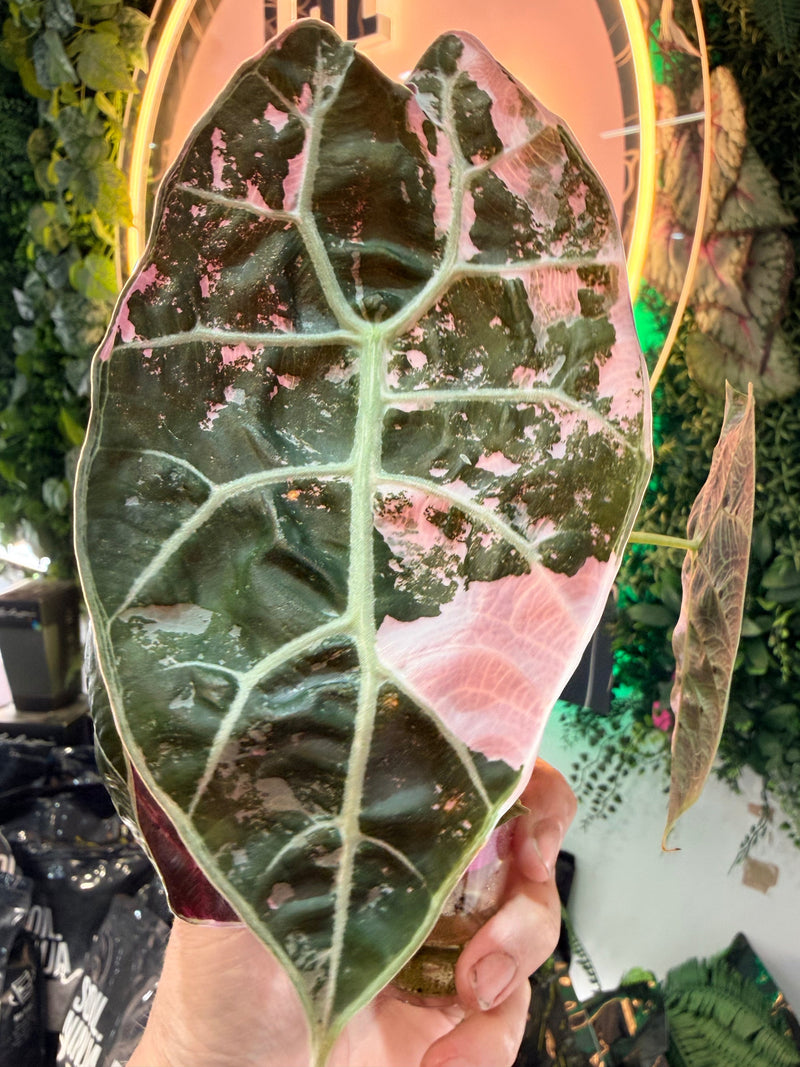
The cultivar name 'Pink Passion' refers to a selection of Alocasia brancifolia in which the mottling on the petioles expresses in pink rather than the standard brown. Wikipedia's entry for Alocasia brancifolia notes: "There appears to be a cultivar, 'Pink Passion', in which the markings on the petioles are pink instead of the usual brown." This pink petiole characteristic, the vivid, bubblegum-pink speckling along the stems that intensifies under bright light conditions, is the defining characteristic of the 'Pink Passion' selection.
The pink stem colour is most vivid under bright indirect light and in warm, consistently humid growing conditions. In lower light or at lower temperatures, the pink expression diminishes, a characteristic shared with other pink-expressing Alocasia and consistent with the light-responsiveness of anthocyanin-based colouration. Collectors who maintain their 'Pink Passion' under optimal conditions will see the pink stem speckling at its most vivid and most visually striking; those who allow light levels to drop will see a corresponding reduction in pink intensity.
The 'Albo Pink' Variegation
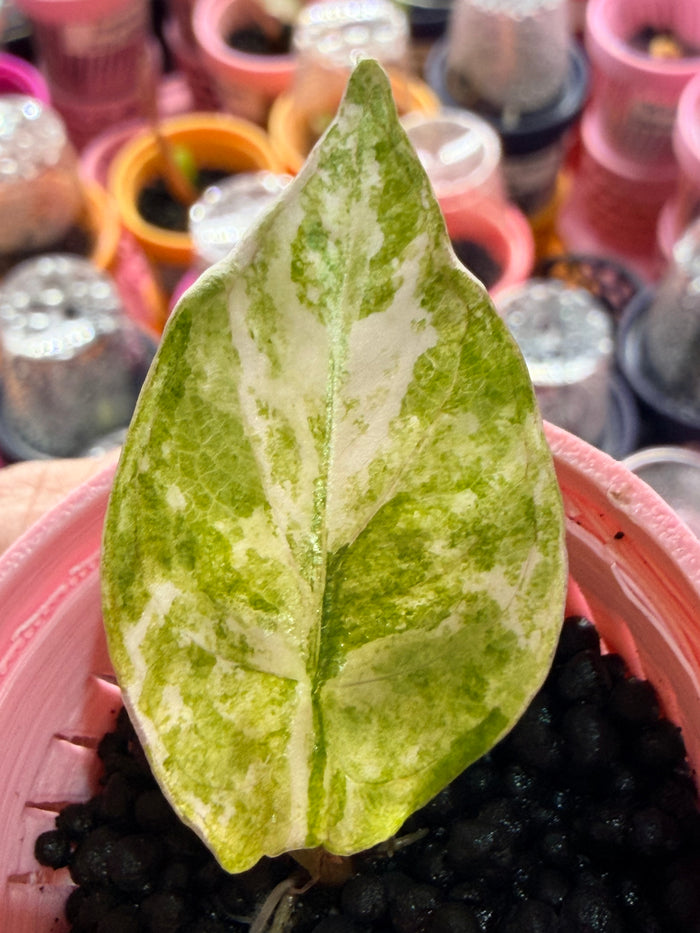
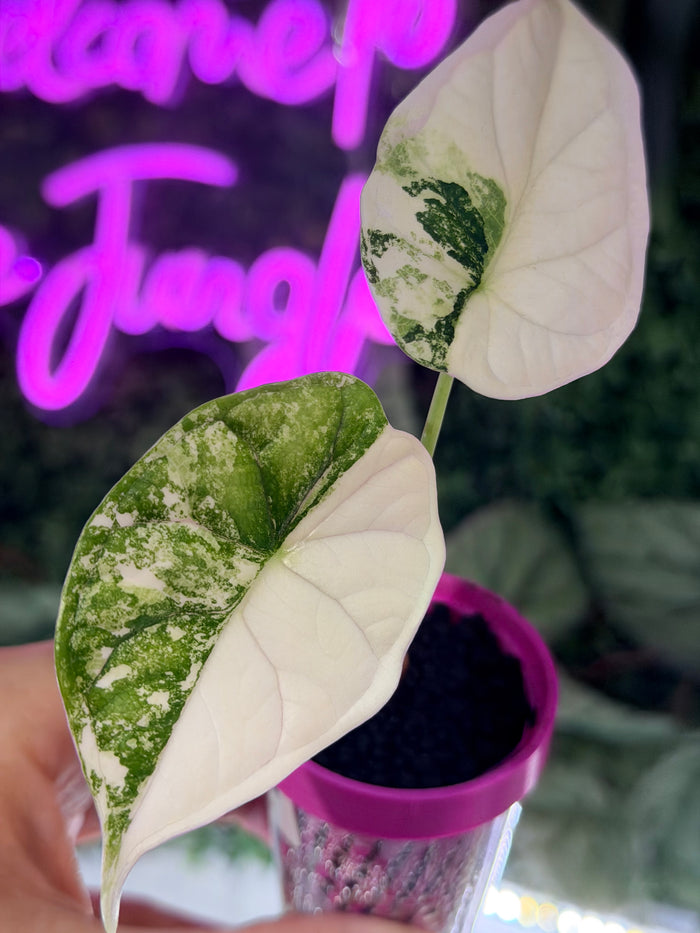
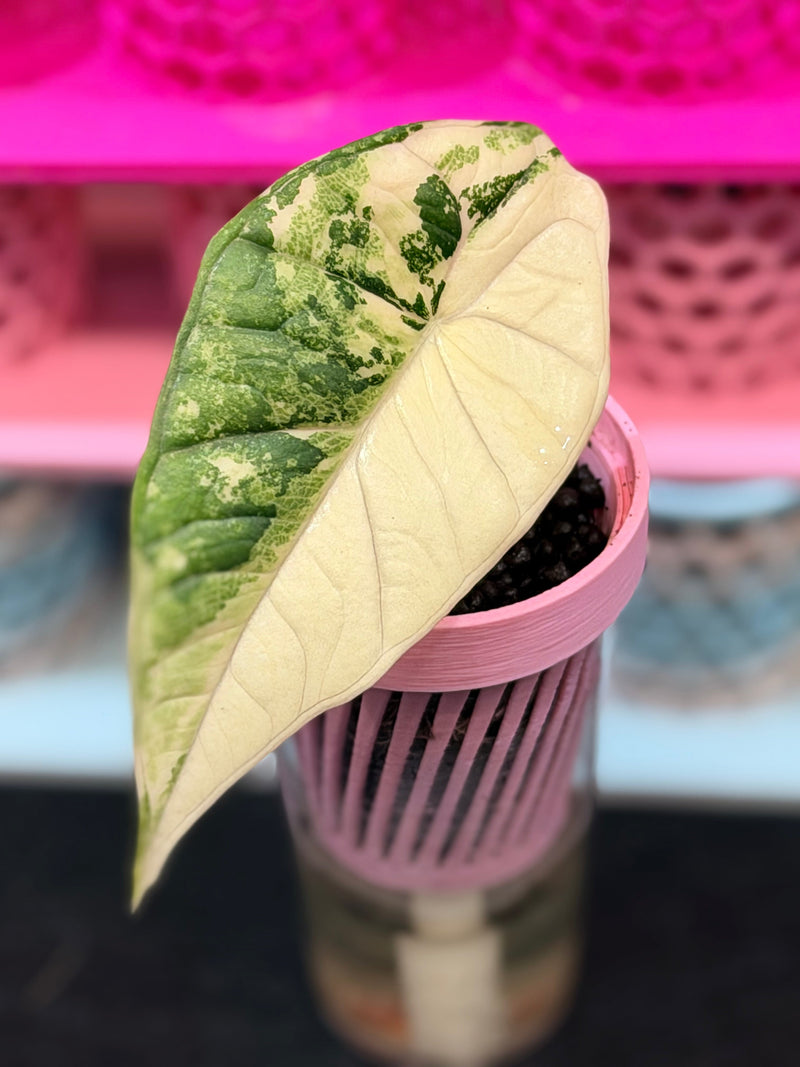
The Albo Pink form adds a further dimension of rarity and visual complexity to the 'Pink Passion' cultivar base. White albo variegation appears across the deeply dissected leaf blades, chimeric, chlorophyll-free sectors creating bright white contrasts against the dark green base. On brancifolia's unusual deeply divided leaves, the albo variegation creates patterns of extraordinary complexity: the combination of the lobed leaf geometry and the variable albo sector distribution means that no two leaves, and no two specimens, will ever produce the same pattern.
The white albo sectors are variable between leaf cycles, as chimeric variegation always is. Some leaves will show large, bold white sections; others will display lighter, more diffuse white expression; occasional leaves may emerge with very limited albo. This ongoing variability is normal and expected, it is the nature of chimeric albo expression in any Alocasia, and in brancifolia the unusual leaf form makes the variability even more visually interesting than it would be on a flat, undivided blade.
Together, pink stems, white albo variegation, and the extraordinary deeply dissected leaf form, the Albo Pink form of 'Pink Passion' creates a plant of three simultaneously exceptional characteristics. This combination is what places it firmly in the upper tier of collector Alocasia globally.
Our complete guide to Alocasia variegation types explains both albo and pink variegation mechanisms in detail for collectors who want to understand what they are managing.
Growing Alocasia Brancifolia 'Pink Passion Albo Pink'
Brancifolia's New Guinea and Moluccas origins translate into specific growing requirements that collectors need to understand and provide consistently.
Light
Bright indirect light is essential, not just for overall plant health but specifically for maintaining the pink stem expression at its most vivid and for providing sufficient photosynthetic capacity to the green tissue in what is, with albo sectors removed from photosynthetic contribution, a plant with reduced photosynthetic efficiency. Position within 1–1.5 metres of a well-lit window.
During UK autumn and winter, LED grow lights are strongly recommended. The New Guinea species origin means brancifolia is adapted to tropical light levels considerably higher than a UK winter provides naturally, and the albo variegation makes the plant particularly sensitive to light reduction, insufficient light during winter can cause the green tissue to struggle while the albo tissue contributes nothing to the plant's energy budget.
Avoid direct sun at all times. The deeply dissected leaves heat up more rapidly under direct sun than solid blade forms because of their greater surface area-to-volume ratio, and the pink-speckled petioles can bleach under strong direct light.
Temperature
Maintain a minimum of 18°C and a target growing temperature of 20–27°C. Brancifolia's New Guinea habitat, consistent tropical warmth without significant seasonal temperature variation, means this species does not have the hardening or acclimatisation to cooler conditions that some Alocasia from more variable climates possess. UK homes in winter need to maintain adequate warmth for this plant; a cold bedroom or poorly heated conservatory is not appropriate.
Humidity
Target 65–80% ambient humidity. The deeply dissected leaf form of brancifolia creates a higher surface area-to-volume ratio than solid-bladed Alocasia, which means moisture loss through transpiration is proportionally higher. This elevated transpiration means that brancifolia needs consistent ambient humidity more urgently than similarly-sized solid-bladed species, allow the humidity to drop substantially and the deeply divided leaves will show margin browning at the segment tips much faster than a comparable solid-bladed plant would.
A quality humidifier positioned nearby is strongly recommended. The combination of high transpiration from the leaf form, the albo variegation's reduced photosynthetic capacity, and the 'Pink Passion' selection's pink expression, which benefits from humidity, makes brancifolia Albo Pink one of the more humidity-demanding plants in our collection.
Substrate and Watering
Well-draining chunky aroid mix. Fluval Stratum for corm propagation. Water when the top 2–3cm is dry, watering thoroughly with complete drainage. The elevated transpiration of the deeply divided leaf form means the substrate may dry faster than it would with a comparable solid-bladed Alocasia, check moisture levels actively rather than following a fixed schedule.
Reduce watering in winter when light levels are lower and growth slows. Root rot in brancifolia in UK winter conditions is typically caused by continued regular watering under reduced light, the plant's reduced metabolic activity means it cannot process the moisture, and anaerobic conditions develop in the substrate.
Feeding
Half-strength balanced fertiliser every second or third watering during active growth. The albo variegation's reduced photosynthetic capacity means the plant's total energy production is lower than an equivalent non-variegated brancifolia, which in turn means its nutritional requirements should be managed conservatively, half-strength rather than full, and regular light feeding rather than infrequent heavy applications. Our plant feed collection includes appropriate products.
Brancifolia 'Pink Passion Albo Pink' in Collection Context
For collectors building a collection that goes beyond the familiar Amazonica-type forms and engages with the true morphological diversity of the Alocasia genus, brancifolia is one of the most important acquisitions. The deeply dissected leaf architecture it represents is available in almost no other cultivated Alocasia, the closest comparison might be Alocasia portei, which offers a related but larger and less refined version of the divided leaf form. Having brancifolia 'Pink Passion Albo Pink' alongside architectural statement plants like Regal Shields and compact collector jewels like Black Velvet creates a collection with genuine morphological breadth, not just colour variation across similar forms, but fundamentally different approaches to leaf architecture within a single genus.
This plant's combination of species character, cultivar selection, and variegation type places it among a small number of collector Alocasia where the rarity designation is genuinely earned on multiple simultaneous grounds.
Questions about Alocasia Brancifolia 'Pink Passion Albo Pink', its care requirements, or its availability as corm, juvenile, or mature specimen? Contact our team at The Alocasia Company, we grow brancifolia at our UK nursery and are happy to discuss any aspect of this exceptional species.
From the nursery