ALOCASIA BLOOD BONE: THE GENUINELY RARE WIM PHILTJENS HYBRID

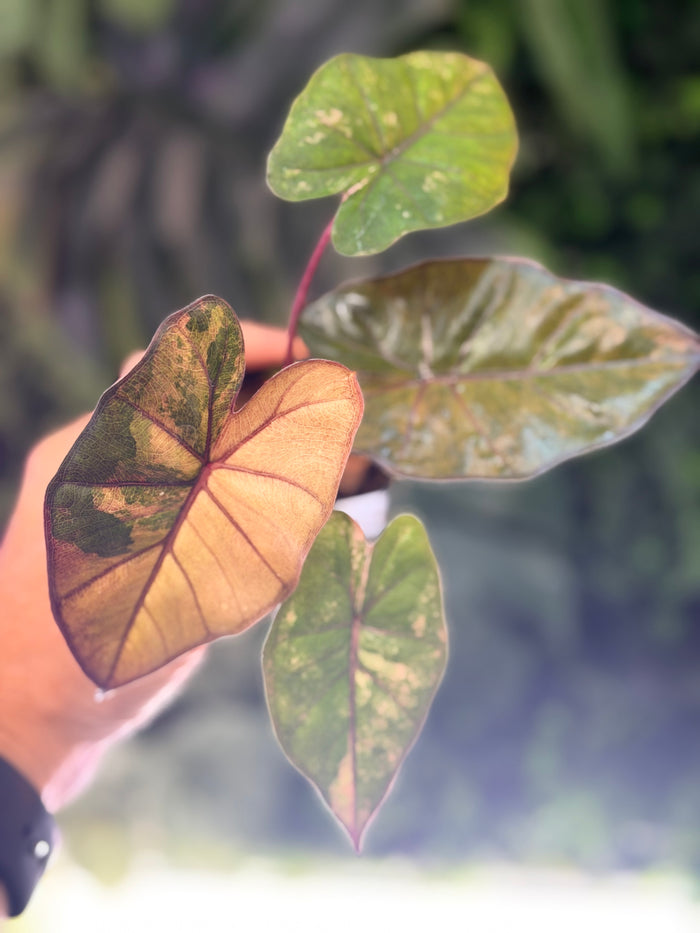
In a market saturated with plants marketed as "rare" when they're merely uncommon, the Alocasia Blood Bone stands apart as a genuinely rare specimen where the term carries actual meaning. Created by emerging hybridiser Wim Philtjens, this exceptional hybrid represents intentional breeding artistry rather than random tissue culture mutation, a distinction that serious collectors immediately recognise and value.
At The Alocasia Company, we're immensely proud to showcase this Alocasia, representing both the hybridiser and their remarkable creation. The Blood Bone exemplifies what genuine rarity means: limited distribution, documented parentage, deliberate creation, and characteristics that cannot be replicated through mass production.
Understanding Genuine Rarity vs. Marketing Hype
The rare plant market has become flooded with specimens labelled "rare" or "ultra-rare" that are simply the latest tissue culture release. Within months, these plants appear in every online shop, their scarcity revealed as marketing rather than reality.
Alocasia Blood Bone represents authentic rarity:
Limited Creation: Produced through hand pollination by a specific hybridiser, not mass tissue culture production. Each plant traces back to Wim Philtjens' original cross.
Controlled Distribution: Not available through wholesale nurseries or mass-market suppliers. Acquisition requires connecting with specialised collectors and nurseries.
Documented Heritage: Known parentage (Alocasia cuprea × Alocasia micholitziana 'Green Velvet'), known hybridiser, known crossing order. This provenance cannot be fabricated.
Distinctive Characteristics: The deep red stems provide instant visual identification, preventing confusion with similar hybrids or the parent species.
Collector Network Distribution: Primarily moves through serious collector circles rather than commercial retail channels, maintaining genuine scarcity.
This is what true rarity looks like, and why Blood Bone commands the respect of advanced collectors who understand the distinction.
Wim Philtjens: The Hybridiser Behind Blood Bone
Wim Philtjens represents the new generation of Alocasia hybridisers, growers who combine botanical knowledge, artistic vision, and technical skill to create intentional hybrids rather than simply capitalising on chance mutations.
The Modern Hybridiser's Approach
Unlike the Victorian-era hybridisers who worked on massive estates with extensive facilities, modern creators like Philtjens often operate on smaller scales with intense focus on specific crosses. This approach allows for:
Careful Parent Selection: Rather than random crosses, modern hybridisers choose parents strategically to combine specific desirable traits.
Documentation of Crossing Order: Recording which parent provides pollen and which carries berries/seeds, as this significantly affects offspring characteristics.
Limited, Quality Production: Small numbers of high-quality specimens rather than mass production, ensuring each plant receives optimal care and selection.
Direct Collector Relationships: Distribution through networks of serious collectors who appreciate documented breeding work.
Philtjens' Vision for Blood Bone
In creating Blood Bone, Philtjens made deliberate choices that distinguish this hybrid from related crosses:
Parent Selection:
- Alocasia cuprea for its metallic surface, compact growth, and robust constitution
- Alocasia micholitziana 'Green Velvet' (Frydek) for its velvety texture, striking white veination, and elegant form
Crossing Order Decision: Cuprea as berry carrier (maternal parent), Frydek as pollen donor (paternal parent). This specific order produces different results than the reverse cross, as we'll explore in detail.
Selection for Distinguishing Features: The deep red stems that make Blood Bone instantly identifiable weren't accidental, they resulted from selecting seedlings with this desirable characteristic from the original cross.
As Philtjens continues developing his hybridising programme, Blood Bone represents an early success that establishes his credentials within the serious collector community.
The Parentage: Cuprea × Micholitziana 'Green Velvet'
Understanding Blood Bone requires appreciating what each parent contributes and why the crossing order matters.
Alocasia Cuprea: The Metallic Foundation
Alocasia cuprea brings several crucial characteristics to the hybrid:
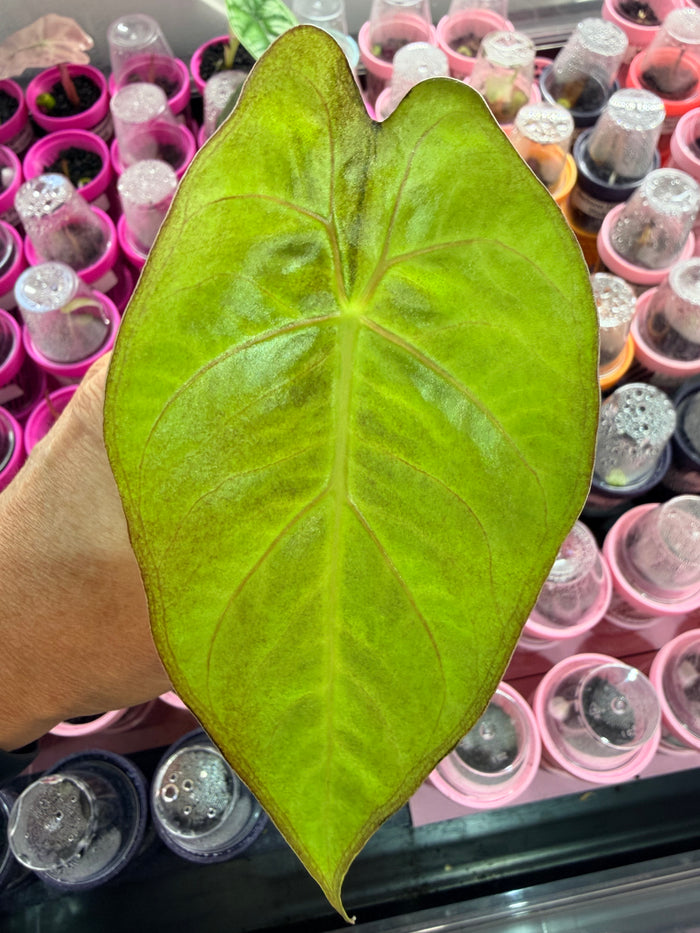
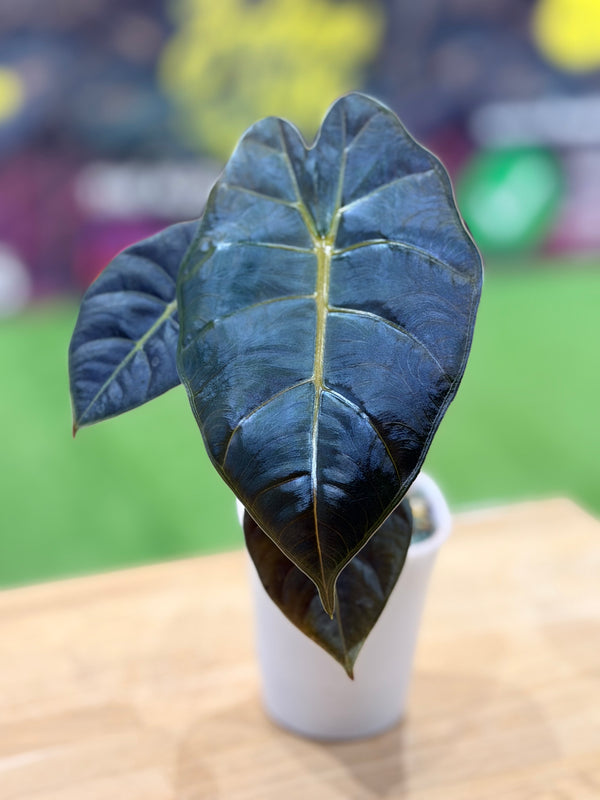
Metallic, Iridescent Surface: The extraordinary coppery sheen that makes cuprea leaves appear almost holographic. This structural colour (not pigmentation) creates the luminous quality that sets cuprea hybrids apart.
Thick, Substantial Leaves: Cuprea produces robust foliage with excellent structural integrity. This thickness carries through to hybrids, creating leaves that hold their shape and resist damage.
Compact Growth Habit: Cuprea's naturally more compact form helps keep hybrids to manageable dimensions whilst maintaining impressive leaf size.
Robust Constitution: Exceptional stress tolerance and adaptability make cuprea genetics valuable for creating hybrids suitable for cultivation rather than just visual appeal.
Deep Colouration: The coppery-green to almost bronze tones provide rich base colours that interact beautifully with other genetic influences.
Alocasia Micholitziana 'Green Velvet' (Frydek): The Velvety Contrast
Alocasia micholitziana, particularly the 'Green Velvet' or Frydek form, contributes equally important traits:
Velvety Leaf Texture: The distinctive soft, plush surface texture that makes Frydek so tactilely appealing. This velvety quality contrasts beautifully with cuprea's glossy finish.
Dramatic White Veination: Bold, prominent white veins that create striking architectural patterns across the leaf surface. This veining provides structural contrast and visual interest.
Arrow-Shaped Leaf Form: The classic sagittate (arrow-shaped) leaves with elongated posterior lobes create elegant silhouettes.
Deep Green Base Colour: Rich, saturated green provides the perfect canvas for displaying white veination and creates beautiful contrast with cuprea's metallic tones.
Graceful Growth Pattern: Frydek's elegant growth habit and leaf presentation add refinement to the robust cuprea foundation.
The Synergy in Blood Bone
When these two exceptional species combine with cuprea as the berry carrier, the result is a hybrid that balances:
- Metallic sheen from cuprea with velvety texture from Frydek
- Compact growth from cuprea with graceful form from Frydek
- Robust constitution from cuprea with refined aesthetics from Frydek
- Deep colouration from cuprea with striking veination from Frydek
Most distinctively, the deep red stems that define Blood Bone emerge from this specific genetic combination and crossing order.
The Significance of Crossing Order: Blood Bone vs. Golden Bone
One of the most fascinating aspects of Blood Bone is its relationship to Alocasia Golden Bone, two hybrids using the same parent species but in reversed crossing order, producing distinctly different results.
Understanding Maternal vs. Paternal Influence
In plant hybridisation, which parent carries the berries/seeds (maternal parent) versus which provides pollen (paternal parent) can dramatically affect offspring characteristics:
Maternal Parent Influence:
- Contributes cytoplasmic genetic material (mitochondria, chloroplasts)
- Often has stronger influence on growth habit and structure
- Provides the seed development environment
- Can affect variegation stability and expression
Paternal Parent Influence:
- Contributes nuclear genetic material only
- Often influences colour, pattern, and specific traits
- Can affect flowering characteristics
- May have subtler but important effects on leaf characteristics
Blood Bone: Cuprea × Frydek
Crossing Order:
- Maternal parent (berry carrier): Alocasia cuprea
- Paternal parent (pollen donor): Alocasia micholitziana 'Green Velvet'
Resulting Characteristics:
- Deep red stems (the defining Blood Bone feature)
- Stronger cuprea influence in growth habit and structure
- Metallic surface quality more prominent
- Compact growth pattern emphasised
- Red pigmentation in stems and petioles
- Leaf substance and thickness from cuprea genetics
- Frydek's veination pattern overlaid on cuprea foundation
Golden Bone: Frydek × Cuprea (Reversed Cross)
Crossing Order:
- Maternal parent (berry carrier): Alocasia micholitziana 'Green Velvet'
- Paternal parent (pollen donor): Alocasia cuprea
Resulting Characteristics:
- Golden/yellow stems (defining Golden Bone feature)
- Stronger Frydek influence in growth habit
- Velvety texture more prominent
- More elongated leaf form
- Yellow/golden pigmentation in stems
- Frydek's growth pattern as foundation
- Cuprea's metallic quality as overlay
Why This Matters for Collectors
Understanding that Blood Bone and Golden Bone are not simply "variations" but distinct hybrids with reversed parentage adds significant interest:
Genetic Appreciation: Collectors can appreciate the hybridiser's skill in recognising that crossing order would produce different, equally valuable results.
Collection Building: Advanced collectors often pursue both crosses to study the differences firsthand, making Blood Bone and Golden Bone complementary acquisitions.
Breeding Knowledge: For collectors interested in hybridisation themselves, these paired examples demonstrate crossing order effects practically.
Provenance Value: Documented crossing order adds legitimacy and value, distinguishing these hybrids from random seedlings or unnamed crosses.
The Defining Feature: Deep Red Stems
The most immediately recognisable characteristic of Alocasia Blood Bone is its distinctive deep red stems, a feature so prominent it inspired the cultivar name.
Visual Impact
Colour: Deep burgundy-red to blood-red stems (hence "Blood Bone") that create dramatic contrast against the leaf colour. This pigmentation extends through:
- Petioles (leaf stems)
- Main leaf veins (where they connect to petioles)
- Occasionally into the midrib itself
Consistency: The red colouration appears reliably across all new growth, making it a stable identifying characteristic rather than a variable expression.
Contrast: The deep red creates strong visual contrast against:
- The metallic green-copper leaf surfaces
- White or pale veining inherited from the Frydek parent
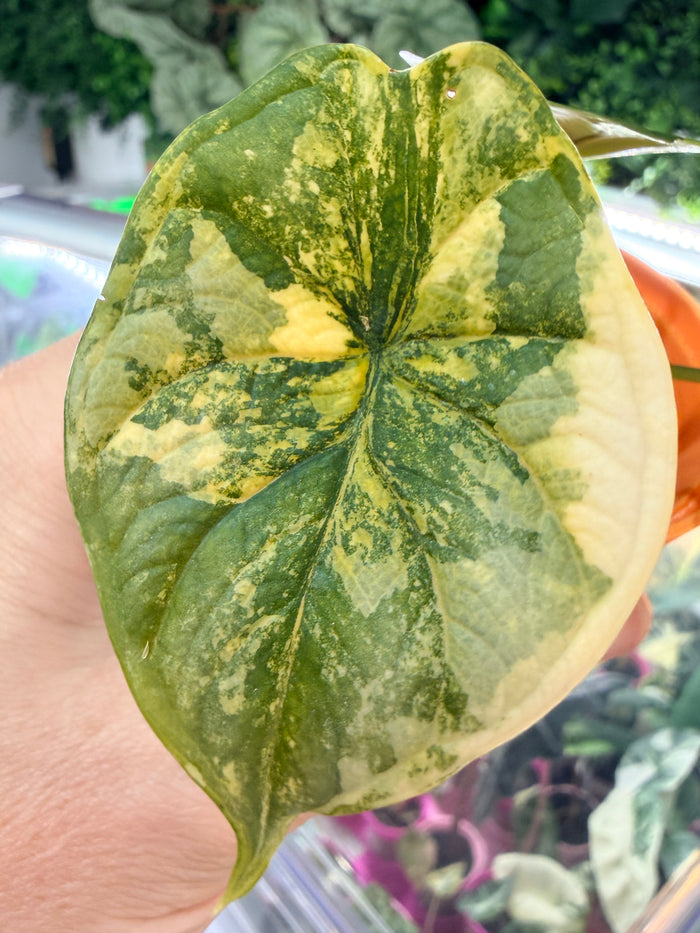
- Any variegation that may occasionally appear
Botanical Significance
The red pigmentation results from anthocyanin production, the same compounds responsible for pink variegation in Alocasia. However, in Blood Bone, the anthocyanins concentrate in stems and vascular tissue rather than leaf surfaces.
This pigmentation serves several functions:
- Protects vascular tissue from UV damage
- May provide some stress protection
- Creates the distinctive appearance collectors prize
- Serves as a genetic marker for this specific hybrid
Identification Confidence
The deep red stems provide absolute confidence in plant identification, crucial in a market where mislabelling is common. When you acquire Blood Bone, the red stems confirm you have the genuine Wim Philtjens hybrid rather than:
- A random cuprea × Frydek seedling
- Mislabelled Golden Bone
- One of the parent species
- An unrelated hybrid marketed incorrectly
This visual certainty adds significant value for collectors building documented collections.
Growing Alocasia Blood Bone
Blood Bone inherits favourable cultivation characteristics from both parents, making it relatively approachable for collectors experienced with either cuprea or Frydek.
Light Requirements
Blood Bone thrives in bright indirect light that showcases both the metallic cuprea-inherited sheen and the deep red stem colouration.
Optimal Conditions:
- Bright indirect light from east or west-facing windows
- Can tolerate slightly lower light than pure Frydek (cuprea influence)
- Benefits from supplemental LED grow lights
- Aim for 12-14 hours quality light during active growth
Light Effects on Appearance:
- Strong light intensifies red stem pigmentation
- Adequate light maintains metallic sheen
- Enhances any white veination from Frydek genetics
- Supports compact growth habit
Avoid direct sunlight which can scorch the velvety leaf surfaces inherited from the Frydek parent.
Humidity and Temperature
Blood Bone appreciates typical Alocasia conditions with some tolerance inherited from the robust cuprea parent.
Humidity:
- Target 60-70% for optimal growth
- Can tolerate 50-60% better than pure Frydek (cuprea hardiness)
- Higher humidity enhances leaf size and quality
- Prevents brown leaf edges and maintains velvety texture
Temperature:
- Optimal range: 18-27°C (65-80°F)
- Minimum: 15°C (59°F) for short periods
- Consistent warmth supports active growth
- Protect from cold draughts and sudden temperature drops
The cuprea genetics provide somewhat better tolerance of less-than-perfect conditions compared to some Alocasia, though optimal care produces the most impressive specimens.
Watering and Substrate
Watering Strategy:
- Keep substrate consistently moist
- Allow top 2-3cm to dry between waterings
- Reduce frequency significantly when growth slows
- Water thoroughly when watering, ensuring good drainage
The thick leaves inherited from cuprea store some water, providing modest drought tolerance, but consistent moisture produces best results.
Optimal Growing Media:
Blood Bone performs exceptionally well in systems that provide both moisture and aeration:
Fluval Stratum (Excellent Choice):
- Lightweight volcanic substrate provides perfect aeration
- Retains adequate moisture without waterlogging
- Allows easy root monitoring in transparent containers
- Natural pH slightly lower than standard substrates
- Supports robust root development
- LECA provides maximum aeration and root visibility
- Prevents overwatering whilst maintaining consistent moisture
- Ideal for monitoring the robust root system Blood Bone develops
- Mineral-based substrate perfect for Lechuza self-watering systems
- Excellent drainage with good moisture retention
- Suitable for the compact growth habit
Premium Soil Mix: If using traditional substrate:
- 40% quality potting compost
- 30% perlite or pumice
- 20% orchid bark
- 10% horticultural charcoal
- Ensures drainage whilst retaining moisture
Feeding for Optimal Growth
Use our comprehensive Alocasia plant feed programme to support vigorous growth and maintain the distinctive red stem colouration.
During Active Growth:
- Feed with every watering for plants in inert media
- Feed every second watering for soil-based substrates
- Complete nutrient solution with micronutrients
- Boosters during peak growth
Key Nutrients for Blood Bone:
Nitrogen: Supports the lush foliage and vigorous growth inherited from both parents.
Magnesium: Essential for chlorophyll production and the green base colour that contrasts with red stems.
Superthrive: Vitamin B complex and kelp-based growth enhancers support overall plant health and stress resistance.
Silicon (Mills Vitalize): Strengthens cell walls, enhancing the substantial leaf quality inherited from cuprea.
Complete Micronutrients: Iron, manganese, and other trace elements support the anthocyanin production that creates the red stems.
For detailed feeding protocols, see our comprehensive feeding guide.
Container Selection
Self-Watering Pots: Excellent for maintaining consistent moisture without overwatering risk. The compact cuprea-influenced growth habit suits self-watering systems well.
Transparent Containers: Ideal when using Fluval Stratum or LECA, allowing you to monitor the root system and appreciate the robust root development Blood Bone produces.
Size Appropriately: Blood Bone's compact growth habit means it doesn't require oversized containers. Choose pots 2-5cm larger than the root ball, upsizing gradually as the plant grows.
Pest Management
Monitor regularly for common Alocasia pests:
Spider Mites: Can be problematic in low humidity. The velvety Frydek-inherited texture can hide early infestations, so regular inspection is crucial.
Thrips: Attracted to new growth. Check new leaves carefully as they unfurl.
Aphids: May cluster on the distinctive red stems and young leaves.
Keep pest control products immediately available for early intervention. The substantial leaf thickness from cuprea genetics provides some resistance, but vigilance remains essential.
Why Advanced Collectors Prize Blood Bone
Several factors make Blood Bone so highly sought-after among serious Alocasia collectors:
Documented Hybridisation Heritage
Unlike random seedlings or unnamed crosses, Blood Bone offers:
- Known hybridiser (Wim Philtjens)
- Documented parentage (cuprea × micholitziana 'Green Velvet')
- Recorded crossing order (cuprea as berry carrier)
- Verifiable provenance
This documentation provides confidence and adds value to advanced collections where provenance matters.
Genuine Scarcity
Blood Bone remains genuinely rare because:
- Limited production by the original hybridiser
- Not mass-produced through tissue culture
- Distribution primarily through collector networks
- Each plant traceable to Philtjens' original cross
This authentic rarity distinguishes it from plants marketed as "rare" but widely available.
Distinctive Visual Identity
The deep red stems provide:
- Instant visual identification
- Confidence in authenticity
- Unique aesthetic not available in either parent species
- Conversation-starting beauty
Scientific Interest
For collectors interested in hybridisation and genetics:
- Demonstrates crossing order effects (vs. Golden Bone)
- Shows how parent selection creates specific outcomes
- Illustrates anthocyanin expression in stems vs. leaves
- Provides breeding insights for future projects
Collection Completeness
Blood Bone represents:
- Modern hybridisation excellence
- The cuprea hybrid family
- Philtjens' work as an emerging hybridiser
- Paired study opportunity with Golden Bone
Advanced collectors building comprehensive Alocasia collections recognise Blood Bone as an essential acquisition.
Building Context: Related Hybrids and Species
Understanding Blood Bone's place within the broader Alocasia world enhances appreciation:
The Parent Species
Alocasia Cuprea: Experiencing the parent species firsthand helps you recognise which Blood Bone characteristics derive from cuprea genetics. The variegated form we offer showcases cuprea's exceptional qualities with added rarity.
Alocasia Micholitziana 'Green Velvet' (Frydek): Similarly, growing the Frydek parent (particularly in variegated form) provides context for understanding Blood Bone's velvety texture and veination patterns.
Related Hybrids
Alocasia Golden Bone: The reversed cross (Frydek × cuprea) with golden/yellow stems. Acquiring both allows direct comparison of how crossing order affects results, a fascinating study for serious collectors.
Other Cuprea Hybrids: Blood Bone joins distinguished company in the cuprea hybrid family, including the historic Alocasia Chantrieri (cuprea × sanderiana). Studying multiple cuprea hybrids reveals how different second parents interact with the cuprea foundation.
Variegation Possibilities
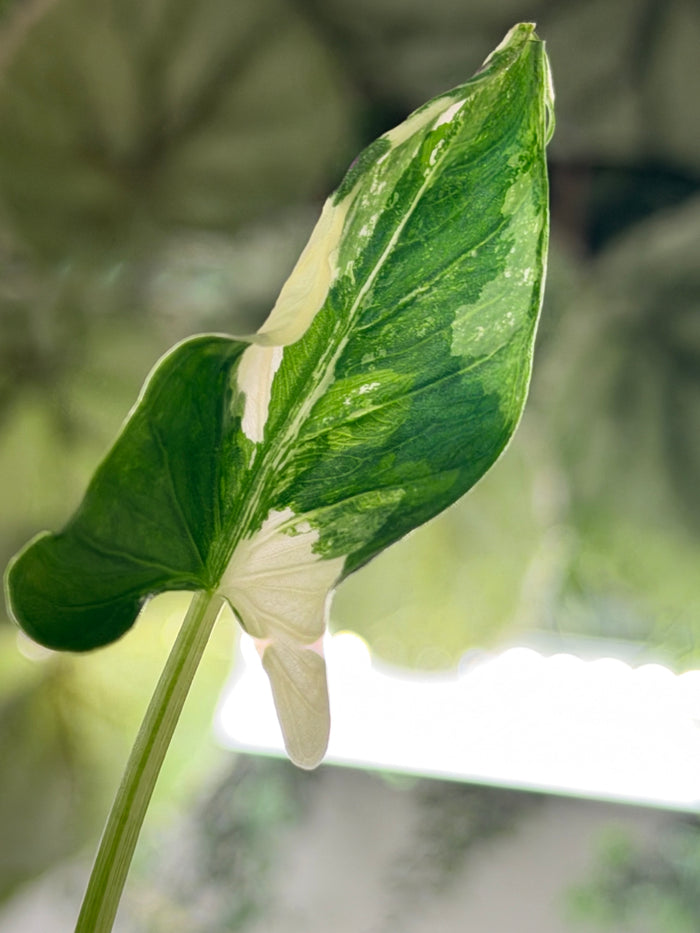
Whilst the standard Blood Bone already commands significant interest, hybridisation occasionally produces variegated sports. Should variegated Blood Bone emerge, it would combine:
- The distinctive red stems
- Metallic cuprea-inherited surface
- Variegation (likely albo or potentially pink)
- Documented hybrid heritage
Such a specimen would represent the ultimate expression of Blood Bone genetics, a possibility that adds future potential to current acquisitions.
Acquiring Alocasia Blood Bone
Due to genuine scarcity and limited production, opportunities to acquire Blood Bone remain rare. When specimens become available, they move quickly through collector networks to those who understand their significance.
What to Look For
When evaluating Blood Bone specimens:
Stem Colour Verification: The deep red stems must be present and pronounced. This is the defining characteristic, if stems are green or only slightly reddish, authenticity is questionable.
Plant Health:
- Firm, healthy leaves showing no pest damage
- Active growth point with new leaf developing
- Clean, robust root system (if visible)
- No signs of disease or rot
Size Considerations: Blood Bone available in various sizes from juvenile plants through mature specimens. Smaller plants offer lower entry cost whilst mature specimens provide immediate impact.
Provenance: Ideally, acquisition includes information about:
- Where the plant originated
- How many generations removed from Philtjens' original cross
- Any growing history or special characteristics
Investment Considerations
Blood Bone represents a significant investment reflecting:
- Genuine rarity and limited availability
- Documented hybridiser and parentage
- Distinctive visual characteristics
- Costs of specialised propagation
- Position in collector market
This positions Blood Bone as a serious acquisition for established collections rather than an impulse purchase, ensuring each plant goes to collectors who will provide appropriate care and appreciate its significance.
Complete Growing Setup
When acquiring Blood Bone, ensure success with quality equipment:
Growing Systems:
- Fluval Stratum for optimal root development
- Self-watering pots for consistent moisture
- Lechuza systems for premium results
- Quality substrates for traditional growing
Environmental Control:
- LED grow lights for optimal lighting
- Heat mats if growing in cooler locations
- Humidifier for maintaining 60-70% humidity
Nutrition:
- Our balanced feed programme
- Superthrive for optimal growth
- Nutrients and boosters for peak performance
Protection:
- Pest control products for prevention
- Complete plant care essentials
UK Delivery
We ship to UK addresses only:
- Free delivery on orders over £75
- Dispatch Monday to Thursday, 12pm cut-off for next-day services
- Premium protective packaging
- Heat pads when needed
- Fully insured postage
- 7-day live arrival guarantee
The Future of Documented Hybrids
Alocasia Blood Bone exemplifies where serious collecting is heading, toward documented, intentionally created hybrids with known parentage rather than random mutations or unnamed seedlings.
Emerging Trends
Hybridiser Recognition: Collectors increasingly value knowing who created a hybrid and how, elevating skilled hybridisers like Philtjens to respected positions within the community.
Provenance Premiums: Plants with documented breeding history command higher prices and greater respect than unnamed crosses, even if visually similar.
Crossing Order Awareness: Understanding that parentage order matters adds depth to collecting, encouraging pursuit of paired crosses like Blood Bone and Golden Bone.
Scientific Collecting: Beyond simple aesthetics, collectors study hybrids to understand genetics, breeding techniques, and trait inheritance.
Philtjens' Continued Work
As an emerging hybridiser, Wim Philtjens' future creations will likely benefit from Blood Bone's success. Early adopters of his work position themselves to acquire future releases, building comprehensive collections of his hybrids.
Breeding Possibilities
For collectors with hybridisation interests, Blood Bone offers:
- Proven genetics for further breeding projects
- Opportunity to create F2 generations
- Potential for backcrossing to parent species
- Basis for studying trait inheritance
Explore Exceptional Alocasia
If Alocasia Blood Bone has captured your interest, discover our complete range of rare specimens and related cultivars:
Parent Species:
- Alocasia Cuprea Latte Variegated - The metallic parent with variegation
- Alocasia Frydek Albo Variegated - The velvety parent with white variegation
Related Hybrids:
- Alocasia Chantrieri - Historic cuprea hybrid (cuprea × sanderiana)
- Alocasia Chantrieri Pink Variegated - Ultimate cuprea hybrid expression
Rare Alocasia Collections:
- All Rare Alocasia - Complete collection of exceptional cultivars
- Mature Plants - Specimen-size rarities for immediate impact
- Juvenile Plants - Young plants to grow and develop
- New Arrivals - Latest rare imports
Variegated Collections:
- Pink Variegated Alocasia - Rare pink expressions
- Albo Variegated Alocasia - Classic white variegation
- Aurea Variegated Alocasia - Golden-yellow cultivars
Educational Resources:
- Complete Guide to Alocasia Variegation Types
- The Mystery of Pink Variegation
- Aurea Variegation Explained
Many collectors build their collection from corms, and propagating them successfully is simpler than it looks. Our Alocasia corm propagation guide covers the self-wicking method we use in the nursery, from choosing a firm corm to keeping it in the right conditions until it sprouts.
Questions about Alocasia Blood Bone, documented hybrid heritage, or building an advanced collection around intentionally created hybrids? Contact our team for expert guidance from specialists who understand both the botanical significance and cultivation requirements of rare, documented Alocasia hybrids. Our UK-based private nursery works directly with hybridisers and serious collectors worldwide, ensuring you receive knowledgeable support backed by genuine expertise in rare specimen cultivation.