
Currently sold out
TANDURUSA 'JACKLYN' ALBO VARIEGATED
New plants go to the drop list first.
Join the drop listThere are plants whose names arrive in horticulture before their botanical identity is fully resolved. Alocasia 'Jacklyn' is one of them, a plant that circulated globally in collector communities under a trade name for years before the formal species description caught up with it. When it did, the result was Alocasia tandurusa Prameswara & A. Hay, formally published in 2023 in a botanical paper documenting a new bipinnatifid-leaved species from Sulawesi. The specific epithet represents a Latinisation of "Tanduk Rusa", the Indonesian vernacular name meaning deer antlers, a direct reference to the deeply lobed, antler-like leaf form that makes this species unlike almost any other Alocasia in cultivation.
The name 'Jacklyn' has an equally specific origin. Aroidpedia records that Enjie Jacklin, a local of Gorontalo in Northern Sulawesi, bought the first few individuals of this species and popularised it online under the name Alocasia 'Jacklin'. 'Jacklyn', the spelling that subsequently became dominant in the trade, is documented by Aroidpedia as a misspelling of the original. Both spellings remain in circulation; the species is Alocasia tandurusa.
The albo variegated form adds chimeric white to cream variegation across that already extraordinary lobed leaf structure, a combination that produces one of the most visually complex plants in the collector Alocasia world. This guide covers the species, the variegation, the care requirements in UK conditions, and the conservation context that all responsible collectors of this species should understand.
The Species: Alocasia tandurusa
Formal Description and Provenance
Alocasia tandurusa was formally described by Prameswara and A. Hay in 2023, with the type specimen collected in West Java from material originating from Bolaang Mongondow Regency of Sulawesi Utara (North Sulawesi). The holotype is housed at BO (Herbarium Bogoriense). The formal description was published in a dedicated paper: Alocasia tandurusa Prameswara & A. Hay, A new (bi)pinnatifid-leaved species from Sulawesi.
Aroidpedia is explicit on a critical conservation point: since the plant came to be known to global horticultural collectors during the aroid mania of the Covid pandemic, the main known wild population in Bolaang Mongondow Regency has been severely depleted. A second, more remote and less accessible population is known but its location is being deliberately withheld from public botanical records to prevent further stripping. Aroidpedia states directly: "easy on-line access to accurate locality data for desirable plants is now resulting in unsustainable stripping of wild populations of aroids in many parts of the tropics worldwide." This is the conservation reality behind Alocasia tandurusa, and it provides an important reason why tissue culture propagation of this species is not merely commercially convenient but genuinely conservation-relevant.
The species relationships are described by Aroidpedia as unclear. Preliminary molecular analyses have been inconclusive. It is noted that the deeply lobed, pinnatifid leaf form, which gives the plant its striking appearance, recurs in several disparate Alocasia clades in New Guinea and the Philippines, making morphological placement unreliable. The closest Philippine relatives are suggested to include Alocasia portei and Alocasia sanderiana.
Climate and Habitat
Aroidpedia documents the natural habitat as wet lower montane forest in North Sulawesi. The climate is tropical humid, with humidity moderate year-round at 60 to 70 percent, temperatures varying seasonally from approximately 9°C to 31°C during the day, with minimums never dropping below 7°C. There is a rainy and humid season from October through May and a dry season between June and October, with annual rainfall averaging 1,200 mm.
The lower montane forest habitat is important context. Unlike the strictly lowland species that dominate the jewel Alocasia world, tandurusa has some adaptation to slightly cooler and more variable conditions at altitude, which may explain its relative tolerance in UK home cultivation compared to strictly equatorial lowland species.
Species Description
The formal morphological description documents a moderately robust terrestrial herb to approximately 1 m tall, with a curved decumbent rhizome to about 7 cm diameter. Leaves are 1 to 4 together, with petioles to 75 cm long, sheathing in the lower 17 to 20 percent, speckled and mottled brownish to purplish. Adult blades reach to approximately 70 cm long and are deeply pinnatifid, lobed more than halfway to the midrib, with the lobes often slightly and irregularly curved, and sometimes the lobes with subsidiary lobes, making the blade sometimes weakly bipinnatifid. Three to four lateral lobes on each side of the anterior lobe carry one primary vein running to the tip.
The adaxial surface is often pubescent, finely hairy, particularly on younger leaves, with raised tertiary veins. The abaxial side is glabrous and sometimes entirely suffused with or completely purple. The characteristic axillary glands on the abaxial side, located in the vein axils, are a diagnostic feature documented in the formal description. Variegated forms (white, yellow, mottled) are recorded by Aroidpedia.
Albo Variegation in Alocasia Jacklyn
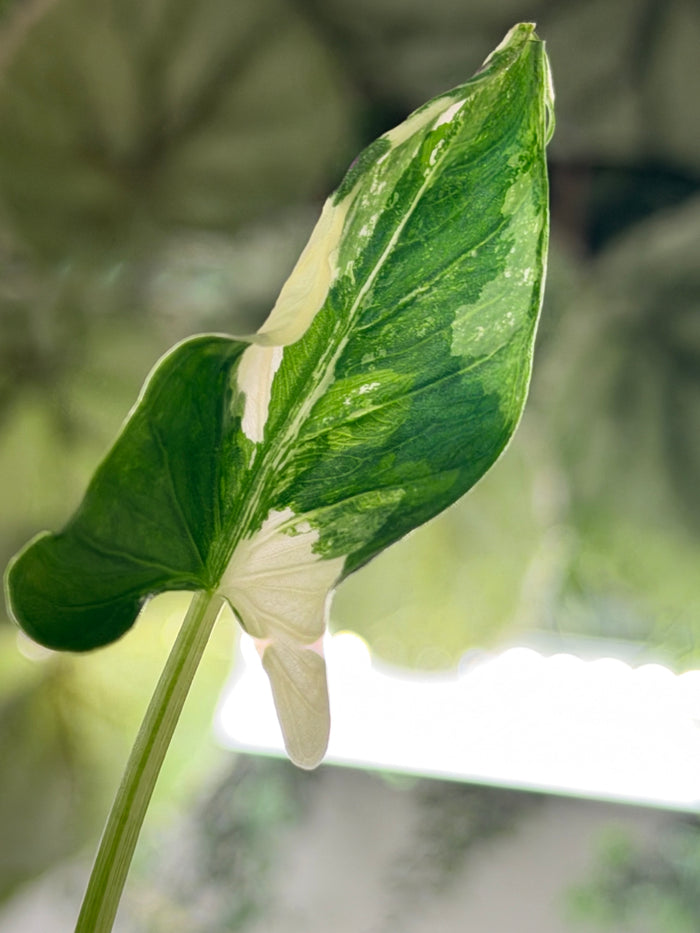
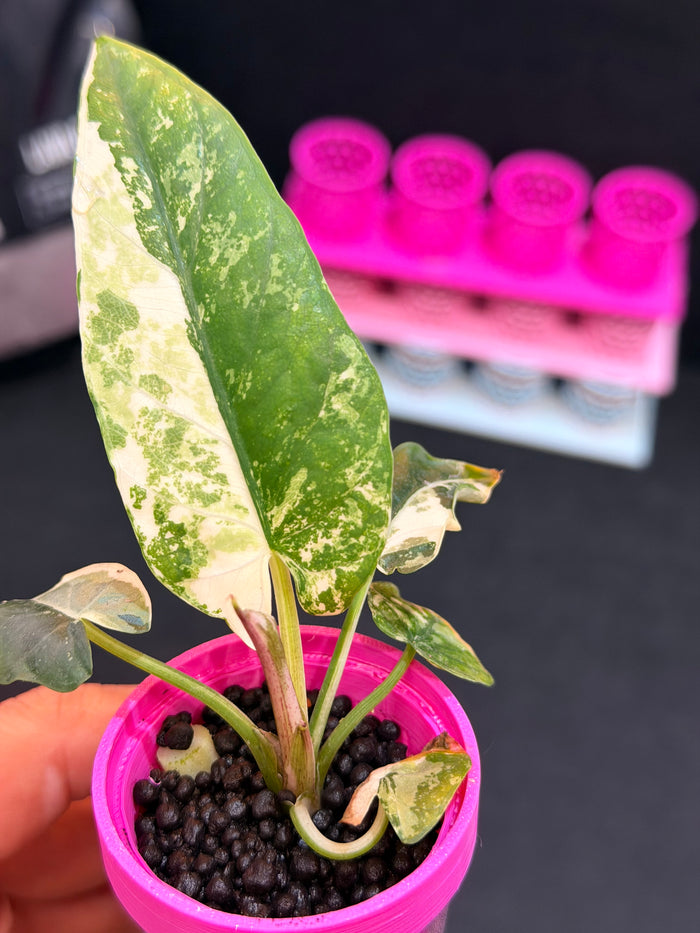
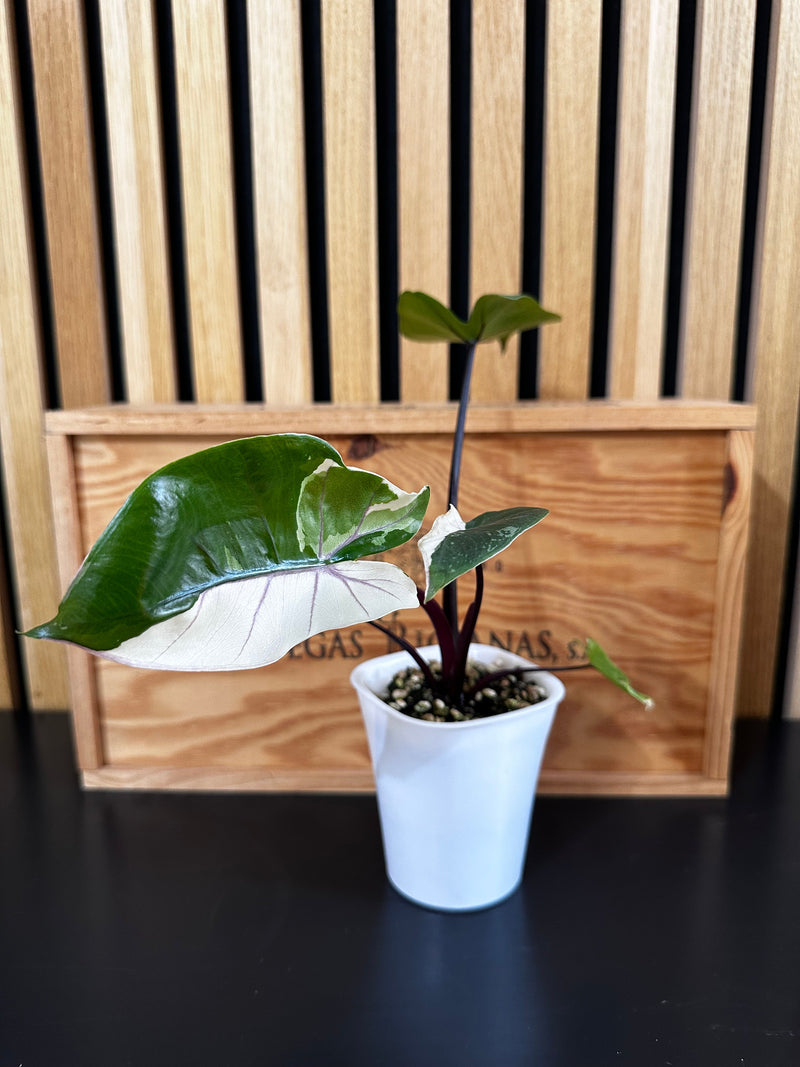
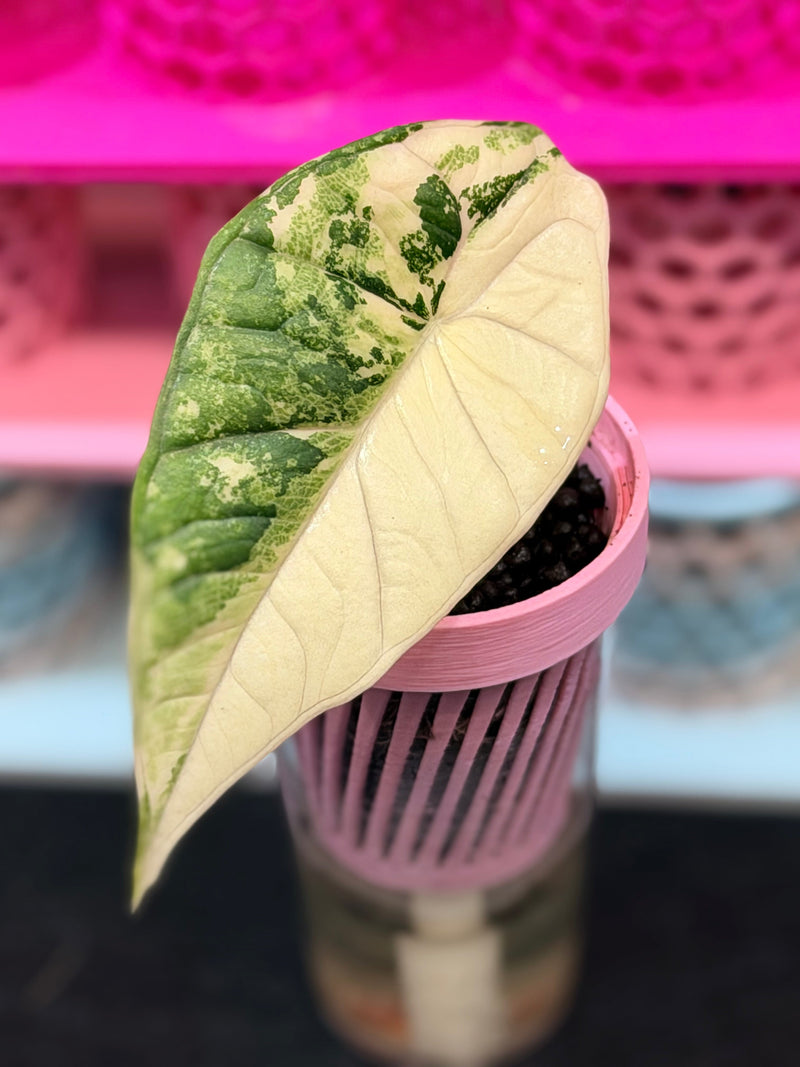
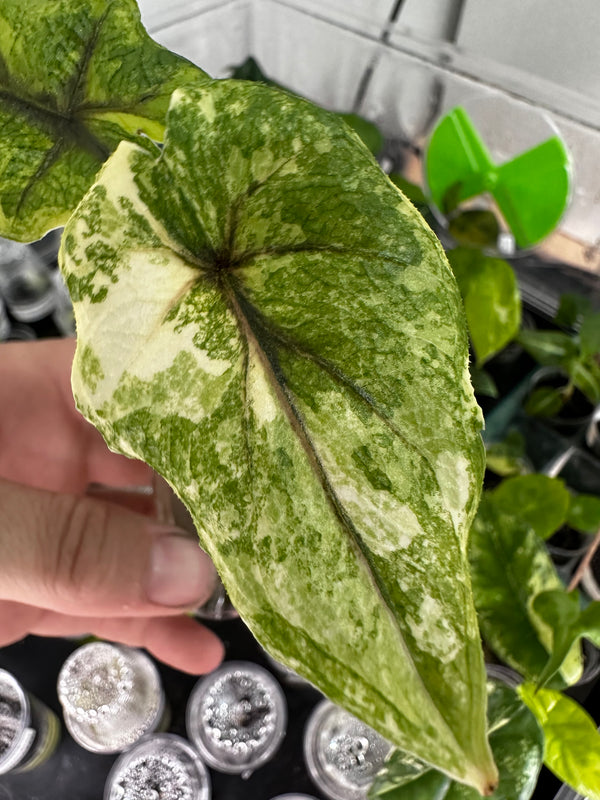
The albo variegated form of Alocasia tandurusa overlays chimeric white to cream variegation across the deeply pinnatifid leaf structure. Against the bright green adaxial surface and the intricate lobe pattern of the type, the albo sectors create a visual complexity that is genuinely unlike anything the conventionally leaf-shaped jewel Alocasia produce. Large cream sectors across a lobed leaf divide the blade into pools of colour separated by the dark primary venation, an effect that rewards close examination and changes appearance as new leaves unfurl.
The chimeric mechanism is the same as in other albo variegated Alocasia, genetically distinct cell populations in the apical meristem, some of which produce inadequate chlorophyll, resulting in pale sectors where the underlying leaf tissue is visible without green pigment masking it. For the detailed cellular science, our albo variegation guide and complete variegation types overview cover the mechanisms in full.
The pubescent (hairy) adaxial surface of tandurusa adds an additional tactile dimension to the variegated form that smooth-leaved species lack. The fine hairs along the raised tertiary veins contrast against the smooth cream of the albo sectors, a detail that distinguishes this species even from close-up comparison with other variegated Alocasia.
Growing Alocasia Jacklyn Albo in the UK
Light
The lower montane forest background of tandurusa suggests adaptation to filtered light conditions, below the forest canopy but at elevations where light intensity is somewhat moderated. In UK home cultivation, bright indirect light is the target, sufficient to maintain good growth momentum and support the photosynthetic requirements of the partially de-greened albo form, but without the direct exposure that would risk scorching the soft, hairy leaf surface.
LED grow lights are particularly useful for this cultivar where natural light intensity and duration may be insufficient to support active growth. The deeply lobed leaf form means individual lobes can shade each other, making consistent all-round light from a supplemental source more effective than relying on a single directional window source.
Substrate and Watering
The lower montane forest ecology, moderate humidity, seasonal rainfall variation, and a rhizome with prolific small tubercles adapted to soil anchoring, indicates a plant that appreciates consistent moisture but handles some variation better than strictly lowland tropical species. Fluval Stratum provides the appropriate balance of moisture retention and drainage for this growth form. Allow the top 2 to 3 cm to dry between waterings. The rhizome can develop to 7 cm diameter at maturity, so pot size should accommodate this as the plant matures.
Temperature
The habitat temperature range, 9°C to 31°C with minimums above 7°C, suggests broader temperature tolerance than strictly equatorial species, but in UK cultivation the practical target remains 16 to 25°C with no sustained cold below 13°C. The montane adaptation does not mean this is a cool-tolerant plant by UK standards, it means it can handle moderate variation, not prolonged chilling.
Humidity
Moderate humidity of 60 to 70 percent is the documented natural range, achievable in many UK settings with modest intervention. A desktop humidifier or grouped plants, particularly with central heating, should maintain appropriate conditions. The pubescent leaf surface of tandurusa is slightly more resistant to humidity-induced stress than smooth-leaved species, as the fine hairs provide some boundary layer protection at the leaf surface.
Pests
Spider mites and thrips are the primary pest concerns, as with most Alocasia in UK conditions. The deeply lobed leaf form creates more hidden surface area for mites to colonise on the undersides, regular inspection between lobes is particularly important.
Conservation Note
Given the documented depletion of wild Alocasia tandurusa populations during the Covid-era aroid boom, collectors acquiring this species from tissue culture propagation, which our Alocasia Jacklyn Albo specimens are, are supporting propagation methods that reduce demand for wild collection. This is not simply a commercial distinction but a meaningful conservation choice. Tissue culture propagation means no wild plants are removed to service collector demand; all specimens carry the same genetics produced in sterile, controlled conditions.
Our tissue culture acclimatisation guide covers the transition from laboratory to home environment in full.
Questions about Alocasia Jacklyn Albo, the tandurusa species, or tissue culture acclimatisation for rare Alocasia? Contact our team for guidance from specialists at our UK-based private nursery.
If you would like to grow more plants of your own, our Alocasia corm propagation guide explains how to propagate Alocasia corms using the self-wicking method, including how to choose a healthy corm and what to expect while it sprouts.