
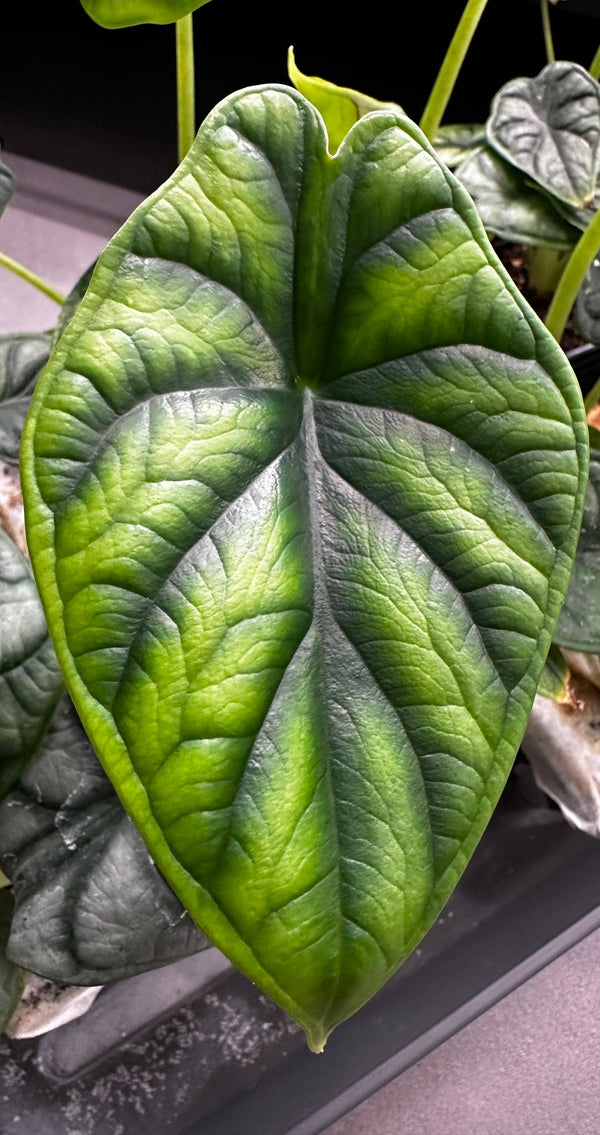
Of all the Alocasia cultivars that have captured collector attention in the past decade, Alocasia baginda 'Dragon Scale' has sustained its position at the top with an unusually firm grip. The reasons are easy to articulate once you have stood in front of a well-grown specimen: the three-dimensional, deeply bullate adaxial surface, the scale-like raised areas of pale grey contrasting against the dark, matte green primary and secondary venation, creates a textural complexity that is structural rather than cosmetic. This is not a leaf that looks interesting in photographs and disappoints in person. It is one of the few Alocasia where the physical quality of the surface exceeds what photography can adequately convey.
The cultivar is named precisely, too. The leaf's bullate patterning genuinely resembles scale, the organised, overlapping structure of reptile skin or armoured plate. Each raised area between the veins is defined by the venation surrounding it, creating a network of scale-like cells across the entire blade. This characteristic, documented in the formal species description, is what distinguishes 'Dragon Scale' from 'Silver Dragon' (the sister cultivar with silver interveinal colouration rather than grey), and from the type species Alocasia baginda itself.
This guide covers the full botanical background of Alocasia baginda, the cultivar characteristics, the notable hybrids it has contributed to, and complete care guidance for UK conditions.
The Species: Alocasia baginda
Formal Description
Alocasia baginda was formally described by Peter Boyce and Deden Mudiana in Acta Phytotaxonomica et Geobotanica volume 61 in 2011. The type material was cultivated at the Bali Botanic Garden (Kebun Raya Eka Karya Bali) under garden accession E20081015, originally from Eastern Kalimantan, Indonesian Borneo. The holotype is preserved as dried specimens and inflorescences in alcohol at THBB.
The Latin original description distinguishes baginda from Alocasia melo, the morphologically closest species, on two primary grounds: the adaxial leaf surface in baginda is smooth (not strongly rugose as in melo), and the interveinal areas carry pale grey bullate portions rather than the generalised rugosity of melo. The specific epithet baginda comes from the Bahasa Indonesia honorific meaning 'King' or 'Majesty', chosen in recognition of the species' considerable horticultural merit, carrying on the genus' tradition of applying regal epithets to exceptional species.
The ecological inference in the formal description is notably candid: Alocasia baginda most closely resembles species that are locally endemic and associated with limestone or ultramafic substrates, and the authors suggest that a search of ultramafic and limestone outcrops in Eastern Kalimantan would likely locate the species in the wild. The ecology remains unknown, the species was described from cultivated material.
Climate and Growing Conditions
Aroidpedia documents the Eastern Kalimantan habitat as equatorial lowland humid forest, with humidity consistently high at 80 to 90 percent, notably higher than the moderate 60 to 70 percent range of the Philippine and limestone-habitat specialists. Temperatures are relatively uniform throughout the year, ranging from approximately 23°C early morning to 32°C during the day, with lowland minimums generally not dropping below 20°C. Annual rainfall is between 3,300 and 4,600 mm.
This equatorial lowland climate means Alocasia baginda is adapted to consistently high humidity and warm, stable temperatures with minimal seasonal variation. In UK cultivation this makes it more demanding than the montane Philippine species or the limestone Borneo specialists, but still manageable with appropriate humidity management.
Species Description
The formal species description documents a small rather robust terrestrial herb 25 to 30 cm tall, developing in age into a short decumbent rhizome. Leaves up to 4 together, spreading. Petioles 13 to 23 cm long, pale green with scattered white speckles in the lower part. The leaf blade is very broadly ovate to sub-orbicular, peltate, 10 to 18 cm long, 7 to 12 cm wide, stiffly and thickly coriaceous. The adaxial surface is matte dark green, with contrasting pale grey bullate portions defined by the primary and marginal veins. The abaxial (underside) surface is pale green, with the distal part of the midrib and the primary and marginal veins in deep red, a diagnostic feature visible from beneath the leaf.
The inflorescence is solitary, with peduncle 12 to 13 cm long; spathe 5 to 6 cm long; the spadix distinctly shorter than to subequalling the spathe, 4 to 4.5 cm long. The spathe constriction in baginda is situated about mid-way up the staminate flower zone, distinguishing it from Alocasia melo where the constriction coincides with the top of the staminate zone.
The Baginda Hybrid Legacy
Alocasia baginda has contributed to a remarkable modern hybrid lineage. Aroidpedia documents: Alocasia 'Black Dragon' (Alocasia baginda 'Silver Dragon' × Alocasia reginula 'Black Velvet'), Alocasia 'Dragon Moon' (Alocasia melo × Alocasia baginda 'Silver Dragon'), the Alocasia 'Green Unicorn' (Alocasia azlanii × Alocasia baginda 'Dragon Scale'), Alocasia 'Silver Streak' (Alocasia baginda 'Silver Dragon' × Alocasia 'Sintang'), Alocasia 'Dragon Wings' (Alocasia baginda × Alocasia scalprum), and Alocasia 'Verta' (Alocasia baginda × Alocasia sinuata). The Green Unicorn hybrid, which uses 'Dragon Scale' as the pollen parent, is in our current collection and our Green Unicorn guide covers the cross and the formal patent documentation in full.
The Cultivar: Dragon Scale
Distinguishing Characteristics
Alocasia baginda 'Dragon Scale' is the cultivar form characterised by the most prominent bullate patterning within the baginda cultivar group, the pale grey raised areas between the dark green veins creating the armour-plate appearance that gives the cultivar its name. The adaxial surface is matte (not glossy), which contributes to the scale effect by absorbing rather than reflecting light. The deep red venation on the abaxial surface provides an additional distinguishing character visible from beneath.
Compared to the sister cultivar 'Silver Dragon', 'Dragon Scale' has a darker overall adaxial reading, the grey bullae against very dark green veins, where 'Silver Dragon' has silver interveinal colouration that creates a lighter, more luminous surface. Both are valuable collectors' plants; the choice between them reflects a preference for dramatic dark contrast versus luminous silver complexity. For a comparison, our Silver Dragon guide covers the sister cultivar in full.
Variegated Forms
Dragon Scale has produced variegated forms including the albo variegated form (Alocasia Dragon Scale Albo Variegated), which combines the bullate textural complexity of the type with chimeric white sectors. Our Dragon Scale Albo guide covers the variegated form in full.
Growing Alocasia Dragon Scale in the UK
Light
The equatorial lowland forest ecology indicates adaptation to filtered forest light, not dim conditions, but consistently diffused indirect light without direct sun exposure. In UK cultivation, bright indirect light from a south or east-facing position is ideal. The matte adaxial surface absorbs light effectively, making the plant relatively efficient at capturing available light, but the high-humidity, low-temperature-variation equatorial background means it still needs consistent warmth and humidity that UK autumn and winter require active management to maintain.
LED grow lights are particularly useful for Dragon Scale through the UK winter, both to maintain growth and to prevent the humidity-stress damage that cold, low-humidity winter conditions can cause on this cultivar's sensitive leaf surface.
Substrate and Watering
Fluval Stratum provides appropriate drainage and moisture balance. Allow the top 2 to 3 cm to dry between waterings. The compact size and relatively limited root mass mean an appropriately sized pot, not oversized, reduces waterlogging risk. Root rot is the primary care failure point for baginda cultivars in UK conditions.
Temperature and Humidity
The equatorial lowland habitat, consistently 23 to 32°C, 80 to 90 percent humidity, annual rainfall 3,300 to 4,600 mm, sets high targets for UK cultivation. In practice, a range of 18 to 27°C and 60 to 80 percent humidity is the working target. Dragon Scale is notably sensitive to cold draughts and to humidity drops during UK winter heating season. A desktop humidifier near the plant, or placement in a humidity-controlled growing cabinet, is the most effective solution.
Pests
Spider mites find the bullate surface of Dragon Scale particularly hospitable, the raised areas between veins create sheltered microenvironments that can harbour mite populations before damage becomes visible. Inspect the undersides of leaves regularly and maintain adequate humidity as primary prevention. The deep red abaxial venation makes mite webbing against that surface visually detectable once established, but by that stage the population is often already significant.
Collector Context
Dragon Scale is the entry point to the baginda cultivar group and the gateway to one of the most productive modern hybrid lineages in the collector Alocasia world. For collectors building out a baginda-focused sub-collection, the natural companions are the Silver Dragon type and the Green Unicorn hybrid that uses Dragon Scale as the pollen parent. Our Alocasia care guide covers the cross-species care fundamentals.
Questions about Alocasia Dragon Scale, the baginda species, or growing jewel Alocasia in UK conditions? Contact our team for guidance from specialists at our UK-based private nursery.