
Alocasia baginda 'Silver Dragon' occupies a particular place in the collector's Alocasia world, a cultivar that earns sustained attention not through shock or novelty, but through a quality of finish that holds up under close inspection. Where 'Dragon Scale' presents a matte dark green with pale grey bullate patterning, 'Silver Dragon' offers something lighter, more luminous: silver interveinal colouration that varies in intensity depending on available light, set against the dark green primary and secondary venation that both cultivars share. The effect is subtle but consistently striking, and at sufficient light levels the silver tones can be genuinely bright across the full leaf surface.
Understanding this cultivar properly requires understanding the species that produced it. Alocasia baginda is documented by Aroidpedia as a formally described species, type material collected from eastern Kalimantan, Indonesian Borneo, and described in Acta Phytotaxonomica et Geobotanica in 2011 by Peter Boyce and Deden Mudiana. The specific epithet baginda comes from the Bahasa Indonesia honorific meaning 'King' or 'Majesty', a naming choice Aroidpedia notes was "influenced by the 'tradition' of applying regal epithets in the genus Alocasia, notably to species with considerable horticultural merit."
For collectors building out a jewel or mid-range Alocasia collection, Silver Dragon is the companion piece to Dragon Scale, same species, same growth character, entirely different surface quality. This guide covers everything you need to know.
The Species: Alocasia baginda
Formal Description and Type Material
Alocasia baginda was formally described based on a specimen cultivated in the Bali Botanic Garden, Kebun Raya Eka Karya Bali, under garden accession E20081015, collected from Eastern Kalimantan. The holotype is preserved as dried specimens and inflorescences in alcohol at THBB. The formal description was published in Acta Phytotaxonomica et Geobotanica volume 61 in 2011.
The Latin diagnosis in the original description distinguishes baginda from Alocasia melo, the most morphologically similar species, primarily through the adaxial leaf surface: baginda is "adaxially smooth (not finely and strongly rugose), dark matte green, with contrasting pale grey bullate portions of the blade." The melo comparison is the key diagnostic: both species share stiffly thickly coriaceous, nearly peltate leaf blades, but where melo is strongly rugose (wrinkled), baginda is smooth, and the interveinal bullate patterning in baginda creates raised scale-like areas rather than a generalised rugosity.
Aroidpedia also notes the interesting ecological inference in the original description: baginda most closely resembles species associated with limestone and ultramafic substrates (Alocasia reginae from Sarawak, Alocasia reginula from Sabah, Alocasia melo from ultramafic areas in Sabah), and the authors suggest that a search of ultramafic and limestone outcrops in Eastern Kalimantan would be the logical next step for locating the species in the wild.
Climate and Ecology
Aroidpedia documents the Eastern Kalimantan habitat as equatorial lowland humid forest, with humidity consistently high in the lowlands ranging from 80 to 90 percent, notably higher than the 60 to 70 percent range of the Bornean limestone specialists like reginula. Temperatures are relatively uniform throughout the year, ranging from approximately 23°C in early morning to 32°C during the day, with minimum temperatures in the lowland areas generally not dropping below 20°C. Annual rainfall is between 3,300 and 4,600 mm depending on locality.
This climate data matters for cultivation. Alocasia baginda is adapted to consistently high humidity and consistent warmth without seasonal cold, considerably more demanding in both respects than the 60–70 percent humidity and wider temperature tolerance of the limestone specialists. In UK home cultivation this means baginda cultivars are more sensitive to winter heating-induced humidity drops and cold draughts than, for instance, Alocasia reginula forms.
Cultivars and the baginda Hybrid Legacy
Aroidpedia lists three notable cultivars: 'Dragon Scale', 'Silver Dragon', and 'Green Dragon'. The species has contributed to a significant hybrid lineage including: Alocasia 'Black Dragon' (Alocasia baginda 'Silver Dragon' × Alocasia reginula 'Black Velvet'), Alocasia 'Dragon Moon' (Alocasia melo × Alocasia baginda 'Silver Dragon'), Alocasia 'Green Unicorn' (Alocasia azlanii × Alocasia baginda 'Dragon Scale'), Alocasia 'Silver Streak' (Alocasia baginda 'Silver Dragon' × Alocasia 'Sintang'), Alocasia 'Dragon Wings' (Alocasia baginda × Alocasia scalprum), and Alocasia 'Verta' (Alocasia baginda × Alocasia sinuata). The species' contribution to collector hybrid development is second only to Alocasia reginula in the jewel and mid-scale Alocasia world.
The Cultivar: Silver Dragon
Distinguishing Characteristics
Alocasia baginda 'Silver Dragon' is characterised by Aroidpedia as exhibiting silver interveinal colouration that varies in strength with available light levels on the adaxial surface, while maintaining the dark green vein colouration shared with 'Dragon Scale'. This light-responsive quality is one of the cultivar's most distinctive practical characteristics: in lower light, the silver tones are more muted; in bright indirect light, they can become strikingly luminous. This makes Silver Dragon a cultivar that rewards investment in good lighting more directly than many others.
The overall morphology reflects the species description, a compact to medium-scale herb with very broadly ovate to sub-orbicular leaf blades, described in the species description as 10 to 18 cm long and 7 to 12 cm wide, stiffly and thickly coriaceous, peltate. The posterior lobes are united for 75 to 90 percent of their length. The primary and marginal veins on the abaxial surface carry deep red colouration, a colour that shows through on the underside and creates additional visual interest when light passes through the blade.
The scale-like bullate texture of the adaxial surface, the physical patterning that gives the baginda cultivars their shared 'dragon' naming, is present in Silver Dragon but expressed differently than in Dragon Scale. Dragon Scale has matte dark green veins against pale grey bullae; Silver Dragon has those same dark green veins against a silver to pale grey-silver interveinal field, creating a lighter, more ethereal surface reading.
Silver Dragon Aurea Variegated Form
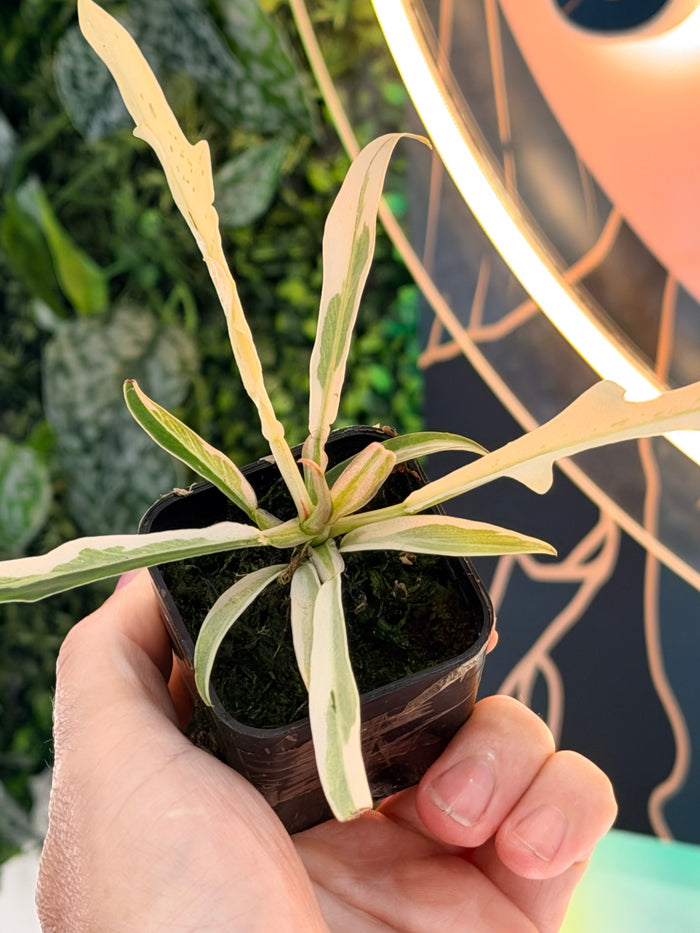
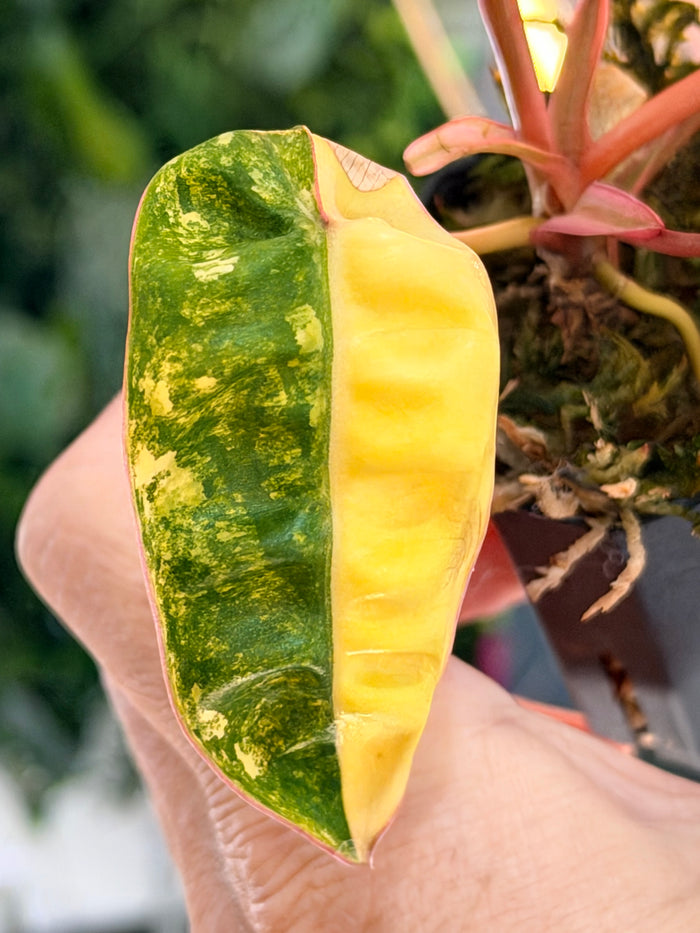
The yellow aurea variegated form of Silver Dragon is documented by Aroidpedia. Aurea variegation on Silver Dragon creates an extraordinary three-element composition: the dark green primary veins, the characteristic silver interveinal base, and the golden-yellow chimeric sectors that appear across the leaf. Against the already-complex silver surface, aurea variegation reads differently than it does on a conventionally green-based Alocasia, the gold tones interact with the silver base in a way that creates a metallic warmth rather than a simple colour contrast. If you are looking at our Silver Dragon Aurea variegated form, our aurea variegation guide explains the carotenoid mechanism behind the gold tones.
Growing Alocasia Silver Dragon in the UK
Light
The light-responsive quality of 'Silver Dragon' makes this a cultivar where investment in light pays dividends. Consistent, bright indirect light, from a south or east-facing window with diffused exposure, or supplemented with LED grow lights, produces the most vivid silver interveinal expression. In lower light conditions the cultivar will survive and maintain leaf production, but the silver quality that makes it worth growing will be significantly diminished. During UK winter, supplemental lighting running 12 to 14 hours daily maintains both growth and colour quality through the period of reduced natural light.
Substrate and Watering
The lowland equatorial forest ecology of Alocasia baginda, with annual rainfall of 3,300 to 4,600 mm and consistently high humidity, indicates a plant adapted to consistent moisture availability. Unlike the limestone cliff specialists (reginula, melo), baginda is not adapted to drainage-dominated conditions, but it still requires good substrate drainage to prevent waterlogging at root level. Fluval Stratum provides an appropriate balance, retaining sufficient moisture while allowing free drainage of excess. Allow the top 2 to 3 cm to dry between waterings. The compact to medium root system of this cultivar does not need an oversized pot.
Temperature and Humidity
The Eastern Kalimantan habitat data, consistent 23 to 32°C with minimums above 20°C and humidity of 80 to 90 percent, sets a high bar for UK cultivation. In practice, Silver Dragon performs well in the 18 to 27°C range and manages with 60 to 75 percent humidity, though it is more sensitive to humidity drops than the drier-origin limestone specialists. During UK winter heating season, active humidity management, a desktop humidifier, grouped plants, or a humidity cabinet, is particularly important for this cultivar. Cold draughts and cold substrate are the primary risk factors.
Feeding and Pests
A balanced liquid feed at half-strength every two to three weeks through the growing season supports healthy growth. Spider mites are the primary pest concern, and the silver leaf surface can make early stippling damage less immediately visible than on conventionally coloured leaves. Regular inspection of undersides is essential, particularly through UK winter.
Collector Context
Silver Dragon sits naturally alongside Alocasia Dragon Scale Albo Variegated and the Green Unicorn hybrid in the baginda lineage group. Together they represent the full range of what this Eastern Kalimantan species has produced in cultivation, the definitive scale texture of Dragon Scale, the luminous silver of Silver Dragon, and the hybrid synthesis of Green Unicorn. For context on the baginda species and its ecology, our Dragon Scale Albo guide covers the species background in full. For the broader care fundamentals that apply across the baginda cultivar group, our Alocasia care guide is the reference point.
Questions about Alocasia Silver Dragon, the baginda species, or building a jewel Alocasia collection in UK conditions? Contact our team for guidance from specialists who grow this cultivar at our UK-based private nursery.