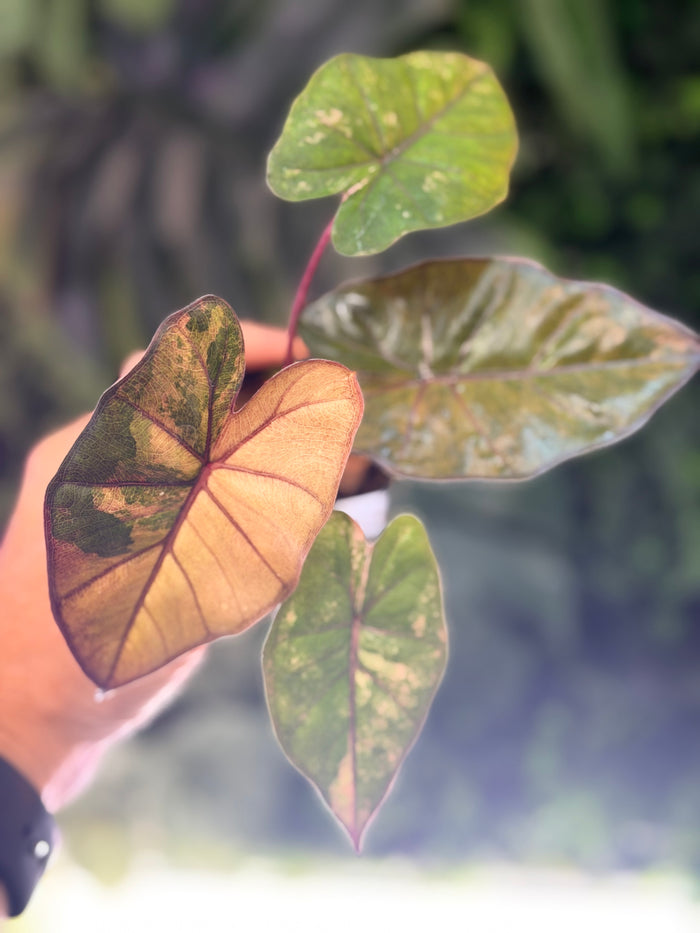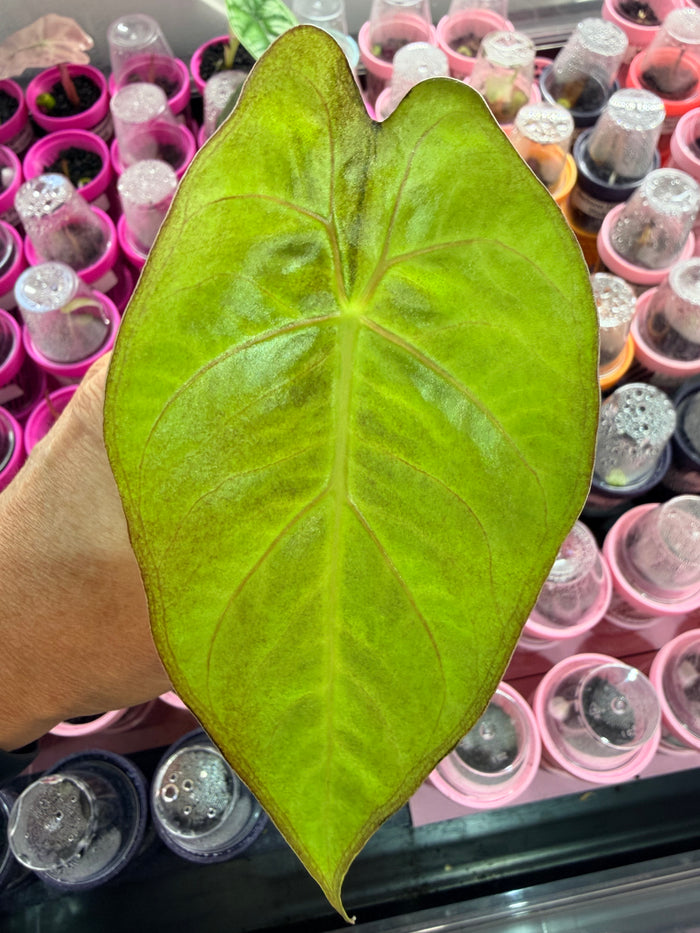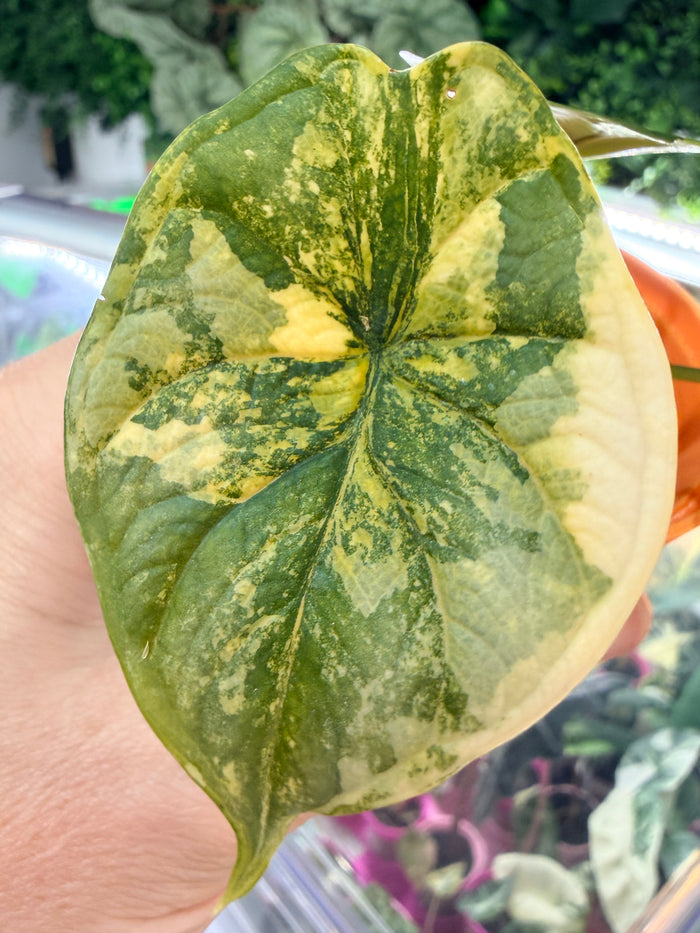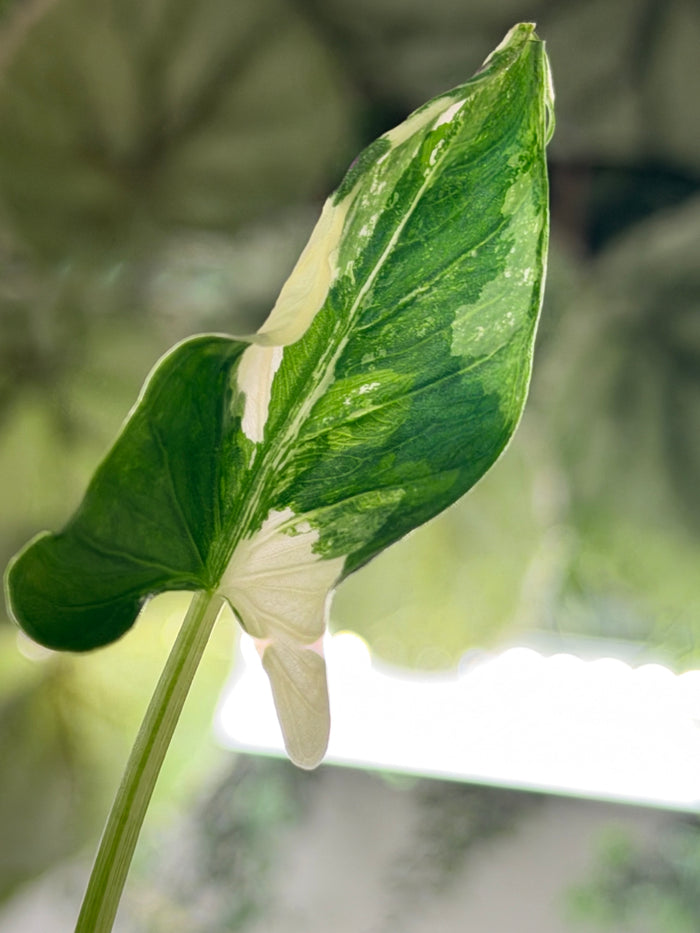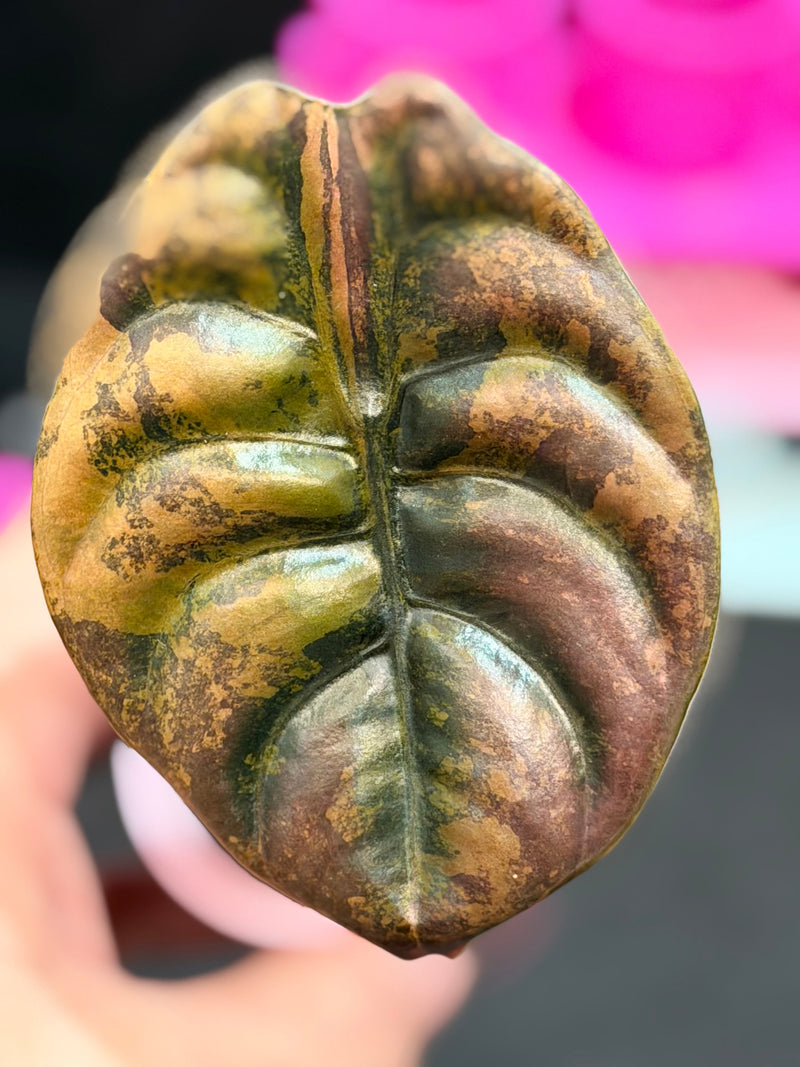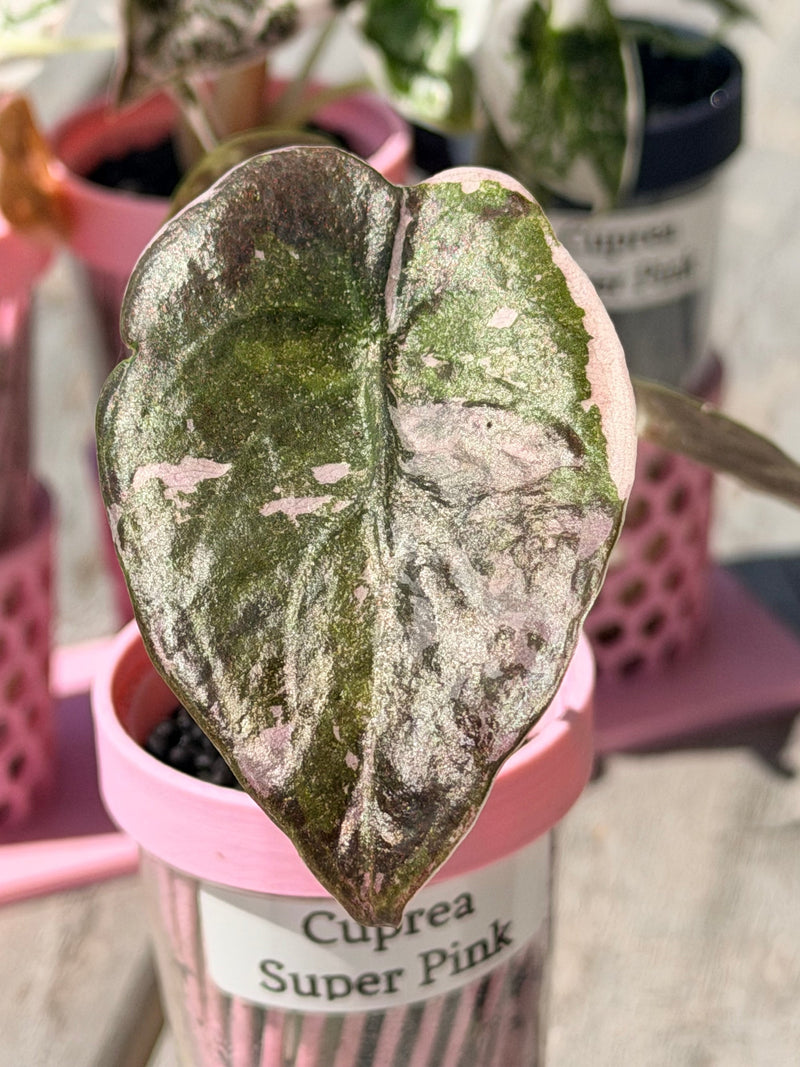

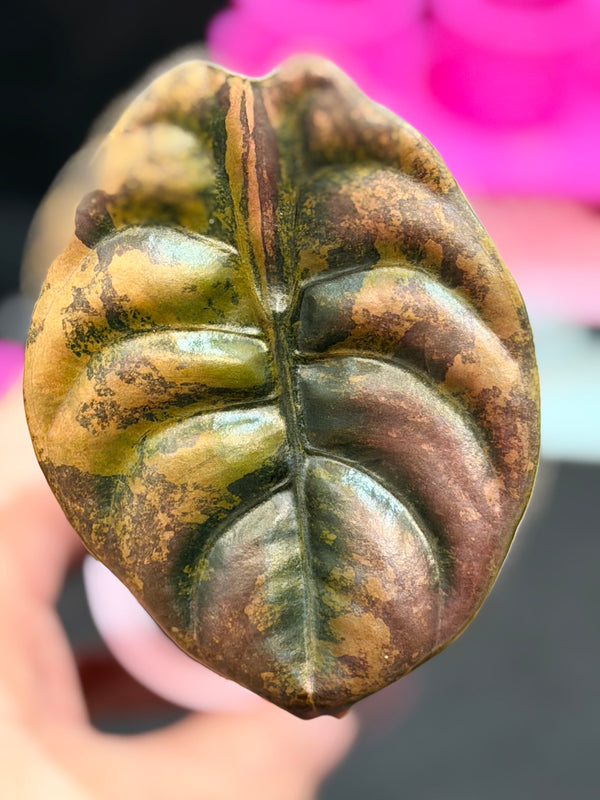
Looking for Alocasia Cuprea Latte Variegated? This guide covers everything you need to know, the remarkable history of Alocasia cuprea as a species, what makes it one of the most botanically significant jewel Alocasia in cultivation, what the 'latte' variegation means in practice, and the honest context around cuprea pink variegation that every serious collector should understand before acquiring one.
Alocasia cuprea is not simply another jewel Alocasia. It holds a distinction that no other Bornean Alocasia species can claim: it is the only Bornean Alocasia continuously in cultivation since its introduction to Western horticulture, a period stretching back to around 1860. The copper-tinted, deeply bullate, glossy bronze-green leaves with their striking deep purple abaxial surfaces have captivated botanists and collectors for over 160 years. The variegated forms that have emerged in cultivation add a further dimension to a species that was already extraordinary in its base form.
Alocasia cuprea: 160 Years of Continuous Cultivation
The horticultural history of Alocasia cuprea is unusually well documented, and understanding it provides context for the plant's significance that pure care guides cannot convey.
The species was first described botanically as Caladium cupreum in 1854 by K.H.E. Koch in the Index seminum of the Berlin Botanic Garden, the seed index that distributed botanical descriptions to subscribing institutions across Europe. Five years later, in September 1859, the plant was introduced in English literature as Gonatanthus cupreus by Low & Co. from Clapton Nursery in London, one of the major Victorian-era nurseries that drove the introduction of tropical plant material to British horticulture. It appeared in English literature as Alocasia metallica from 1860, and in 1861 German botanist Karl Koch consolidated the various synonyms under Alocasia cuprea, the name that has remained accepted ever since.
The taxonomy around the name is genuinely complex, there was considerable 19th-century confusion between A. cuprea and what was then called Alocasia metallica, which turns out to have been applied to two different plants by different botanists. The resolution, confirmed by N.E. Brown's annotation at Kew following direct correspondence with Koch himself, established that the plant described here under A. cuprea was definitively Koch's intended application of that name. The accepted current authority is Alocasia cuprea (H.Low ex Sankey) K.Koch, Berliner Klin. Wochenschr. 4: 141 (1861).
What this history establishes is that Alocasia cuprea has been in continuous cultivation in Western collections for over 165 years. It was growing in Victorian glasshouses when the Aroid hobby as we know it today did not yet exist. It has survived the decline and revival of tropical plant collecting, the disruptions of two world wars, and the mass-market commodification of houseplants, and remains one of the most sought-after jewel Alocasia in serious collections. That longevity is not accidental, it reflects a genuinely extraordinary plant.
The Species: Where Cuprea Grows and Why It Looks the Way It Does
Alocasia cuprea is native to Borneo, specifically Sabah and Sarawak in Malaysian Borneo, with a 2022 distribution update confirming additional populations in Krayan, North Kalimantan (Indonesian Borneo). The native climate is equatorial lowland humid forest: temperatures uniformly between 23°C and 32°C throughout the year, minimum temperatures never dropping below 20°C, and annual rainfall of 3,300–4,600mm. Humidity is consistently high, ranging from 80–90%.
The ecology of the species in the wild is particularly instructive for growers. Alocasia cuprea has been observed growing on slopes in rainforest, on sandstone, limestone, and in ultramafic areas, demonstrating an unusual substrate flexibility compared to many related jewel Alocasia that are restricted to specific geology. Crucially, it grows at approximately 1,000–1,500m altitude, and in its Sarawak and Sabah habitat the forest type is kerangas, heath forest on strongly acidic soils. The North Kalimantan populations, by contrast, grow on neutral-pH soils, confirming the species' substrate tolerance described by taxonomist A. Hay: appearing to be unaffected by substrate type across ultramafic, limestone, and sandstone areas.
The root ecology explains one of the most commonly noted features of cuprea in cultivation: it has a surprisingly small root system relative to its leaf size. In the wild, it roots among the rocky forest floor on slopes, where deep penetrative root systems have limited value. Instead, Alocasia cuprea absorbs epikarst water, the water that percolates through the rocky substrate, and compensates for the unpredictable water availability of its rocky slope habitat by storing moisture in its huge, thick, leathery leaves. This has direct implications for how the plant should be grown: it does not need a large pot, overwatering is a greater risk than with many Alocasia, and the substrate should replicate the free-draining, rocky conditions of its native habitat rather than a moisture-retentive mix.
What Cuprea Actually Looks Like: Adult Form Versus Juvenile
One of the most useful things to understand about Alocasia cuprea is that juvenile and adult plants look noticeably different, a distinction that matters both for identification and for understanding what you are working towards as a plant matures.
Juvenile leaves are peltate, nearly fully round, with partially or completely connate (fused) posterior lobes, and both adaxial and abaxial surfaces show reddish colouration, deeper on the underside. As the plant matures into adulthood, the leaf form changes significantly: adult leaves are large, ribbed, and glossy, botanically described as resembling copper-tinted grey breastplates, bullate between the main veins, creating the deeply textured, almost hammered-metal surface that gives the species its common description as the Mirror Taro or Jewel Alocasia.
The adult adaxial surface is a glossy bronze-green, darker near the primary veins, with 8–11 primary lateral veins per side on the anterior lobe diverging at angles ranging from approximately 60° to 100°. The abaxial surface is deep purple, a feature it retains at maturity while the red/copper adaxial colouration is the characteristic of juveniles. The hyaline colourless margin of approximately 1.5mm around the leaf edge is a subtle but distinctive feature visible on close inspection.
Adult specimens can reach 80cm tall, with petioles to 70cm and leaf blades to 60cm long by 40cm wide, substantially larger than the juvenile plant suggests. Patience is required: the compact juvenile is not the finished plant.
Cultivar Names: What 'Red Secret', 'Blackie', and 'Latte' Mean Botanically
Before discussing the Latte Variegated form, it is important to understand what Aroidpedia records about Alocasia cuprea cultivar names, because it directly affects how 'Latte' should be understood.
Aroidpedia is explicit: although various cultivar names are used commercially to differentiate cuprea stock, including 'Red Secret', no cultivars of Alocasia cuprea are formally recognised. Two natural forms are known, distinguished solely by the colour of the floral chamber in their inflorescences: one with a wine-red chamber and another that is mostly green. The leaf colour variations and size differences observed among plants in cultivation are due to natural variability and differences in maturity, not distinct cultivars.
David Burnett, noting his observations of wild specimens in Sabah in 1982, records that Alocasia cuprea is remarkably non-variable for an Alocasia, with no significant differences between wild and cultivated stock.
The commercial name 'Latte' in Cuprea Latte Variegated therefore describes a variegation expression rather than a formally recognised cultivar. It refers to the warm, milky, coffee-toned colouration of the variegated sectors, creamy to pale beige tones that interact with the natural bronze-green and copper ground of the cuprea leaf to produce a warm, layered effect distinct from the stark white of albo variegation.
The Pink Variegation Question: What Collectors Need to Know
Aroidpedia includes a critical note about pink variegation in Alocasia cuprea that every collector considering this plant deserves to understand fully: pink variegation in Alocasia cuprea is flagged as likely induced, with a reference to Philodendron 'Pink Congo'.
The Philodendron 'Pink Congo' case, which became widely publicised in the collector hobby around 2019–2020, involved plants sold at high prices as variegated specimens that had actually been treated with a chemical (believed to be ethylene or similar growth regulators) that temporarily suppresses chlorophyll production, creating the appearance of variegation. These plants revert to fully green as the treatment effect wears off over time, typically within months to a year or two. They are not genuinely chimeric variegated plants; they are chemically altered specimens that have been marketed as something they are not.
Aroidpedia's note that cuprea pink variegation is likely induced in the same manner is significant. It does not state this as confirmed fact, the qualification 'likely' is explicit, but it raises a legitimate concern that pink-variegated cuprea specimens circulating in the hobby may not carry stable chimeric pink mutations, and that the pink colouration may fade or revert as the plant grows on.
This is different from the white and yellow variegated forms of Alocasia cuprea, which Aroidpedia lists without the same caveat, suggesting those forms are more likely to represent stable chimeric mutations of the kind seen in albo and aurea variegated Alocasia more broadly.
What does this mean practically for collectors considering Cuprea Latte Variegated? The 'latte' tone, warm cream and beige rather than vivid pink, sits in territory that is less clearly pink in the sense implicated by the Aroidpedia note. If the variegation is genuinely a cream or pale beige sectoral expression interacting with the cuprea's natural copper-bronze ground colour, it may well represent a more stable chimeric mutation than brightly pink-variegated cuprea. However, it is worth purchasing from a source that can demonstrate the plant's variegation history across multiple leaf cycles rather than from a single recently produced leaf.
We grow our Alocasia Cuprea Latte Variegated from verified variegated mother plant stock at our UK nursery, and we assess plants across multiple leaf cycles before listing. We are transparent about the variegation history of the specific stock we sell.
Cuprea's Hybrid Legacy
One aspect of Alocasia cuprea's significance that is worth appreciating is its role as a parent species in some of the most historically important Alocasia hybrids ever created, several of which predate the modern collector hobby by over a century.
Alocasia 'Chantrieri' (cuprea × sanderiana) is one of the most iconic historic Alocasia hybrids, combining the bullate, copper-toned quality of cuprea with the dramatic silver-veined, deeply lobed foliage of sanderiana. Alocasia 'Sedenii' (longiloba Lowii 'Veitchii' × cuprea) dates from the Victorian era. Alocasia 'Chelsonii' (cuprea × longiloba) is another 19th-century cross. Alocasia 'Maroon Shield' (odora × cuprea) brings the odora vigour to the cuprea leaf character.
This hybrid history reinforces cuprea's botanical significance: it has been a valued parent in ornamental Alocasia breeding for as long as Western horticulture has been creating Alocasia hybrids, a testament to the qualities it transmits reliably to its offspring. Our Alocasia Chantrieri Pink Variegated, in our pink variegated collection, carries that cuprea parentage directly.
Growing Alocasia Cuprea Latte Variegated in the UK: Complete Care Guide
Substrate and Potting
The ecology of Alocasia cuprea in the wild, rocky slope habitat, small root system, free-draining karst and sandstone substrate, translates directly into substrate requirements that are more aggressively draining than many Alocasia cultivars. A high-perlite mix, 35–40% perlite minimum, with chunky bark content and minimal fine-particle material provides the sharp drainage the species needs.
Fluval Stratum is our preferred substrate at the nursery, providing the free-draining structure, appropriate pH, and microbial support that suits Alocasia cuprea well. The rocky slope habitat also suggests the plant appreciates a degree of acidity, slightly acidic to neutral pH is appropriate, consistent with the kerangas forest soils of its Sarawak habitat.
Pot sizing should be conservative. The naturally small root system of Alocasia cuprea relative to its leaf mass means it does not need large containers, and excess substrate around the root ball creates the anaerobic moisture-retention conditions that this species is particularly poorly adapted to handle. Use the smallest pot that comfortably accommodates the root system, and do not be tempted to pot up prematurely in response to rapid leaf growth, the leaf growth rate in healthy conditions is not matched by equivalent root development.
Light
Alocasia cuprea requires bright, indirect light, more than many jewel Alocasia, in part because the thick, glossy, coriaceous leaves are adapted to absorb the strong light of its relatively exposed rocky slope habitat rather than the deep shade of the forest floor.
In UK conditions, an east or west-facing position works well. South-facing positions with some diffusion, a sheer curtain or placement set back from the window, provide the light levels that produce the best leaf character. The bullate texture and bronze-green glossiness of the adaxial surface is most pronounced in good light; insufficient light produces flatter, duller leaves.
Supplemental LED grow lighting is particularly beneficial for Alocasia cuprea, which responds visibly to good light conditions. A 12–14 hour photoperiod with appropriate intensity will maintain growth quality.
The variegated Latte form requires the same light management as the standard species, with the additional consideration that the variegated sectors contain less chlorophyll, adequate light for the green portions is therefore more important than ever, without exposing the more light-sensitive pale sectors to direct sun.
Temperature and Humidity
As an equatorial lowland forest species with minimum wild temperatures of 20°C, Alocasia cuprea is among the more temperature-sensitive jewel Alocasia. A minimum consistent temperature of 18–20°C is appropriate for the best results; the plant will survive at 15°C but growth will slow significantly and the quality of new leaves may suffer.
This makes temperature management more important for Alocasia cuprea than for more cold-tolerant Alocasia like reginula cultivars, positioning away from cold windows and external walls, and avoiding any exposure to cold draughts, is essential.
Humidity of 70–80% reflects the native conditions and will produce the best leaf quality and growth rate. At typical UK home humidity of 40–50% the plant will survive but may show brown leaf tip margins and produce smaller, less well-formed new leaves. A dedicated humidifier is the most effective solution; grouping with other humidity-tolerant plants provides a secondary benefit. Our self watering corm pots with humidity dome provide an excellent controlled-humidity environment for corm propagation and early growth stages.
Watering
The leaf-based water storage adaptation of Alocasia cuprea in its rocky slope native habitat means it is more drought-tolerant than many Alocasia, and correspondingly more sensitive to overwatering. Allow the top 3–4cm of substrate to dry before watering, drain fully, and never allow water to sit in the saucer. The small root system is highly susceptible to root rot in anaerobic conditions, and the species' substrate flexibility in the wild does not translate to tolerance of waterlogged growing media in cultivation.
Room-temperature water is essential; cold water on the roots of a plant from equatorial lowland forest can cause stress that manifests in poor leaf quality on subsequent growth. In hard water areas, the gradual calcium carbonate accumulation in the substrate affects pH and drainage over time, flushing with rainwater or refreshing the substrate annually prevents this becoming a long-term issue.
Feeding
A dilute, balanced liquid fertiliser applied with every watering provides consistent nutrition without risk of fertiliser burn on the relatively small root system. Half the manufacturer's recommended concentration is appropriate. Cease feeding when growth is visibly inactive, Alocasia cuprea does not benefit from being fed a resting substrate.
Our plant feed collection and targeted nutrients support both the base feed programme and targeted supplementation. For the Latte Variegated form specifically, a micronutrient supplement containing magnesium is beneficial, the reduced chlorophyll content of the variegated sectors places a greater demand on the green portions for photosynthetic function, and ensuring those areas have optimal nutrition matters more than in a fully green plant. Superthrive is part of every feed we mix at the nursery, a vitamin B1 and kelp supplement that supports root development and helps plants settle after repotting or a change of conditions.
Growing Cuprea Latte Variegated from Corm
Alocasia cuprea propagates from corm, and the species' naturally small root system means corms can be modest in size relative to the eventual plant. Corm viability and the germination conditions matter more than corm size.
The standard conditions apply: substrate temperature of 25–28°C, ambient humidity above 70%, and a free-draining substrate, Fluval Stratum in our Corm Keeper system provides the optimal controlled environment. The full corm propagation process is covered in detail in our corm propagation guide.
For variegated corms specifically: the variegation expression in the resulting plant cannot be guaranteed, and for the reasons outlined in the variegation section above, it is worth being realistic about what 'latte' corms may produce. The best approach is to provide optimal growing conditions and assess expression across the first several leaf cycles before drawing conclusions.
Pest and Disease Management
Spider mites are the primary pest risk for Alocasia cuprea, particularly in lower-humidity UK homes. The thick, glossy, bullate leaf surface provides some physical resistance to mite establishment relative to smoother-leaved Alocasia, but the dense texture also creates microenvironments on the leaf surface where mites can shelter. Regular inspection of leaf undersides during every watering is essential.
Thrips are a significant concern given the visual impact they have on Alocasia cuprea specifically, the glossy, deeply textured adaxial surface makes thrips track marks particularly visible, and damage to the bullate surface during leaf development is permanent. Inspect developing leaves closely as they emerge.
Root rot, as noted, is a particular risk given the small root system and the species' sensitivity to waterlogged conditions. The correct substrate and watering approach prevents the overwhelming majority of root rot cases, but if unexpected decline is observed, unpot and inspect immediately. Our root rot guide covers the identification and recovery process in full. Our pest control range covers active treatment options for both mite and thrips infestations.
Cuprea Latte Variegated in a Collection Context
Alocasia cuprea in any form is a plant with genuine historical and botanical significance that transcends the current collector hobby. Owning a specimen of the only Bornean Alocasia continuously in cultivation since the Victorian era, growing the same species that occupied the glasshouses of Low & Co. in Clapton in 1859, is a connection to plant collecting history that few other Alocasia can provide.
The Latte Variegated form adds the additional visual dimension of chimeric cream and warm-toned variegation to leaves that are already among the most visually distinctive in the genus. In collection context it sits naturally alongside the standard cuprea and other variegated cuprea forms, as well as alongside the cuprea hybrid offspring, particularly Chantrieri, which makes the cuprea lineage legible in a different leaf form. Our full Alocasia collection provides the full range across corms, juveniles, and mature plants.
Availability of Cuprea Latte Variegated is limited by the finite production from verified variegated mother plants. Our rare plant drop system gives subscriber list members first access when specimens become available.
Questions about Alocasia Cuprea Latte Variegated, the species' history and care requirements, or the variegation question? Contact our team, we grow Alocasia cuprea and its variegated forms at our private UK nursery and can advise on care, collection context, and what to look for when assessing variegation stability.