ALOCASIA CUPREA SUPER PINK TISSUE CULTURE: COMPLETE GUIDE TO THE VIVID METALLIC PINK JEWEL ALOCASIA

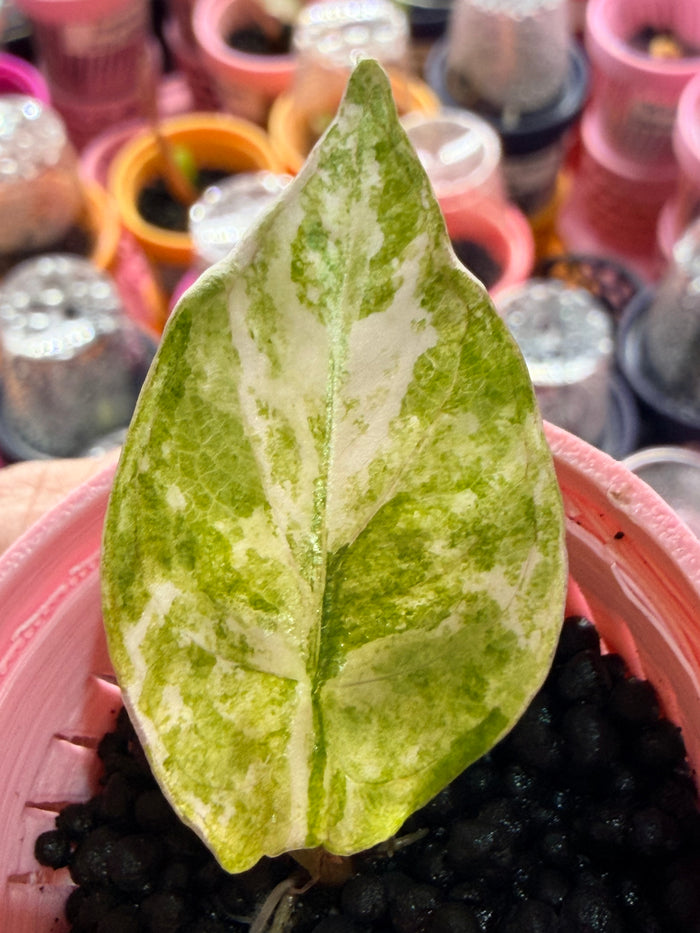
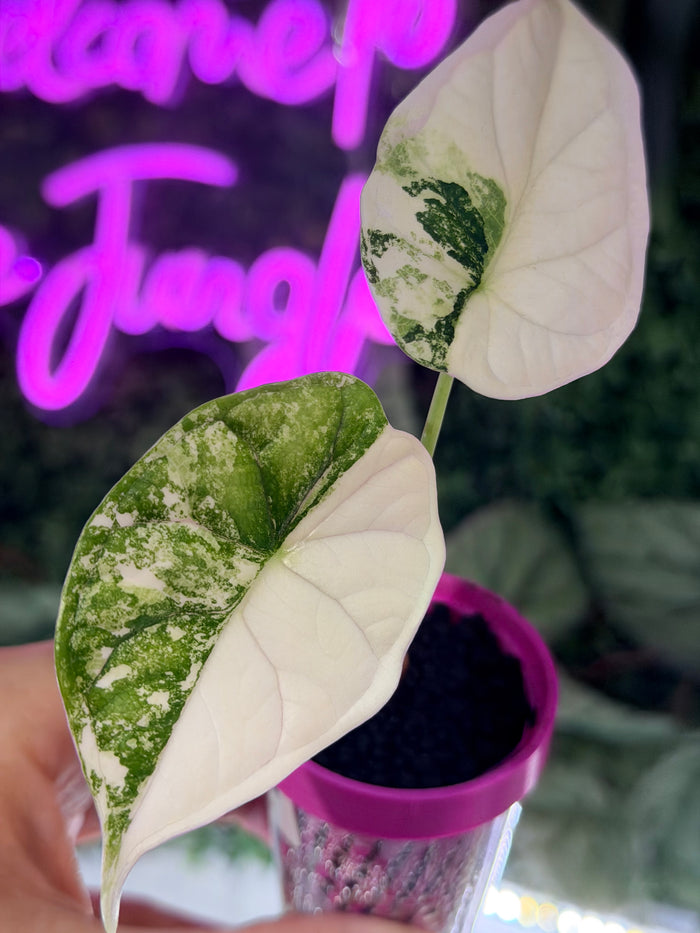
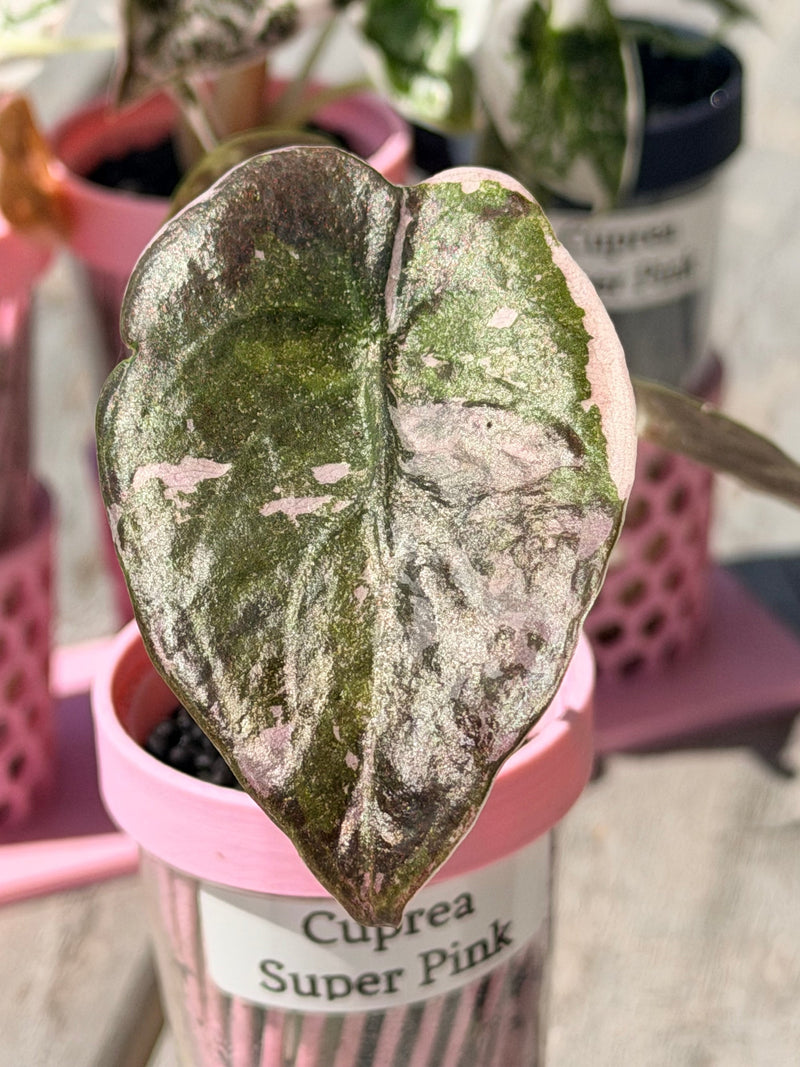
Alocasia Cuprea Super Pink makes a specific and immediate visual claim that its name supports entirely: this is the most vivid expression of pink colouration currently available within the Alocasia cuprea species line. Where other variegated cuprea forms express pink as one element within a more complex palette, the multi-tonal Nom Yen, the pastel Pink Mint, the warm Latte Variegated, Super Pink presents pink as the dominant, primary visual statement. Leaves that are genuinely, unmistakably pink in a way that surprises even experienced collectors encountering the plant for the first time.
Available as a tissue culture plant, grown from tissue culture and acclimatised in sterile environment, Super Pink comes with the quality assurance and health advantages that well-executed TC propagation provides, alongside a brief acclimatisation period for new owners to manage.
The cuprea Species Foundation
Understanding what makes Super Pink so distinctive requires understanding Alocasia cuprea itself, the species that provides both the metallic surface quality and the base onto which the Super Pink expression appears.
Alocasia cuprea is, as detailed in our Cuprea Nom Yen guide, the only Bornean Alocasia species in continuous cultivation since its introduction around 1860. First described in 1854 and introduced into UK cultivation in 1859, it has over 160 years of documented horticultural history. Native to Sabah and Sarawak in Borneo, it grows on rocky slopes in kerangas (heath forest) at approximately 1,000–1,500m altitude, a free-draining, high-humidity environment where the species has developed its extraordinary adaptation to slopes rather than lowland waterlogged conditions.
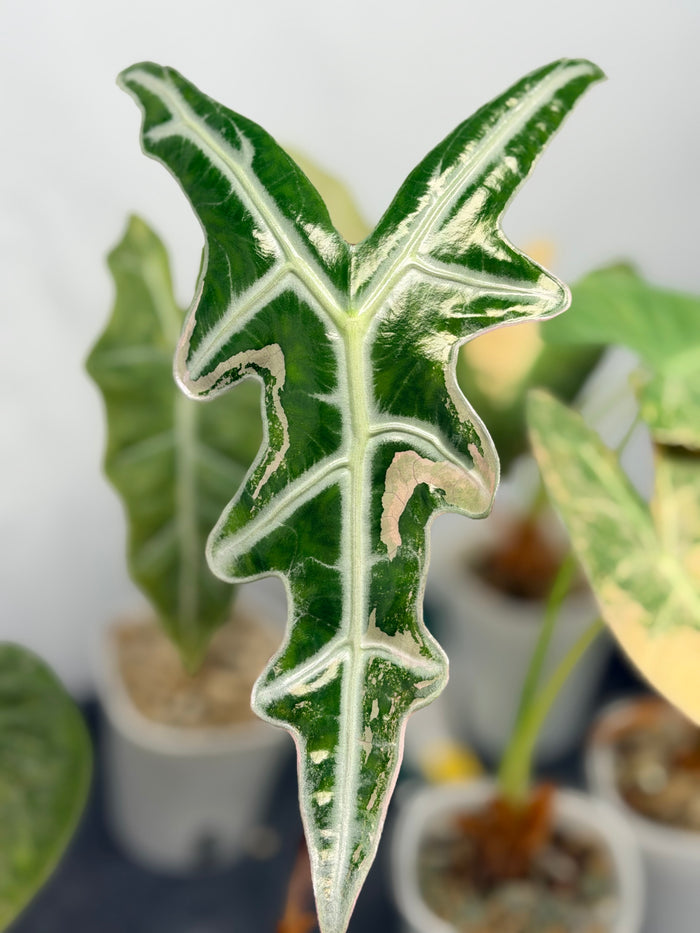
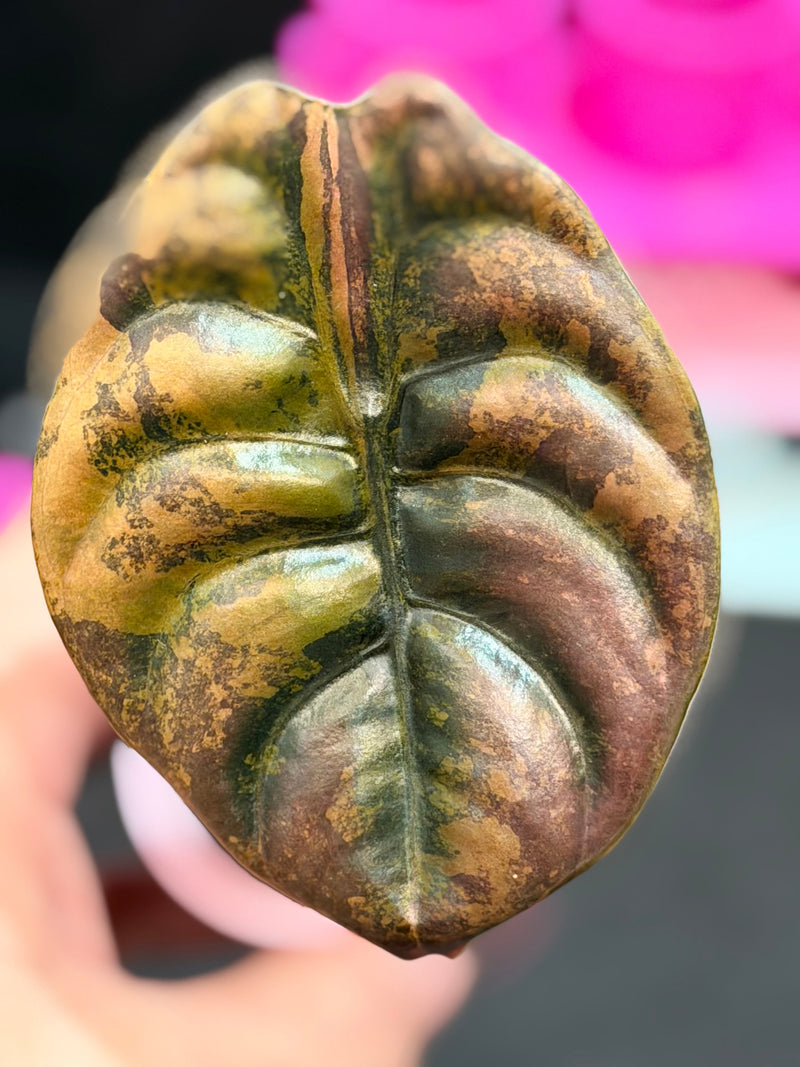
The species' defining characteristic is its metallic, iridescent leaf surface, a structural phenomenon arising from the microscopic arrangement of leaf surface cells rather than from pigmentation. This structural iridescence creates a coppery glow that shifts as viewing angle changes, giving cuprea a quality collectors consistently describe as otherworldly. Adult leaves reach 60cm long by 40cm wide, bullate (blistered) between main veins, with deep purple abaxial (underside) surfaces that create a bicolour effect when leaves are backlit or viewed from below.
The natural habitat's free-draining, rocky-slope ecology explains the most important cultivation requirement for all cuprea forms: the substrate must drain completely and the plant should not sit in waterlogged conditions. This ecological background makes cuprea and its variegated forms somewhat more tolerant of slight substrate drying than many tropical Alocasia, while making them more sensitive to anaerobic wet conditions than species from lowland bog environments.
What 'Super Pink' Means: The Variegation Type and Its Character
Aroidpedia's entry on Alocasia cuprea lists the variegated forms as including white, yellow, light green, and pink, with the note that pink is "likely induced", a reference to the fact that some pink expression in aroids can result from induced chemical treatment rather than stable genetic variegation. Collectors should be aware of this documented consideration in the species.
For Super Pink specifically, the 'Super' designation accurately describes the intensity of the pink expression relative to other pink cuprea forms. The pink colouration is the primary visual characteristic, leaves that appear unmistakably, assertively pink rather than having pink as a secondary element. This intensity comes partly from the density of anthocyanin expression (the pigment mechanism that creates pink and red tones in plant tissue) and partly from the interaction of that pigmentation with cuprea's structural surface iridescence.
The metallic cuprea surface does not simply carry the pink colour, it interacts with it. The structural iridescence that creates the copper glow in standard cuprea operates identically in Super Pink but with pink as the base colour rather than bronze-green. The result is a leaf surface that appears to glow with pink light rather than copper light, the metallic quality amplifying and shifting the pink rather than competing with it. This interaction is why Super Pink is so difficult to photograph accurately and why it must be seen in person to be fully appreciated.
The intensity of the pink expression is light-responsive and condition-dependent. Under bright indirect light and in warm, consistently humid conditions, Super Pink is at its most vivid. In lower light or under stress, the pink diminishes and the plant tends toward a less distinctly pink appearance. This responsiveness means that the growing conditions you provide have a direct and visible effect on the plant's appearance, a characteristic that serious collectors find engaging rather than frustrating, as it creates a clear feedback loop between care quality and plant quality.
Tissue Culture: What It Means for Super Pink
Super Pink is available as a tissue culture plant, grown from tissue culture and acclimatised in sterile environment. This means the plant has been propagated from plant tissue in a laboratory setting under sterile conditions, rather than from corm or division.
The advantages of tissue culture propagation include disease-free status (no soil-borne pathogens), genetic consistency (all TC plants from the same source culture are genetically identical), and the ability to scale production more rapidly than division-based methods. The disadvantage is an acclimatisation period that new owners need to manage: TC plants arriving from sterile laboratory conditions have been growing in 95%+ humidity, constant nutrient availability, and controlled temperature, very different from typical home growing conditions.
The acclimatisation process for TC-derived Super Pink should be gradual. Our guide to tissue culture acclimatisation covers this in detail, but the key principles are: maintain high humidity during the initial weeks (70–80%+), avoid direct sun, maintain consistent warmth, and introduce the plant gently to normal home conditions over 4–6 weeks rather than immediately exposing it to typical ambient conditions.
Once acclimatised, TC Super Pink performs identically to corm- or division-grown specimens. The acclimatisation period is a temporary management challenge, not a permanent characteristic difference.
Growing Alocasia Cuprea Super Pink
Following the cuprea species ecology, rocky slopes, free-draining substrate, equatorial lowland humid forest conditions, informs all growing decisions.
Light
Bright indirect light is the primary requirement, serving both the metallic surface quality's need for directional light and the pink expression's light-responsiveness. Without adequate bright indirect light, Super Pink will not express its defining characteristic at full intensity.
Position within 1 metre of a well-lit south or west-facing window, or provide LED grow lights at appropriate intensity. LED supplementation should be considered mandatory for maintaining Super Pink's pink expression, as UK natural light alone is insufficient. Avoid direct sun, which will bleach the pink-expressing tissue before it affects the green areas, destroying the plant's most distinctive characteristic.
Temperature
Maintain 20–27°C. Cuprea's equatorial lowland origin means it expects consistent warmth, minimum acceptable temperature is approximately 18°C, below which growth halts and root health becomes vulnerable. UK central heating should maintain adequate warmth in living spaces, but avoid positioning near draughty windows or doors where night temperatures drop significantly.
Humidity
65–80% ambient humidity. Cuprea is the most humidity-tolerant of the major jewel Alocasia, somewhat more forgiving of lower humidity than Alocasia reginula 'Black Velvet' or Alocasia melo, but Super Pink's pink expression benefits from the upper end of this range. A humidifier is strongly recommended in UK home conditions where heating typically reduces ambient humidity to 30–50%.
Substrate and Watering
Well-draining chunky aroid mix with particular emphasis on drainage quality. The rocky slope ecology demands free-draining substrate that does not stay wet between waterings. Fluval Stratum for propagation; chunky bark-perlite-coco mix for established plants.
Allow the top 3cm to dry between waterings, slightly drier than the standard 2cm recommendation for most Alocasia, reflecting cuprea's slope-drainage ecology. Complete drainage after each watering; empty saucers promptly. Reduce significantly when growth slows.
Feeding
Half-strength balanced fertiliser during active growth. Pink expression in cuprea forms is sensitive to nutritional stress, conservative half-strength feeding protects the pink character while providing necessary nutrients. Stop entirely when growth halts. Our plant feed collection covers appropriate options.
Super Pink Within the cuprea Variegated Collection
For collectors building a comprehensive cuprea variegated group, Super Pink provides bold, assertive pink, the most immediately dramatic option in the family. Alongside the complex multi-tonal depth of Nom Yen Variegated, the pastel refinement of Pink Mint, and the warm earth tones of Latte Variegated, Super Pink covers the most assertively pink end of the spectrum, the form to add when you want the cuprea metallic quality expressed through vivid, confident colour rather than subtle complexity.
Questions about Alocasia Cuprea Super Pink TC, the tissue culture acclimatisation process, or how it fits within a cuprea collection? Contact our team, we grow the full cuprea variegated range at our UK nursery and are happy to advise on all aspects.
For a step-by-step method that works for any cultivar, see our Alocasia corm propagation guide, which covers corm selection, the self-wicking set-up and the conditions that bring a corm into growth.
From the nursery